Dry Brine Calculator
Scale dry salt, cure time, and finished yield for poultry, steaks, roasts, fish, tofu, and salted farm produce by exact ingredient weight.
🧂Named Dry Brine Presets
⚖️Batch Inputs
Dry Brine Result
📊Salt Type Comparison Grid
📘Reference Tables
| Salt type | Approx grams per teaspoon | Approx grams per tablespoon | Best use in dry brines |
|---|---|---|---|
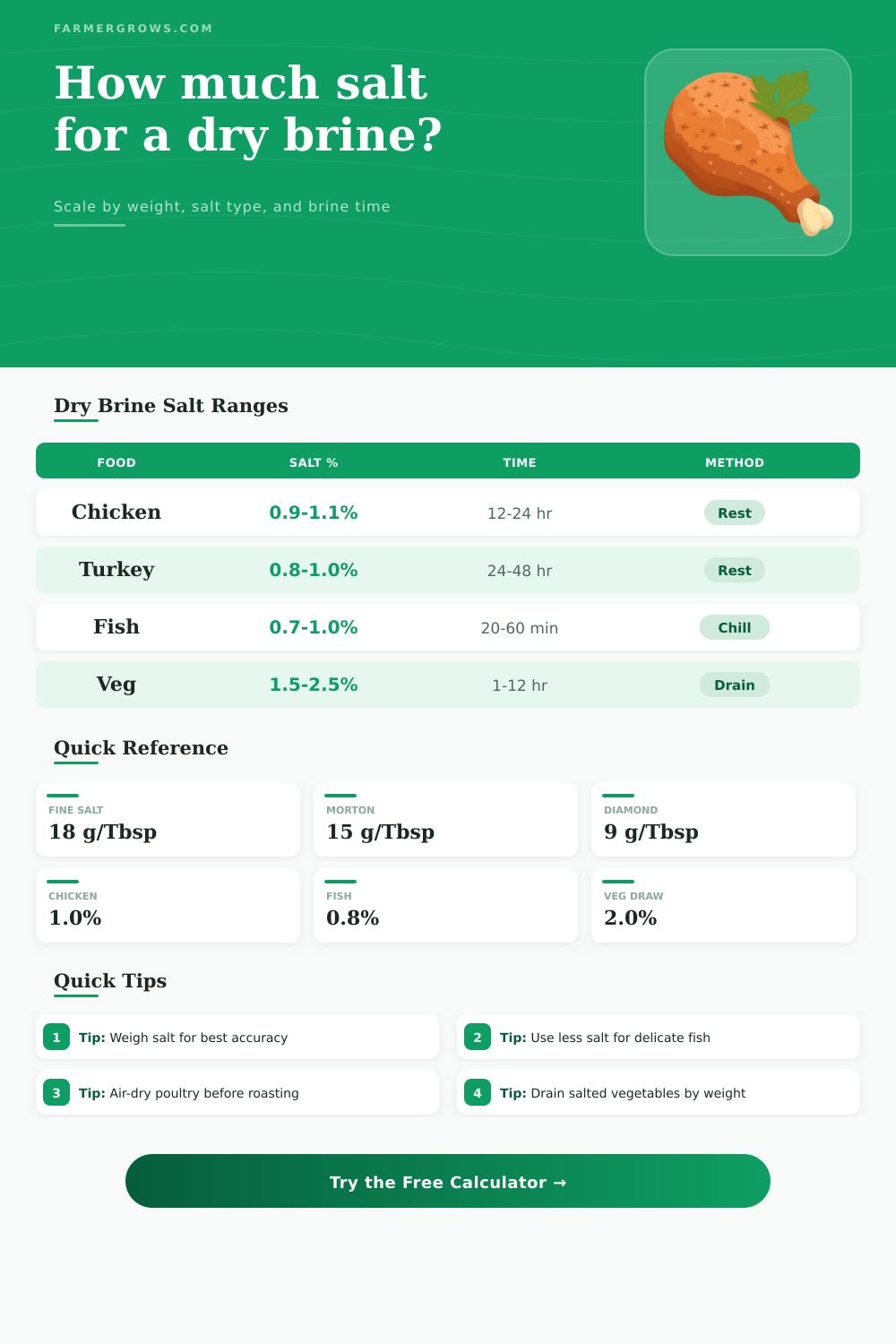
| Fine sea salt or table salt | 6.0 g | 18 g | Accurate small batches; dissolves quickly |
| Morton kosher salt | 5.0 g | 15 g | General poultry, steaks, and roasts |
| Diamond Crystal kosher salt | 3.0 g | 9 g | Even hand coverage with less dense flakes |
| Coarse sea salt | 5.5 g | 16.5 g | Large cuts when weighed, not scooped |
| Pickling or canning salt | 6.2 g | 18.6 g | Vegetable brines and fermentation bases |
| Flaky finishing salt | 2.0 g | 6 g | Finishing only; poor measuring consistency |
| Food or batch | Dry salt range | Typical time | Handling note |
|---|---|---|---|
| Whole chicken | 0.9% to 1.1% | 12 to 24 hr | Rest uncovered for crisp skin |
| Turkey 10 to 18 lb | 0.8% to 1.0% | 24 to 48 hr | Salt breast and thighs evenly |
| Steaks and chops | 0.8% to 1.2% | 1 to 12 hr | Short rest for thin cuts |
| Large pork, beef, or lamb roast | 0.9% to 1.25% | 12 to 48 hr | Rotate once for even contact |
| Fish fillet | 0.6% to 1.0% | 20 to 60 min | Chill and avoid long exposure |
| Vegetable water draw | 1.5% to 2.5% | 1 to 12 hr | Drain or rinse depending recipe |
| Kraut vegetable base | 2.0% to 2.5% | Pack immediately | Keep expressed brine with cabbage |
| Thickness | Fast salt effect | Better rest window | Best matching foods |
|---|---|---|---|
| Under 0.75 in | 15 to 30 min | 30 to 60 min | Fish, thin cutlets, tofu slabs |
| 0.75 to 1.5 in | 30 to 60 min | 1 to 6 hr | Steaks, chops, poultry pieces |
| 1.5 to 3 in | 2 to 6 hr | 6 to 18 hr | Small roasts and whole chickens |
| 3 to 5 in | 6 to 12 hr | 12 to 36 hr | Pork shoulder, lamb leg, turkey |
| Over 5 in | 12 to 24 hr | 24 to 48 hr | Large turkey and bone-in roasts |
| Common batch | Food weight | Salt target | Salt needed by weight |
|---|---|---|---|
| Two ribeye steaks | 1.5 lb / 0.68 kg | 1.0% | 6.8 g salt |
| Whole chicken | 4 lb / 1.81 kg | 1.0% | 18.1 g salt |
| Pork shoulder | 8 lb / 3.63 kg | 1.1% | 39.9 g salt |
| Turkey | 14 lb / 6.35 kg | 0.9% | 57.2 g salt |
| Cabbage kraut base | 5 lb / 2.27 kg | 2.2% | 49.9 g salt |
🌱Dry Brine Notes
Dry brining is a method of seasoning food by applying salt to the surface of the food to season the food throughout the food. Dry brining work because the salt will pull moisture out of the food, the salt will dissolve into that moisture, and the salt will be able to travel back into the food. The salt is able to travel into the muscle of the food, and the moisture in the meat will retain its juiciness while the skin (or crust of the food) becomes crisply.
The amount of salt that you use in dry brining will determine if the seasoning of the food is even or patchy. If you use too little salt, the seasoning will remain on the outside of the food. If you use too much salt, however, the food may end up dry instead of juicy.
How to Dry Brine Food Using a Salt Calculator
To determine the proper amount of salt to use, a salt calculator can be used that takes into account the weight of the food, the thickness of the food, the rest time of the food, and the type of food being brined. The salt calculator can factor in the thickness of the food because food that is thin require a different rest time than food that is thick, like a thin steak will require a different rest time than a whole turkey. The type of salt that you use will affect how the salt should be measured.
A tablespoon of one brand of salt may weigh more than another brand of salt, so measuring by volume may cause salt to be under-measured or over-measured. The salt calculator will tell you the amount of salt to weigh in grams, as well as the amount of salt to add in volume. Measuring salt in grams will provide more precise measurement than measuring by volume.
The thickness and rest time of the food are two factors that interact with each other. If the food is thin and salt moves into the food quickly, it may be seasoned in less than an hour. However, thicker food may require a rest time of a full day for the salt to penetrate to the center of the food.
The salt calculator will provide the rest time necessary for the thickness of the food that is entered into the calculator. If you must butterfly the food to even out the thickness of the food, the rest time is to be shortened. Vegetables require a different type of rule than meat when brining because the goal with vegetables is to remove the water from the vegetables.
Vegetables like cabbage and carrots will require more salt to draw out the water from those vegetables. The salt calculator will provide different range of salt for vegetables so that the brining recipe can either keep the liquid from the vegetables or drain the liquid from the vegetables. Moisture will be lost from the food when it is dry brined.
The percentage of moisture that will be lost from meat is reflected in the weight of the food that is calculated with the salt calculator. Vegetables will lose a large amount of moisture if the liquid is to be drained from those vegetables. Weighing the amount of salt that will be used is the most effective method versus scooping the salt.
If the recipe requires a specific weight of salt and meat, then this process can be repeated. Maintaining the salt calculators measurements will ensure consistency in the seasoning of food. Any error in the weight of the salt or in the percentage of salt that is targeted will create an error in the seasoning of large amount of meat.
Some of the most common mistake with dry brining are not following the requirements of dry brining. For instance, covering the meat too tightly will prevent the crust from crisping. Air must circulate around the meat so that the moisture will evaporate from the surface of the meat.
Using the same percentage of salt for all proteins is another mistake. Fish and poultry require a different percentage of salt than do meats. The salt calculator will alert the cook if the percentage of salt that is targeted is outside of the typical range of salt percentages for specific types of food.
The temperature at which the food is dry brined will impact how far the salt travels into the food. Salt movement is slower in the cold of a refrigerator compared to the warmer temperature of the kitchen. Using a refrigerator to keep the meat safe will require a longer rest time for the salt to penetrate the food to the desired thickness.
To dry brine the food, the food must be patted dry and you must distribute salt evenly over the food to the weight that is calculated by the salt calculator. The food must be rested for the time that is calculated by the salt calculator. The surface of the food will become damp after a few hours of dry brining as the salt draws moisture out of the food.
However, the surface will dry out once the salt has entered the food. Once the rest time is up, the food can be cooked as normal. Often, many cooks will find that they dont need to add more salt to the food at the table because the salt has penetrated the food.
Dry brining will result in the food being juicy with a crisp crust. If you compare dry brined food that is salted only by the eye with food that is salted to the calculated amount, there will be a difference in the quality of the meal. Using the calculated amount of salt and rest time will result in juicier meats and a better crust.
It’s important to use the right amount of salt so you dont ruin the meat. You should of checked the weight twice.