Dragon Fruit Cutting Root Time Calculator
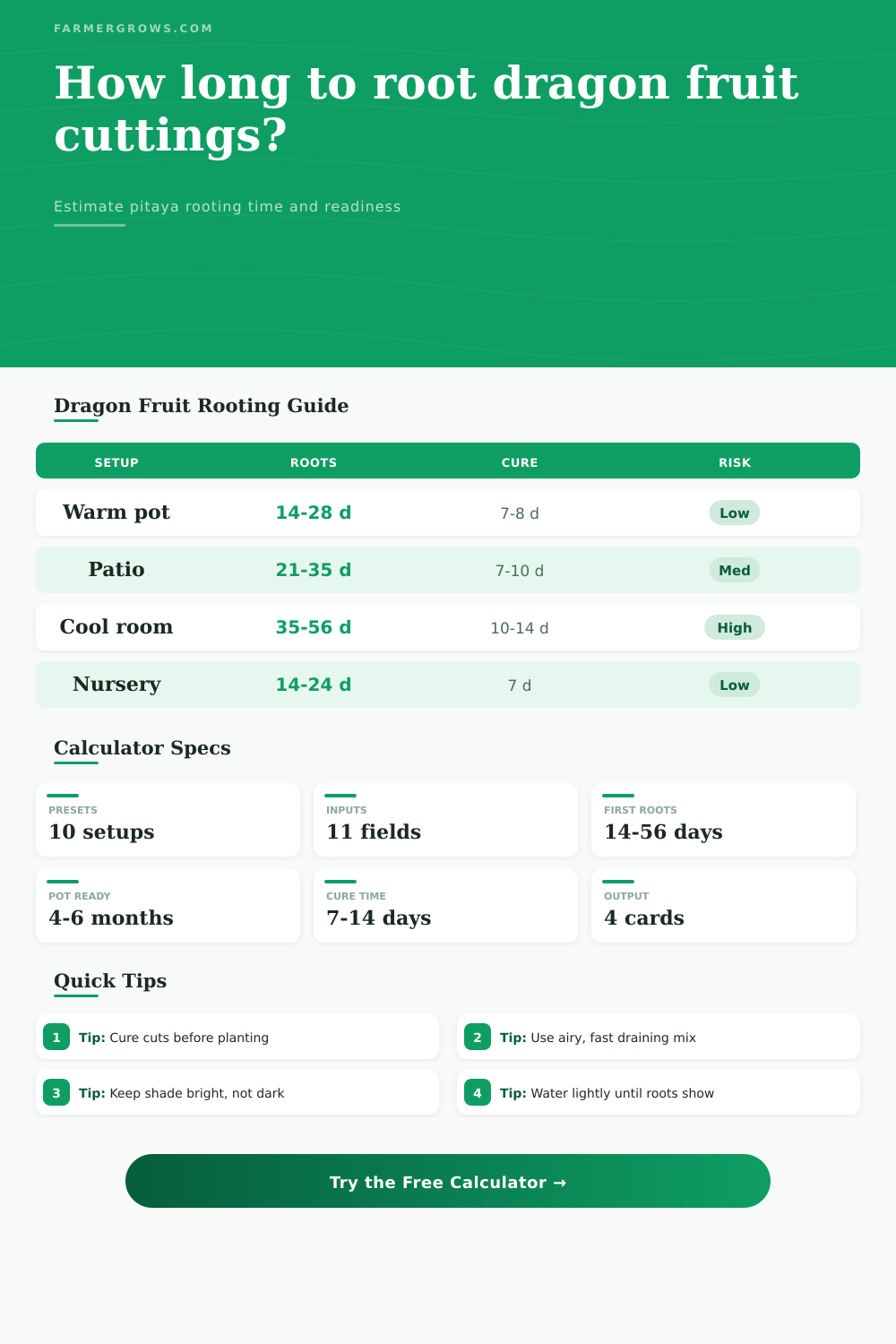
Estimate first-root timing, tug-test readiness, pot development, and rot pressure from cutting size, cure time, media drainage, temperature, humidity, watering, hormone use, shade, and season.
Pick a real propagation setup, then adjust the cutting and nursery conditions. The calculator treats first roots as early anchoring roots and pot-ready as a stronger root system.
Estimated Rooting Schedule
Results update as you change the cutting and rooting environment.
Good home default when it drains fast, stays slightly moist, and supports the cutting without compacting.
Low organic matter and strong drainage reduce rot, but very dry rooms may need closer moisture checks.
A classic propagation blend; it can root well when moisture is controlled and air spaces remain open.
Native soil can work outdoors if very well drained, but pots often stay too dense and wet.
| Propagation stage | Typical timing | What to look for | Calculator use |
|---|---|---|---|
| Fresh cut made | Day 0 | Clean, firm base with no crushed tissue | Start curing counter |
| Callus cure complete | 7 to 8 days | Dry, sealed cut surface in shade | Baseline cure target |
| First root initiation | About 2 to 8 weeks | Small roots or light resistance at base | Main root time result |
| Pot-ready root ball | 4 to 6 months | Root system holds media together | Container development result |
| Cutting length | Metric length | Rooting behavior | Best use |
|---|---|---|---|
| 5 to 6 inches | 13 to 15 cm | Can root, but has less stored reserve | Experimental short pieces |
| 6 to 15 inches | 15 to 38 cm | Common whole stem segment range | Home propagation |
| 10 inches | 25 cm | Study cuttings rooted successfully after two weeks | Nursery trials |
| 18 to 24 inches | 46 to 61 cm | Slower to handle, faster to reach a support | Trellis establishment |
| Rooting condition | Faster setting | Slower setting | Why it matters |
|---|---|---|---|
| Temperature | 75 to 85°F | Below 65°F | Warm cactus tissue forms roots faster |
| Media | Airy, drained pot mix | Dense wet soil | Roots need oxygen at the basal cut |
| Watering | Light after mix dries | Constant wetness | Wet bases rot before roots expand |
| Light | Bright shade | Deep shade or harsh sun | Shade prevents stress while light keeps energy flow |
| Setup | Expected first roots | Tug-test window | Management note |
|---|---|---|---|
| Heated greenhouse bench | 14 to 24 days | 3 to 5 weeks | Keep shade bright and water sparingly |
| Warm patio in spring | 21 to 35 days | 4 to 7 weeks | Protect from cool nights and rain splash |
| Cool indoor window | 35 to 56 days | 7 to 10 weeks | Use warmth before adding more water |
| Rainy humid season | 28 to 49 days | 6 to 9 weeks | Raise pots and keep mix extra airy |
Separate first roots from transplant readiness. A dragon fruit cutting may show roots early, but a reliable potted root system can take several months. Tug gently and avoid disturbing the base.
Fix wet conditions before chasing speed. More water rarely speeds a cactus cutting. Improve drainage, warmth, and bright shade first, especially with fresh cuts or rainy weather.
Cactus enthusiasts are an optimistic bunch. Dragon fruit stems (or arms?) have thick flesh. You can cut off a fat section and slice it cleanly. Lay it on the counter to dry, then place it somewhere safe. It’s a simple plan; the timing can be more variable than usual. In some cases, a cutting roots within a few weeks; other times one sits there looking perfectly fine for two months before quietly rotting at the base.
Why? Often it comes down to factors that are hard to see. Such as composition of growing medium, its drainage, ambient humidity, or just how mature the stem tissue was when sliced away. To guess how long your dragon fruit cutting will take to root, you need not look at the calendar, but into the science of oxygen exchange and water storage. You can use this tool to visualize those silent forces: The calculator (above) asks what mix you’re using, the temperature where you live, and how long ago you cut it.
Why Dragon Fruit Cuttings Rot or Grow
Why? The dragon fruit stem act as a reservoir. Thick, long stems store more water and carbohydrates than skinny ones; those stored reserves drive growth of new roots. But it’s also risky: Bacteria get into the base of a cutting if it remains damp prior to sealing it off from itself. So the tool balances length of the segment against the days or hours it took to cure, and tells you a reasonable period when to expect to spot the first whiteness at the root end. It even predicts when the thing will be steady enough to start tugging on gently without toppling over.
There’s only one thing more critical than this: Growers rush their callusing. Letting the cut end dry out in a dry, shady spot so that it develops a corky, hard seal is essential, and it typically requires seven to ten days. Planting before then means an invitation for rot. The calculator accounts for number of days you waited. Entering a zero or one will result in a spiked rot risk score.
This is not a suggestion. This is a warning. An open wound plus wet soil equals mushy failure. Speed doesn’t matter if the plant isn’t alive before it gets going, even in warm conditions.
The temperature also controls the pace of the cellular clock. Warmth accelerates it, cool slows it down. Ideally, the temperature would be a constant between seventy-five and eighty-five degrees Fahrenheit. Below that, things take much more time (the cold could mean you see no roots for many months). But even then, only warmth isn’t your savior; there’s another half of the equation: Drainage. Because dragon fruit roots require air, they cannot tolerate dense garden soil. You must have media with sufficient pores to let air into the root zone. Choose an airy medium such as a mix containing lots of perlite or pumice or coarse sand. That’s what the tool will adjust depending on the medium you choose. The lighter and airier the medium, the quicker and safer process will go. Heavier compost-rich mixes shows longer timelines and higher rot risks.
Most people kill their cuttings by watering too much. They think “oh, it’s got nothing in there yet and I want to make it grow.” Wrong. The stem doesn’t take in moisture until its roots forms. So keep the soil nearly dry until then. When it dries all the way, water very gently again. The calculator assumes a cautious approach to watering. Choose the wet/water-frequently option, and maybe your estimate of time-to-root will decrease, but your chances of rotting it will go up. There are tradeoffs: you can speed things up if you really pour on the water, but you risk losing the plant.
Shade helps keep the stem moist, but it also lets in enough light for photosynthesis. Direct sun is no good (the stem gets baked). It is better if it is a little brighter. The tool factors in that level of shade to control rate of evaporation. Humid conditions decrease transpiration, which means the plant does not lose as much water. Drier air speeds up transpiration, which means the stem’s moisture is used up quicker. Both can factor into your timing: do I really have to go check this thing again so soon?
Know when to hold ’em, know when to go: Wait until you see roots before rushing to transplant, but then don’t be too hasty. You’re looking for a good root system, not just a couple of white threads. It needs to provide a solid root ball. You’ll need that. That’s months, not weeks, so the calculator’s window represents how long it should take to get the cuttings into a suitable container.
Don’t worry (it won’t take forever). Remember your motto here: patience is not a virtue, it’s a survival strategy. Leave it alone and wait for roots to develop. Warm, dry, and time. It takes time. Time.
Give it a tug. The tug test tells you the plant is ready for next step when it doesn’t come out easily. It’s not a cutting anymore; now it’s a plant with a stem that stands up all by itself, rooted in two. You could of done better if you’d been more careful. Actually, just watch out for moddern problems.