
There’s one issue with picking too early when you’re growing dragon fruit: Sure, it comes off of the cactus looking good, but days later it doesn’t taste like anything. It’s watery and crisp, it doesn’t have any sugar.
Dragon fruit doesn’t continue to ripen once picked. Whereas an avocado or banana will soften and sweeten on the counter, dragon fruit stop right then and there when it detaches from plant. If it isn’t sweet on the vine, it won’t be sweet in kitchen. Green fruit picking will never work as a strategy. This is accepting mediocrity.
How to Know When Dragon Fruit Is Ready
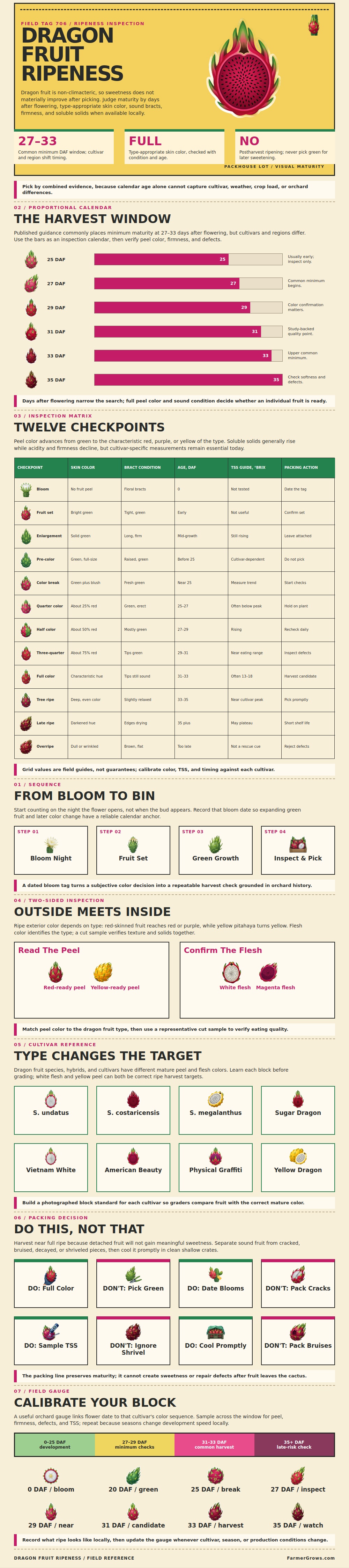
If you want to count days, the best way to gauge ripeness is to begin with day of first bloom (the night the flower actualy opens). The biological clock begins with bloom; many growers who begin with appearance of the bud will get close to a correct number. Once you know what day the flower opened, you can refer to days after flowering as a general guideline. Twenty-seven to thirty-three days are about when most varieties reach a minimum level of maturity.
That’s still not conclusive, however; weather, local climate, crop load, and other factors might move those days plus or minus a couple of days. The calendar is thus a tool and not a hard-and-fast rule. It gives you an indication of when to begin checking carefully but it won’t tell you when to pull it.
Of course, the first step is still visual inspection. For each variety, you’ll want to see full characteristic color of the peel. For example, red-skinned varieties should be really red (or purple), and yellow varieties should be a very bright, consistent yellow. Typically, any remaining green show that the fruit is continuing to fill out with sugar.
As we also note in the infographic, don’t neglect condition of the bracts. The leafy structures covering the fruit (the bracts) will continue to be green and somewhat tight if the fruit isn’t yet ready. As the fruit approach maturity, the bracts begin to loosen and sometimes even dry out a bit. If they’re still stiff and standing up straight, then the fruit’s still taking on sugar. It is a small detail but it can be one of the best clues in the field.
The next level of testing comes when you check the flesh. If it’s magenta varieties, the inside should have an even rich color, while white flesh types will be firm and creamy. Clear or pale flesh indicate that the fruit requires additional time on the vine.
A refractometer. A tool for measuring soluble solids (brix levels), provides scientific confirmation of what we’re seeing visually. It allows us to take the guessing out off the process by measuring actual sugar content of the fruit. Professional orchards uses both visual clues and brix measurements so all their picked fruits is up to par. In home garden, the cut test tends to suffice.
This inspection will guide your packing decisions. You want only fruit that is firm, fully colored, and whose bracts are also sound. Fruit that shows any bruising, cracking or other indication of softness or decay must be separated out immediately. This damaged fruit will go bad fast, and can taint the good fruit when stored alongside it. Prompt cooling of the fruit after harvest will help retain both flavor and texture, the result of all your efforts.
You want to catch the fruit at its best rather than waiting for it to improve. Knowing the cycle of ripening changes your perspective on harvest. Instead of blindly following a date on the calendar, you are suddenly able to understand what is happening. You can look at the fruit instead of the calendar. The sugar forms, the color intensifies, and the bracts softens. And then one day, you notice that everything has come together.
The flower unfolded that one night back there. And now here we are, it’s time to let the fruit tell its story. You should of waited for ripeness.