
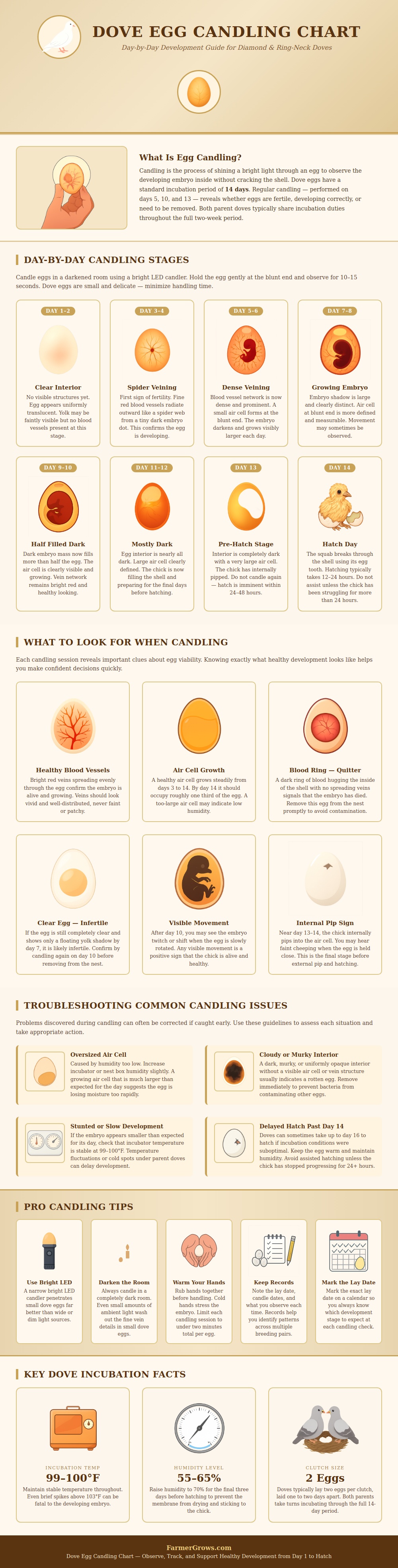
Candling is an process of looking into an egg with a bright light to see if there is an embryo inside of the egg. Candling allow people to view the embryo inside of the egg without moving the egg from the nest. For diamond doves and ring-neck doves, the incubation period last for fourteen days, so the eggs must be observed during that fourteen day period.
Candling allows for people to determine if an embryo inside of the egg is healthy or if the embryo has stopped growing altogether. For the first two days that the eggs are incubated, the interior of the egg will appear clear. The embryo inside of the egg not having developed yet makes the interior of the egg appears clear.
Checking Dove Eggs with a Light
By the third and fourth days of incubation, a network of red line will begin to appear from the center of the interior of the egg. These red lines indicate that the egg was fertilized since they are the blood supply of the embryo inside of the eggs shell. If the egg is candled and there is nothing visible within the egg during the first two days, the egg should be allowed to continue to incubate since the embryo may not be developed enough to be visible.
Between day five and seven of incubation, more red lines will appear inside of the egg, as well as an air space will appear at the blunt end of the egg. The embryo inside of the egg will grow in size and dark each day inside of the shell. Day seven and eight of incubation will allow the embryo to grow to the point where it will create a dark shadow inside of its shell.
Slowly turning the egg may allow for people to see the embryo move within the egg. Each of these visual developments is important to determine if the temperature and humidity levels inside of the nest is appropriate for the developing embryo inside of each egg. If the red lines inside of the egg do not continue to grow after day eight, then the humidity or the temperature inside of the nest may be too low for the embryo to continue developing.
By day ten of incubation, the embryo inside of the egg will have developed to the point where it fills more than half of the eggshell. The air cell inside of the egg will also become larger. Two days after day ten, the interior of the egg will appear to be almost entirely dark except for the air cell inside of the egg.
The embryo inside of the egg, now referred to as a chick, has begun to fill the available space within the eggshell. Additionally, the chick has developed the ability to breathe from the air cell inside of the eggshell. At this point, people should not candle the egg; the embryo inside of the egg is too fragile.
Additionally, if the egg is candled at this point, the presence of the human may disturb the parents. Candling can be used to recognize if the embryo inside of the egg is not developing correctly. If there is a dark ring inside of the eggshell but no red lines are visible, the embryo inside of the egg may have passed away during the incubation period.
If the interior of the egg is completely clear after day seven, the egg is likely not fertilized. If the contents inside of the egg are cloudy with no defined air cell, the egg is rotting; in this case, the egg should be removed from the nest to prevent the spread of bacteria to the other eggs in the nest. There are only two main factors that impact the development of the embryo inside of the eggs; temperature and humidity.
For diamond doves and ring-neck doves, the temperature of the eggs should be maintained between 99 and 100 degree within the nest. Additionally, the doves requires moderate moisture (humidity) levels within their nests. If the temperature rises to over 103 degrees, the embryo development within the eggs may cease.
If the humidity within the nest is too low, the air cell inside of the egg will expand at a rapid rate, and the embryo will not have enough moisture to successfully hatch from its shell. Additionally, humidity should be increased during the final three days of incubation to allow for the membrane surrounding the embryo to remain flexible. Both parents incubate the eggs; however, the parents may leave the eggs uncovered while sleeping.
When the parents leave the eggs uncovered, the temperature of the eggs may drop. To candle the eggs properly and safely, people should warm their hands prior to handling the eggs. Additionally, people should candle the eggs in a dark room.
During candling, the eggs should be observed for one or two minutes. A narrow and bright light source will reveal the interior of the egg more than a dim light source. Written notes should be taken regarding the date that each egg was laid and what was seen during candling.
By taking these notes of each egg, people will be able to recognize any patterns in their development; being able to recognize these patterns will allow for adjustments to the humidity and temperature levels within the nest for the future eggs of those doves. Candling allows for people to gain information regarding the status of the nest that contains the eggs. For instance, candling will allow for people to determine how quickly the doves begins to incubate their eggs.
Additionally, people can also use candling to determine if the parents are covering the eggs appropriately. Each of these observations of the eggs will allow for humans to provide necessary support to the doves; this support will ensure that each chick successfully hatches from its shell after the incubation period of fourteen days.