Butternut Pumpkin Growth Time Calculator
Estimate butternut pumpkin harvest dates, vine length, fruit set, tan-skin maturity, curing time, storage sweetening, and patch yield from direct sowing or transplanting.
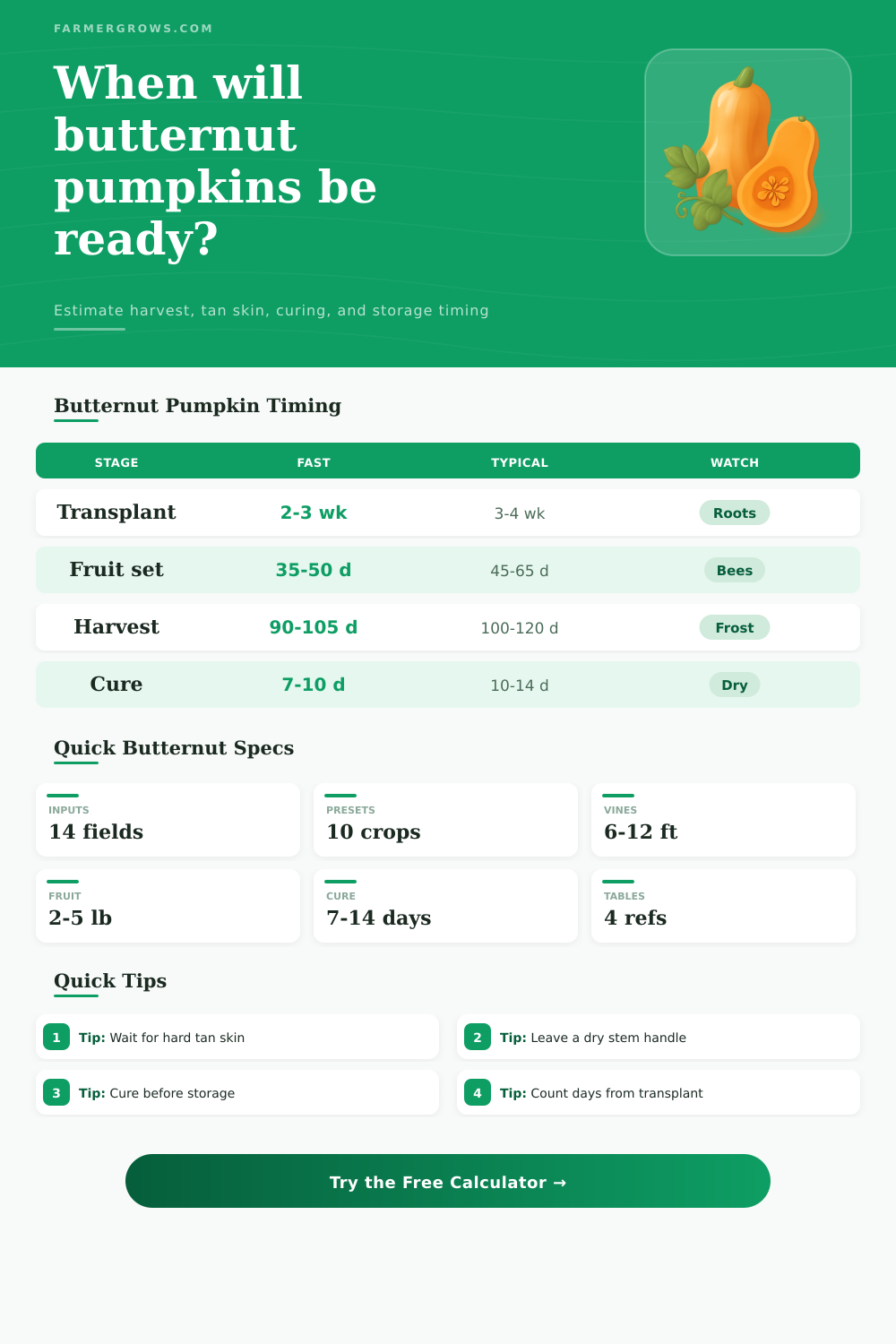
Butternut pumpkin is C. moschata winter squash, so it usually needs a long warm run, strong pollination, and curing after harvest. This tool is tuned for butternut types, not Kent, Cinderella, giant, or Halloween pumpkin timing.
Butternut Pumpkin Growth Results
Dates are planning estimates. Harvest when rind color, stem corking, and frost pressure agree with the calendar.
| Butternut type | Typical days | Fruit weight | Vine habit | Storage note |
|---|---|---|---|---|
| Waltham butternut | 100-110 days | 3-6 lb | Long 8-12 ft vines | Reliable keeper after full cure |
| Hunter F1 | 90-100 days | 2-4 lb | Moderate 6-9 ft vines | Good for shorter seasons |
| Honeynut mini butternut | 100-110 days | 0.5-1.5 lb | Moderate 5-8 ft vines | Sweetens quickly, shorter storage |
| Butterbush compact | 85-95 days | 1.5-3 lb | Compact 3-5 ft vines | Garden-friendly, moderate keeping |
| Tiana F1 | 90-100 days | 2-4 lb | Compact to moderate vines | Uniform market fruit |
| Ponca baby butternut | 95-105 days | 1-2 lb | Moderate 5-8 ft vines | Good flavor after a short rest |
| Metro PMR | 105-115 days | 3-5 lb | Long 8-11 ft vines | Useful where mildew pressure is high |
| Argonaut long-neck | 110-120 days | 8-20 lb | Very long 10-15 ft vines | Needs long warm season and space |
| Condition | Butternut response | Timing effect | What to watch |
|---|---|---|---|
| Soil below 60 F at sowing | Slow emergence and root growth | Add 10-20 days | Rot risk, weak stands |
| Soil 65-70 F | Acceptable start for transplants | Add 3-8 days | Cool nights after planting |
| Soil 70-85 F | Best early vine growth | Use label days | Even moisture |
| Hot dry flowering period | Less fruit set and smaller fruit | Add 4-10 days | Bee activity, blossom drop |
| Cool late season | Tan color and stem corking slow | Add 7-14 days | Frost before cure |
| Method | Start point | Fruit set estimate | Harvest estimate | Best use |
|---|---|---|---|---|
| Direct sow hills | After warm soil | 45-65 days from sowing | 95-120 days | Long warm seasons and low transplant shock |
| Direct sow on black plastic | Soil warmed earlier | 40-58 days from sowing | 90-112 days | Cool springs, weed control, quicker vines |
| Young transplant | 2-3 true leaves | 30-50 field days | 80-105 field days | Short seasons and careful root handling |
| Large transplant | Pot nearly full | 35-55 field days | 88-112 field days | Only if roots are not bound |
| Patch style | Spacing | Vine length | Fruit set target | Yield expectation |
|---|---|---|---|---|
| Compact bush butternut | 3-4 ft each way | 3-5 ft | 2-4 fruit per plant | 4-10 lb per plant |
| Standard garden hills | 4-6 ft hills, 6-8 ft rows | 6-10 ft | 2-5 fruit per plant | 6-18 lb per plant |
| Market rows | 3-5 ft in row, 6-8 ft rows | 6-11 ft | 2.5-4 fruit per plant | 8-16 lb per plant |
| Long-neck butternut | 6-8 ft hills, 8-10 ft rows | 10-15 ft | 1-3 fruit per plant | 10-40 lb per plant |
Harvest cue: Butternut pumpkins store best when the rind is fully tan, hard to mark with a fingernail, and attached to a dry, corky stem. Pale green shoulders usually mean the fruit still needs warm days if frost is not close.
Curing cue: Cure sound fruit in a warm, dry, airy place before storage. Do not cure bruised, cracked, or frost-damaged fruit with keepers; cook those first because they rarely hold well.
The specific let-down I’m referring to happens if your butternut squash is harvested too early. It appears to be big enough; you clip it from its vine; then you go to cut into it later and the flesh inside are all watery and blah. Now here’s the thing: Chances are it wasn’t the lack of water, or poor soil quality, that did it. Chances are it was simply misreading the timing.
Butternut pumpkins is members of the winter squash family, which require a long, warm season to reach their peak in flavor and keepability for storage. Patience is not our strong suit, so rushing things are a common error, particularly at just the moment we’re least inclined to wait.
Why Your Butternut Squash Is Watery and How to Fix It
To help figure all this out, I created a calculator (above) that takes into account factors that no seed packet ever mentions. And the number on the seed label, that generic days-to-maturity range? That’s assuming ideal conditions. Your garden never provide ideal conditions. Use the calculator to type in when you plan to sow, and until when your first frost occurs, and whether your variety has sufficient time to ripen before giving in to winter’s wrath with its vine-killing chill.
Not how many days since you sowed; when will it have had the days to ripen fully, and become truly ripe, to achieve hard rinds and sweet sugars? The math is very different if you’re growing from seed, either sown directly in the ground or as transplants. It’s easier (and feels easier) to direct sow into warm hills; but then your timer doesn’t begin until those seedlings poke their noses through probably still-cool soil. A transplant begins with a headstart, so long as you treat its root system gently. However, you’ll undo all of that if you keep your starts potbound. This will stall them when it comes time to set them out. To compensate, the calculator allows you to indicate whether you have baby starts to work with or fully established, big boys.
There are also presets such as Honeynut if you want something small and fast-growing, or Waltham if you prefer more classic long vines. Every variety has its own internal clock; choose one that isn’t compatible with your season length, and watch yourself be disappointed.
Early pace is set by planting soil temperature. Below sixty degrees Fahrenheit, things slow way down; adding weeks to the timeline; and increasing the risk for rot. To account for variable growing seasons across the country, the tool considers average seasonal temperatures to calculate how fast a plant’s fruit will fill out and vines will run. But weather tells only part of the tale. Temperature isn’t all; pollination plays an equally important role. Wet, cloudy days around bloom time can hinder bee activity, resulting in poor set or even misshapen fruit. Good sun and moisture while the fruit is growing lead to uniform growth of the squash itself.
And then what? Wait until the fruit are full-size. Wait for the rind to turn from striped green to solid dull tan. Then, this is key, see whether your fingernail will poke through. Can’t get any closer to the flesh than that? More time on the vine. Puncture easily? Time to pick. Picking fruit too early causes rot that won’t go away, and this cannot be undone.
Use the calculator’s estimate of when harvesting starts (based off the variety’s maturity) as a starting point, but always rely on your eyes to tell you if it’s still weeks before frost. Once harvested, longterm storage requires curing. Leave sound fruit in a warm, dry place with good air circulation for ten or even two weeks, depending on the variety. In addition to healing any minor wounds to the stems, it also helps the rind become extra-tough. It makes a tender crop sturdy enough to store in your pantry months later.
While resting, the squash will transform from starchy to sugary, enhancing its flavor. Why does an old butternut taste better than a fresh one? This happens because sugar converts during rest time. The tool shows how soon your crop will be fit to eat once cured… To help you plan meals according to both availability and optimal flavor, not just one or the other.
Yield spacing is more important then most growers know. It helps reduce disease pressure, which in turn prevents yield loss. Mildew loves crowded vines and can cause plants to lose their leaves before the fruit is full-sized. Long-neck types such as Argonaut want some major elbow room to unfurl; compact ones will fit in tighter spaces. The inputs help calculate reasonable yields based on space without going overboard. It makes you plan for space like it’s a precious resource (not merely something to cover with dirt).
Growing butternut squash is a lesson in how biology meets expectations. Use the calculator as a guide, then use your hands and eyes to check it out. Look for the tan skin. Try to pierce the skin with a fingernail to check for a hard rind. Never cut off the corky stem. Give them their due, and expect sweetness. They’ll repay you with thick, luscious flesh that stores well into the coldest days of winter.
All this awaits… just wait for the right time.