Dog Gestation Period Calculator
Estimate canine whelping dates from mating, ovulation, progesterone timing, breed size, litter size, imaging windows, and practical whelping prep milestones.
This planner estimates dates for breeding records and whelping preparation. It is not a diagnosis tool. Call your veterinarian promptly for bleeding, fever, severe pain, prolonged straining, green discharge before the first pup, or any labor concern.
Often needs close monitoring because puppies are large relative to the dam.
Date accuracy matters when litters are large for the dam's frame.
A useful baseline for average 63-day ovulation-based planning.
Bigger litters can arrive a little earlier, so prep early.
Your Dog Gestation Plan
Enter a date to calculate the expected whelping window.
| Date basis | Calculator rule | Typical range | Planning note |
|---|---|---|---|
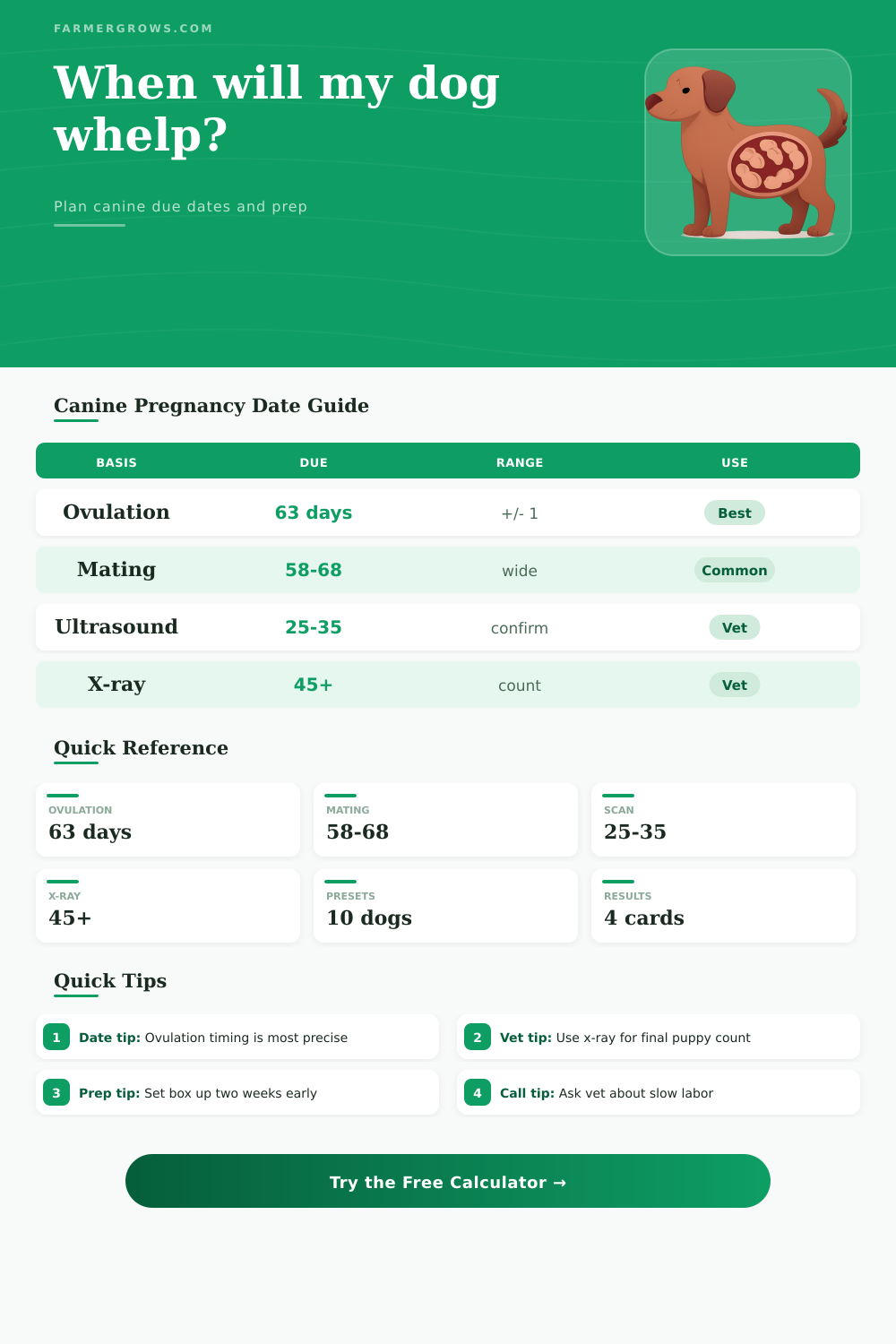
| Known ovulation | Ovulation + 63 days | Usually tight, about +/- 1-2 days | Best for planned breeding and elective veterinary decisions. |
| LH surge or first progesterone rise | Date + 65 days | About 64-66 days | Ovulation usually follows about 2 days later. |
| Progesterone-estimated ovulation | Date + 63 days | About 62-64 days | Use the clinic's stated ovulation date if provided. |
| First mating | Mating + 58 to 72 days | Wide because sperm can survive | Use the broad watch window if ovulation was not timed. |
| Last mating | Last tie + 58 to 68 days | Still wider than ovulation timing | Useful when first tie date is unknown. |
| Milestone | Day from ovulation | What it helps with | Limitations |
|---|---|---|---|
| Relaxin blood test | About day 22-30+ | Pregnancy confirmation when timed correctly | Not a puppy count and can be too early. |
| Ultrasound confirmation | About day 25-35 | Pregnancy confirmation and fetal viability check | Early puppy counts can be inaccurate. |
| Radiograph skeleton visibility | About day 42-45+ | Confirms mineralized fetal skeletons | Earlier x-rays may miss pups. |
| Best x-ray puppy count | About day 50-58+ | More dependable final litter count | Your veterinarian chooses timing by case. |
| Task | When to plan | Why it matters | Calculator output |
|---|---|---|---|
| Confirm pregnancy | Day 25-35 | Plan nutrition, records, and follow-up exams | Ultrasound window |
| Set up whelping box | Due date minus 7-14 days | Lets the dam settle before labor | Prep date card in breakdown |
| Count puppies | Day 50+ when advised | Helps identify whether whelping is complete | X-ray window |
| Start close watch | Early date onward | Prepare supplies, temperature checks, and vet contact | Early watch date |
| Breed size | Common planning concern | Litter-size effect | Prep advice |
|---|---|---|---|
| Toy or miniature | Small pelvis and puppy size mismatch risk | Single pups may be oversized | Discuss delivery plan early with your veterinarian. |
| Small | Large litters can stress the dam | May need earlier close watch | Have calcium and nursing guidance from the vet. |
| Medium | Often follows average timeline well | Litter count helps judge completion | Use x-ray count when available. |
| Large and giant | Large litters can arrive earlier | Many pups can prolong labor | Prepare clean bedding and emergency transport. |
Use the best date basis: Ovulation or progesterone timing usually gives a tighter whelping prediction than the first mating date because eggs mature after ovulation and semen can remain viable for days.
Plan with your veterinarian: A calculator can organize dates, but your veterinarian should guide pregnancy confirmation, radiographs, delivery concerns, and any breed-specific risk.
Planning a litter requires you to keep track of specific date related to the pregnancy of the dam. The dates of pregnancy change according to how you decide to time the pregnancy of the dam. Many people chooses to use the mating date as the starting point for calculating the due date of the puppies.
The mating date may be several days away from the date of ovulation, however. In this case, the sperm can remain viable for a period of time and the eggs may take time to mature before becoming pregnant. Thus, the date that the litter will arrive may be anywhere from fifty-eight to seventy-two days after the first tie between the breeding dog and bitch.
How to Calculate When Puppies Will Be Born
For these reasons, a calculator that permit the user to choose the basis for the start of the pregnancy dates is a helpful tool for people who wish to manage the whelping process. The date that is used for starting to calculate the pregnancy will impact the narrowness of the expected window for whelping. Should the breeder use the progesterone test or the LH hormone surge tests to determine the exact date of ovulation, the puppies are expected approximately sixty-three days later.
However, if the breeders only has the mating date, the pregnancy date will have to be wider to account for the unknown number of days between the mating and the release of the eggs from the bitch’s body. The size of the breed of both the bitch and the puppies will also impact the estimated date of whelping. Toy dog breeds that have large litters of puppy will whelp earlier than giant breeds with fewer puppies in their litters.
In this case, the calculator will help to mathematically calculate and determine this due date for the owner. Veterinarians use the same dates as the pregnancy calculator indicated for those breeds who are scheduled for confirmation scans of their pregnancies. An ultrasound examination performed between day twenty-five and day thirty-five after the breeding bitch ovulated can confirm the presence of a heartbeat within the puppies, and the ultrasound can provide a rough estimation of the litter size.
However, the ultrasound may have missed one or more puppies. After day forty-five, however, the radiograph can show the skeletons of the puppies and the radiograph provides a final, reliable count of the litter. This information can help the whelping owner to understand whether or not the bitch have successfully delivered all of her puppies.
These dates can be entered into the calculator based off the owner’s chosen start date for pregnancy. Preparations for whelping occur according to a timeline that does not necessarily coincide with the due date of the puppies. Most breeding breeders will place the whelping box in the room in which the bitch will sleep approximately two week prior to the due date of the puppies.
This allows the dam to investigate and “claim” the whelping box. Furthermore, the owner may begin to monitor the body temperature of the bitch one week prior to the due date; a drop in the body temperature of the bitch indicates that she will soon give birth to her litter of puppies. These dates can be entered into the calculator with the owner’s chosen lead time for preparation for whelping and the size of the litter.
While the dates calculated by the pregnancy calculator are accurate according to the breeding and birth of puppies, there are some variables in the real world that can alter those dates. Breeding dams who have given birth to puppies before will usually whelp a day or two earlier than a first-time mother dog of the same breed and size. The birth of a single large puppy, illness in the dam, or stress can also alter the dates.
Furthermore, the same care and preparation that is provided for breeds with large litters and single puppies can differ; a single large puppy may not follow the same expected timeline as a litter of puppies of average size. Thus, while the calculator can help to provide an estimated date for whelping, the health and well-being of the dog is more important considered than adherence to the calendar dates established by the calculator. Common mistakes for those who calculate the whelping dates for their breeding dams may include using the date of the first mating as the date of ovulation.
Breeding owners who use this method may expect the puppies to arrive sixty-three days after mating, and may feel alarmed should the breeder not experience whelping on that date. Another common mistake is to only record the date of the last mating between the breeding dog and dam; it is possible that the earlier matings contributed to the pregnancy. These types of errors by the owner can lead to widening of the pregnancy date range and increase in stress for the owners involved in breeding their dogs.
The pregnancy date calculator can mitigate these issues by permitting the owner to label the specific date of the pregnancy, and to view how altering that date may impact the dates after which the puppies are to be born. Another common mistake by owners may be to skip the radiograph examination of the dam to determine the number of puppies. An ultrasound examination may indicate a small litter of puppies, but the radiograph examinations after day forty-five may reveal another puppy that was hidden from view on the ultrasound examination.
Thus, by knowing the exact number of puppies, the owner can eliminate any worries that any puppy may still be inside the dam after she has given birth. The pregnancy calculator can help to establish the date for this radiograph examination so that the owner can ask the clinic about the date of the examination, ensuring that the dates established by the calculator are not too early or too late for the puppies’ radiograph examination. Breed-specific knowledge can help to determine how much owners should rely upon the numbers established by the pregnancy date calculator.
Breeding dams in toy dog breeds who are to have one or two large puppies may require a discussion about delivery of the puppies well before the sixty-three day date. Conversely, giant dog breeds with large litters may begin to whelp a day or two before the sixty-three day date. These variables can be programmed into the calculator to automatically create the “early watch” date for the puppies, but the calculator does not account for the history of that particular bitch.
For instance, if the dam delivered a litter of puppies on day sixty-one, it is more likely that her next litter will also deliver around that same date. Thus, while the calculator may create a date for delivery of the puppies, the history of that dams whelping dates is more important to the owner than the average pregnancy date created by the calculator. Calculations of the date of whelping cannot include the decision of when to call the veterinarian’s office for assistance in whelping the bitch.
In the case that the bitch is straining excessively, if there is green discharge before the first puppy is born, if she has developed a fever, or if she is unusually quiet, the owner must contact the veterinarian’s office for assistance. These dates created by the calculator will help to indicate the time period during which the bitch should be observed for these symptoms. After the initial dates are established, however, the preparation that the breeder made approximately two week prior to the due date will provide the bitch with the clean towels, the warmed whelping box, and the phone number of the veterinarian’s office.
The pregnancy date calculator is a helpful tool that indicates the dates upon which certain tasks should be performed for the whelping bitch and her puppies. The dates can ensure that the breeder does not miss any important steps during the crucial period between the first week and the week prior to whelping the dogs. Nevertheless, the owner should never rely entirely upon the dates indicated by the calculator for the birth of their puppies; the dogs do not follow the same timeline as the calculations made by the calculator.
However, should these dates be combined with the daily observation of the bitch and her puppies and the relationship that she has with the veterinarian who care for her, the owner can establish an effective plan for breeding and whelping the puppies of the bitch.