How Much Should I Feed My Dog Calculator
Estimate daily dog calories, dry cups, wet cans, grams, treat allowance, and meal portions from weight, life stage, activity, body condition, and food energy.
This planner uses common resting energy requirement and maintenance energy factor methods for everyday feeding estimates. It is not a diagnosis tool and is not a substitute for veterinary guidance for puppies, pregnancy, illness, or prescribed diets.
Dog Feeding Estimate
Amounts are based on RER, selected life-stage factors, treat percentage, and the calories listed on your dog food label.
| Dog profile | Starting factor | Often used for | Calculator adjustment |
|---|---|---|---|
| Puppy under 4 months | 3.0 x RER | Rapid growth stage | Activity and body condition still refine the estimate |
| Puppy 4 to 12 months | 2.0 x RER | Slower growth stage | Large breeds may need closer professional guidance |
| Neutered adult | 1.6 x RER | Typical adult maintenance | Lower if heavy, higher if active |
| Intact adult | 1.8 x RER | Higher adult maintenance | Activity can move the result substantially |
| Senior adult | 1.4 x RER | Moderate senior routine | Use body condition and muscle trend to adjust |
| Food label value | Example | Calculator use | Why it matters |
|---|---|---|---|
| Dry kcal per cup | 350 to 500 kcal | Food calories divided by label calories | Dense kibble can cut cup volume sharply |
| Grams per cup | 90 to 130 g | Cups multiplied by cup weight | Useful when weighing meals on a kitchen scale |
| Wet kcal per can | 250 to 450 kcal | Wet calories divided by can calories | Can sizes and recipes vary widely |
| Can grams | 156 to 369 g | Cans multiplied by can size | Helps split partial cans across meals |
| Body condition choice | Typical sign | Calculator effect | Practical check |
|---|---|---|---|
| Thin | Ribs very easy to see or feel | Adds a modest gain allowance | Track weekly weight and stool quality |
| Ideal | Ribs easy to feel, visible waist | Uses selected life-stage estimate | Hold steady unless weight trends change |
| A little soft | Waist less clear, ribs padded | Slightly lowers maintenance estimate | Measure treats and review snacks |
| Heavy | Ribs hard to feel, round outline | Uses a more conservative goal estimate | Discuss safe loss speed with a vet |
| Ideal weight | Adult maintenance estimate | Dry cups at 400 kcal/cup | Wet cans at 375 kcal/can |
|---|---|---|---|
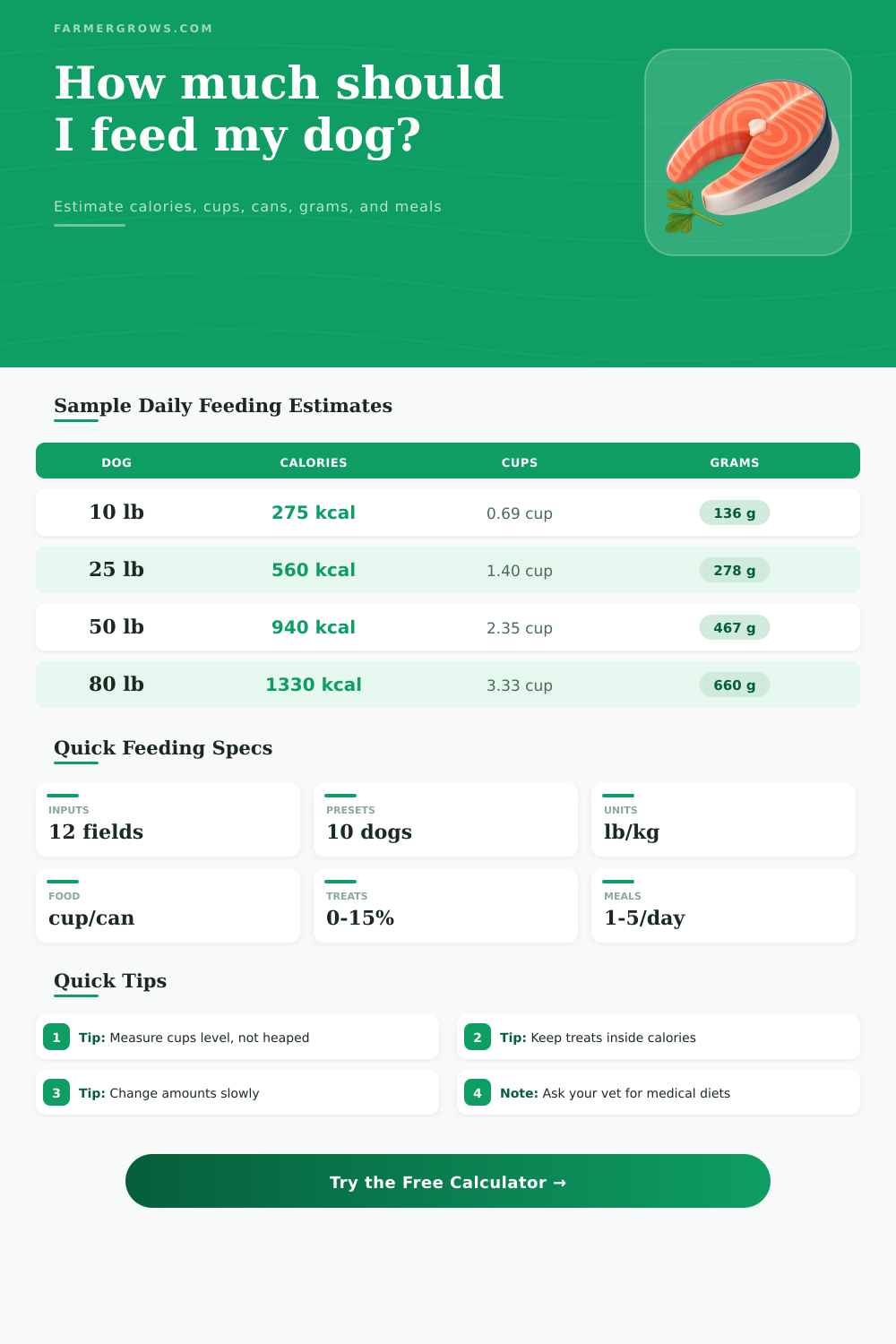
| 10 lb dog | 275 kcal/day | 0.69 cup/day | 0.73 can/day |
| 25 lb dog | 560 kcal/day | 1.40 cups/day | 1.49 cans/day |
| 50 lb dog | 940 kcal/day | 2.35 cups/day | 2.51 cans/day |
| 80 lb dog | 1,330 kcal/day | 3.33 cups/day | 3.55 cans/day |
| 110 lb dog | 1,710 kcal/day | 4.28 cups/day | 4.56 cans/day |
Measuring tip: Use the food label's kcal per cup or kcal per can, then keep treats within the daily calorie total instead of adding them on top.
Care caution: Dogs with rapid weight change, pregnancy, lactation, disease, allergies, or prescription diets need individualized feeding advice from a veterinarian.
To determine the correct amount of foods for a dog, it is necessary to consider a variety of factors relating to the dog. Each dog have a different resting energy need. Factors that impact a dog’s resting energy need include the size of the dog, the life stage of the dog, and the movement of the dog during it’s days.
A calorie calculator can help to determining a starting point for feeding a dog, with various factors being considered by the calculator. To use a calorie calculator, the owner must enter the current weight of the dog and the target weight of the dog, after which the calculator utilize a resting energy equation to calculate the energy needs of the dog. The life stage of the dog can impact the energy needs of the dog.
How to Find the Right Amount of Food for Your Dog
For instance, dogs in there puppy phase (under four months of age) require more energy then adult dogs of the same size, and senior dogs require less energy than adult dogs. Furthermore, the calorie calculator will adjust for whether the dog is spayed or neutered, even though these adjustments dont have to be memorized by the owner of the dog. The activity and body condition of the dog will also impact the amount of food that is provide to the dog.
For example, a dog that is inactive will require less food than a dog that is more active. Furthermore, the body condition of the dog (its physical state) can help to indicate whether the dog’s current weight is too high or too low. For example, if the ribs of the dog are difficult to feel, the dog may be overweight, and its food target will be calculated to reflect the need for the dog to lose some of its weight.
Alternatively, if the dog appears to be thin, the body condition factor will indicate to the owner that the dog is underweight, and the food target will be adjusted accordingly. The type of food that is fed to the dog will impact how the calorie target of the dog is translated into portions of food. For instance, dry food comes in a variety of densities, and the same number of calories may indicate that there is a small amount of one dry food as opposed to a large amount of another dry food with fewer calories.
Similarly, wet food comes in a variety of densities, as well, and thus will require different portion sizes compared to dry food. If dry and wet food are to be provided to the dog, the calorie calculator can determine how many calories of the food should be dry food and wet food according to the percentage of each food that is to be fed. The calories that are provided to the dog through treats must also be considered in the calorie calculations for the dog’s food portions.
Treats should not be considered as providing the dog with calories in addition to those portions of food that are calculated by the calorie calculator. Instead, treats should only contain ten percent of the daily calories that are provided to the dog. Furthermore, the calorie calculator will calculate the number of calories that will be provided through treats, and then calculate the portions of food required to provide the remaining calories to the dog for the day.
This prevents the dog from gaining too much weight due to the calories that are provided in treats. Reference tables on the calculator may help to provide additional information about how the calculator work. For example, the tables can explain the factors that are related to the life stages of the dog, the various label conversions of food, body condition scores, and how those body conditions can lead to adjustments in the amount of food that is to be fed to the dog.
Such tables are provided in case the owner wishes to more precisely understand the reasons for the adjustments in the amount of food that is to be fed to the dog. In addition to calculating the proper amount of food for the dog, it is also necessary to ensure that the food is measured correctly. Using level scoops to measure the food is better than using heaped scoops to provide the same amount of food.
Furthermore, using a kitchen scale to weigh the food that is to be provided to the dog is better than using measuring cups to measure the food. Using a kitchen scale and level scoops will ensure that the amount of food is repeatable each day. The amount of food for the dog should be changed gradually.
For instance, changing the amount of food by ten percent or more each day can upset the dog’s digestion. Thus, the dog should be weighed and its body condition checked each week. Performing these checks will allow the owner to ensure that the amount of food that is provided to the dog is correct.
Dogs in specific life stages, pregnant dogs, and dogs with medical conditions may require knowledge beyond that which can be provided through the use of the calorie calculator. For instance, if a veterinarian has prescribed a specific type of food for a dog, those instructions should be followed. Thus, while the calorie calculator can help to provide an amount of food for a dog with various factors considered, the final decision regarding the feeding of a dog with medical needs should come from a veterinarian.
The goal of using the calorie calculator to determine the amount of food that should be provided to a dog is to maintain the dog’s weight, energy, and appetite. To ensure that the dog receives the appropriate amount of food, the owner must watch for how the dog respond to the amount of food that is fed to it. Furthermore, if changes in the amount of food are required due to the response of the dog, those changes should be made in small increments so as to not upset the dog’s digestion.
Following these steps will allow the owner to keep the dog feeling comfortable.