Daikon Radish Growth Time Calculator
Estimate daikon root harvest, deep taproot bio-drilling, cover crop termination, and residue timing from sowing date, variety, spacing, soil warmth, compaction, moisture, and frost plans.
This calculator starts after daikon is planted and focuses on root growth, forage or cover crop use, soil-opening taproots, and termination timing. It is intentionally different from a radish seed germination estimate.
Daikon Root Growth Timeline
Your daikon root and cover crop timing will appear here.
| Daikon type | Best season | Main root use | Typical root window | Spacing note |
|---|---|---|---|---|
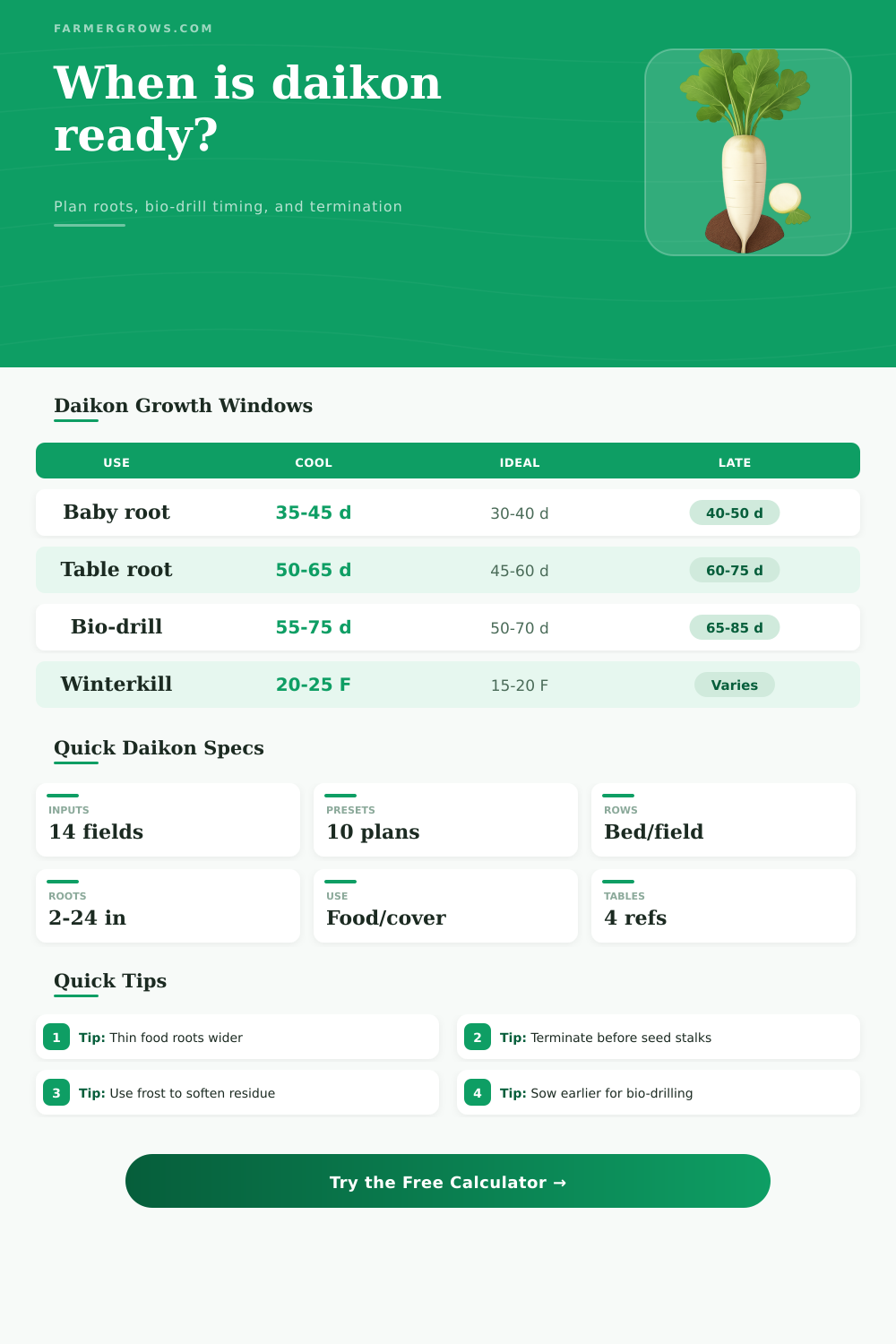
| Japanese Minowase | Cool spring or fall | Fresh table root | 50 to 70 days | 4 to 8 inches for smooth long roots. |
| Miyashige white | Spring or fall | Fresh slicing and cooking | 45 to 60 days | 4 to 6 inches gives medium roots. |
| Korean mu | Fall preferred | Storage and kimchi | 55 to 75 days | 6 to 10 inches for broad shoulders. |
| Tillage radish | Late summer to fall | Bio-drill cover crop | 50 to 80 days | 2 to 5 inches when drilled for cover. |
| Forage radish blend | Fall cover mix | Grazing and nutrient catch | 60 to 90 days | Adjust stand for grazing pressure and mix density. |
| Root-zone soil temperature | Growth effect | Root quality | Management note |
|---|---|---|---|
| 40 to 49°F | Slow root sizing | Good flavor but delayed bulk | Give extra calendar days before expecting deep channels. |
| 50 to 68°F | Ideal daikon growth | Smooth roots and strong tops | Best range for both food roots and cover crop bio-drilling. |
| 69 to 78°F | Fast early canopy | Root quality depends on water | Keep steady moisture to avoid woody shoulders. |
| 79 to 88°F | Heat stress risk | Pithy or sharp roots more likely | Favor cover crop use or delay food-root sowing. |
| Spacing pattern | Expected root size | Best use | Timing consequence |
|---|---|---|---|
| 2 to 3 inches | Small to medium taproots | Cover crop canopy, forage, mix | Earlier closure, less single-root diameter. |
| 4 to 6 inches | Medium long daikon | Home table roots and bio-drill balance | Good root fill without severe crowding. |
| 7 to 10 inches | Large kitchen or storage roots | Kimchi, storage, market bunches | May need a few more days to size shoulders. |
| 12+ inches | Very large roots if soil is deep | Show roots or seed stock trial | Open canopy can allow weed competition. |
| Termination choice | Best timing | Root channel outcome | Risk if late |
|---|---|---|---|
| Natural winterkill | After strong fall root fill | Soft residue and open winter channels | Mild winters may leave live plants. |
| Mow or flail | Before bolting or seed set | Stops tops while roots decay in place | Regrowth possible if crowns survive. |
| Graze | Before hard freeze or stem elongation | Useful forage while roots still loosen soil | Wet grazing can compact the gain away. |
| Incorporate | 2 to 4 weeks before next crop | Faster residue breakdown | Odor and nutrient flush if soil is warm. |
For bio-drilling: Sow early enough to give daikon 45 to 70 good growing days before termination. Small plants still cover soil, but they will not open deep channels.
For kitchen roots: Use wider spacing, steady water, and harvest before heat or bolting makes roots pithy. Big roots are useful only while texture stays crisp.
You look at the ground where you’re supposed to have a row of daikon radish growing big by now. All you see are some stubborn little sprouts and more little stubborn little sprouts, and you gets panicked. Did I plant too late? Oh, wait; maybe my seeds was old! No, chances are it’s buried underground, in the layer of compaction and temperature conditions you can’t see.
Let the math on the calculator above figure out what your frost window and sowing date should of be. Then, work with actual soil conditions (which matter most) to determine how those roots will shape up: straight or forked into a crazy shape. It makes waiting feel like concrete plan.
How to Grow Daikon Radishes Well
The first variable that most growers misunderstand is soil temperature versus air temperature. On an afternoon when your thermometer say it’s seventy degrees out there in the sun, feeling like plenty warm enough; it feels like it should be growing time. But what about two or four inches down, where those daikon roots sits? The thermal inertia of the soil keeps it way cooler than you think. When root zone doesn’t reach at least fifty degrees Fahrenheit, metabolism slows to a crawl. It doesn’t push its taproot deeper; it puts all that energy into making leaves instead. So even though you may have rich soil and proper spacing, if the soil itself isn’t warm enough, you’ll end up with pithy, shallow roots. And that’s the thing that people get wrong, they judge whether it’s ready on the basis off calendar month, not the thermal reality of what the soil is doing in their own particular garden bed.
The spacing is very important, daikon should have some elbow room, as it were, to develop shoulders without bumping into other roots. For growing radishes at all for eating, you’d like more space between plant within the row (six inches to maybe 10 inches, depending on what variety); this allows each one plenty of real estate to push through soil profile, pushing itself along rather then fighting for moisture and nutrients from its peers. But if they’re intended as a cover crop to smother compaction, then you’ll get more biomass produced and maximum weed-smothering if you space them closely, since a thicker canopy will form.
The tool will give you an idea of what kind of stand you’ll achieve based off your decisions about seed spacing, taking into account how thickly they germinate and whether you’ll do any thinning. Maybe the most gratifying application of all is bio-drilling, which takes some patience. The idea isn’t to get big plants; it’s to get deep-rooted ones whose taproots create conduits for water and air to infiltrate once they die (long after your last harvest). Terminating the crop prematurely, typically by grazing or mowing before they’ve had a chance to really build up mass, means less soil benefit than if you’d let the roots do their work. In order for the roots to decompose and leave major voids, they must first grow to a large enough size. Aim to terminate them at around 45-70 growing days, so the taproots can do their structural work while alive.
Frost affects things in two ways. First, light frosts don’t hurt. They may even help by triggering a “natural antifreeze” mechanism that produces sugars to enhance taste, particular with storage types. But if you’re counting on a hard freeze to kill the stand of your cover crop as its termination method, know the date of your first frost, and work backward from there to figure out when it’s best to sow, so that the plants reaches their maximum biomass just as winter sets in. In colder zones, cold weather will kill off Daikons naturaly. This leaves behind residue that mellows into the soil over several weeks, breaking down to release nitrogen and enhance soil structure without any need for tilling.
In the end, cultivating daikon is about more than just pushing things along. Whether you are growing a field of tillage radishes to aerate clay soil in the fall, or pulling up crisp white roots for an early spring salad, it is as much about understanding what you can expect from the environment. It’s about matching your variety choice, timing, and space use to the physical and thermal reality of where you livig. The time line comes from the tool; the rest comes from watching the roots show themselves in your particular soil conditions.
When you finally see those perfect, straight, smooth roots come out of the ground, you’ll know just how worthwhile all that advance planning was.