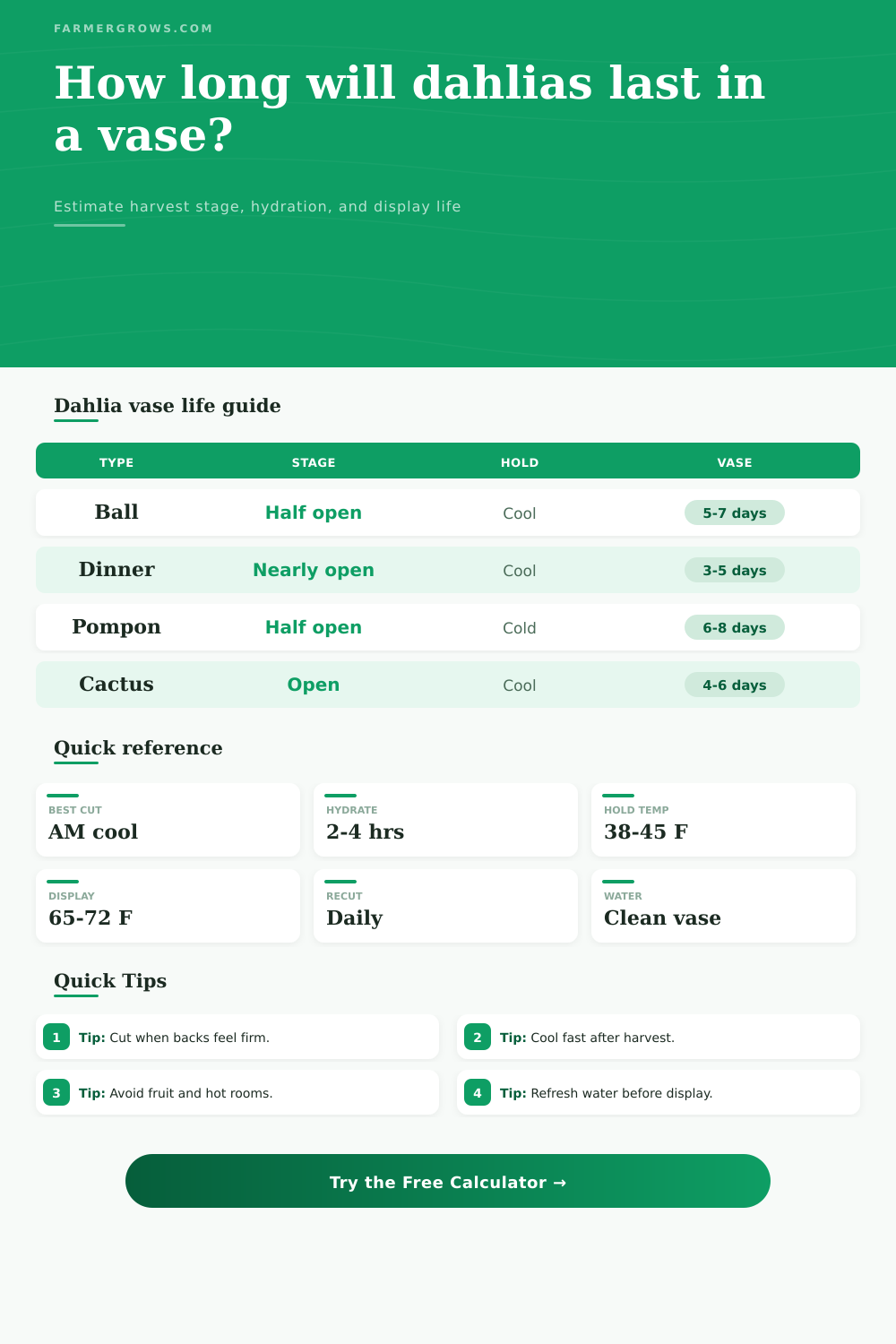
Dahlia Flower Vase Life Calculator
Estimate how many display days dahlias can hold after cutting, based on bloom form, harvest stage, stem maturity, hydration time, cold storage, preservative, sanitation, transit, and room conditions.
📋Dahlia vase-life presets
Start with a real grower scenario, then adjust harvest stage, handling, temperature, and display conditions for your own stems.
🌼Bloom type and harvest stage
Dahlias have hollow stems, thirsty heads, and limited postharvest reserves. Form, maturity, and stem firmness set the starting vase-life potential.
💧Hydration, holding, and vase care
Use this section for the postharvest chain: initial hydration, cooler temperature, holding duration, preservative, sanitation, recutting, and display room stress.
Dahlia vase-life estimate
Calculated from dahlia form, maturity, hydration, holding, vase care, transit, and display stress.
Calculation breakdown
📊Grower handling snapshot
📘Dahlia vase-life reference tables
| Form | Baseline | Best cut stage | Weak point |
|---|---|---|---|
| Pompon | 6-8 days | Half to nearly open | Small stems dry out |
| Ball | 5-7 days | Half open, firm back | Bruised petals |
| Cactus | 4-6 days | Open but fresh | Petal tips flag |
| Decorative | 4-6 days | Nearly open | Heavy heads bend |
| Dinnerplate | 3-5 days | Nearly open | High water demand |
| Collarette | 3-5 days | Open, clean center | Open center ages fast |
| Stage | Signal | Vase effect | Use |
|---|---|---|---|
| Too tight | Soft back | May not open well | Avoid for sale |
| Half open | Firm back | Best for dense forms | Market bunches |
| Nearly open | Firm full color | Best for large forms | Events |
| Fully open | Fresh center | Shorter but showy | Same-week use |
| Overmature | Pollen visible | Fast decline | Local display only |
| Condition | Range | Effect | Note |
|---|---|---|---|
| Cold hold | 38-45°F | Slows aging | Short term only |
| Cool room | 55-64°F | Good display | Best for events |
| Normal room | 65-72°F | Moderate aging | Keep shaded |
| Warm room | 73-80°F | Fast water loss | Change water often |
| Hot spot | 80°F+ | Rapid flagging | Avoid sun and ovens |
| Symptom | Likely cause | Fix | Urgency |
|---|---|---|---|
| Soft neck | Poor uptake | Recut and hydrate | High |
| Cloudy water | Bacteria | Wash vase | High |
| Petal flagging | Heat or dry air | Move cooler | Medium |
| Brown tips | Age or bruising | Use soon | Medium |
| Stem collapse | Low water volume | Deep fresh water | High |
For most market dahlias, choose blooms with firm backs and enough open color for immediate display. Very tight buds rarely improve after cutting.
Large decorative and dinnerplate dahlias can drink heavily. Use deep clean water, avoid crowding, and recut stems when moving from bucket to vase.
Calculator estimates are practical planning ranges, not guarantees. Variety, plant stress, pest damage, and bruising can move results outside the model.
When your gorgeous dahlia bouquet flops by Tuesday afternoon, do you panic? Chances are good that you cut them on the proper day, washed them, and stored them out of direct sunlight. And still, no dice. Don’t worry, it’s not you, it’s (mostly) not your bad luck. It’s almost always some combination of bacteria blocking the stem or thermal stress caused as soon as the stem are cut from the ground. But the math is done for you in this calculator (above). This means no more guesswork about whether a few hours in the warmth will ruin what was a perfectly formed bouquet.
“The thing no one thinks about is the bloom form versus the harvest stage. The flowers in balls and pompons is tightly constructed. Pick them when they are half-open and still firm in the base, and they will last. With the dinnerplates, they’re a whole other animal. They’ve got these big heads, so much water demand, and they flop around. By waiting till the dinnerplate is all the way open, you’ve wasted half the vase life right there on the plant. The tool comes into play depending on whether the flower is tight, half open, nearly open, or overmature. The number of days it changes the baseline depend on that. It’s not just about beauty. It’s about physiology. Firm on the back means they’re done expanding inside but haven’t yet started to drop their petals outside. That’s when they’ll last longest.”
Why Your Dahlias Die Fast
The other big issue is temperature. Remember: dahlias come from tropical regions and loathe cold injury, but also dislike being cooked up in hot weather. Keep them in the 38- to 45-degree F range to keep them cool but not frozen. This will prolong their lives. See the chart on the page.
If you cut your flower during the heat of the day and leave it in a barn to cool down, the stem will cook from the inside out. Bacteria multiply fastest in that warm stagnant water trapped in hollow stems. And once those stems get warmed up, the only thing that really can slow the aging clock is getting rid of the field warmth quickly, within half an hour; otherwise, the vase life penalty for waiting five or more hours, no matter what preservative you dump into the water then, equals days lost.
You don’t need a name-brand solution; how you hydrate is more important. You see guys who use dirty buckets with all kinds of fancy chemical additives. Those additives cost a lot of money. Bacteria clog the vascular system. Nothing you add will help if they’re out of sugar. That’s why the tool asks how often you recut and sanitize. With a stem like a dahlia (they’re hollow) which can get an air lock, recutting stems daily keep the intake open. Put one in some standing water in the same cut position for three days and it’ll seal up with a bacterial slime inside the tube. Nothing you put in there as a preservative will ever make its way into a closed-up stem. Water matters. It has to be clean.
Another issue is transit conditions. On a steamy day in a warm vehicle, the turgor pressure goes out fast in a flower bouquet. The calculator takes into account the temperature (hot/dry or cool/wet) during transport. For example, dry shipment lets the cut end close off to air; recutting as soon as they arrive is essential. Or else, all at once, your flowers go down twelve hours later. They’ll look good, and then kapow! You could buy the most beautiful blooms from around the county, but leave them baking in a paper bag while driving home, and you’ve already lost the war.
All told: a plant’s vase life is a function of competing factors of bacterial growth vs. Thermal decay vs. Water uptake. This is not some magical guesswork, but real-world physics that the calculator can help you assess. Where in your process is it leaking quality? Perhaps it’s how dirty your buckets are. Perhaps it’s what time of day you cut from. Or perhaps your room just isn’t cool enough for dinnerplates to last longer then day three, as I’ve found. Tweak a variable and see which one is your weak link.
If you pamper dahlias, they will reward you; if you neglect them, they will warn you, but they won’t fade away gently like a rose. They just start flagging right away, when something’s wrong. If you know the interaction of the three factors, how quickly to cool them after harvest, what temperature water is best, and how to use water hygienically, you can turn a three-day period into a week. And it all comes down to getting rid of the heat before bacteria start to grow. Most folks don’t realize that’s the key. Cool the water, wash the stems, don’t push those blooms past their ideal temperature, and your vase will deliver days, not hours; of livig color. You should of seen how much it matters.