Dahlia Tuber Storage Life Calculator
Estimate remaining safe storage weeks, rot pressure, shrivel risk, and inspection timing from storage temperature, humidity, medium, tuber condition, curing days, and planting date.
📋Dahlia tuber storage presets
Choose the closest winter storage situation, then adjust the dates, temperature, humidity, packing medium, curing time, and inspection interval for your own dahlia clumps.
🌼Storage conditions and tuber inputs
Dahlia tubers store longest when cured, cool, dark, and packed in a medium that slows water loss without staying wet. The calculator estimates safe storage from both rot pressure and dehydration pressure.
Dahlia tuber storage estimate
Enter your storage conditions to estimate safe weeks remaining.
Storage breakdown
📊Storage condition markers
These quick markers translate the calculation into practical storage decisions for the current box.
🌡What-if storage comparison
Compare the current setup against common adjustments. Cool, humid, breathable storage usually extends the safe window; warm or sealed storage narrows it quickly.
📘Dahlia tuber storage reference tables
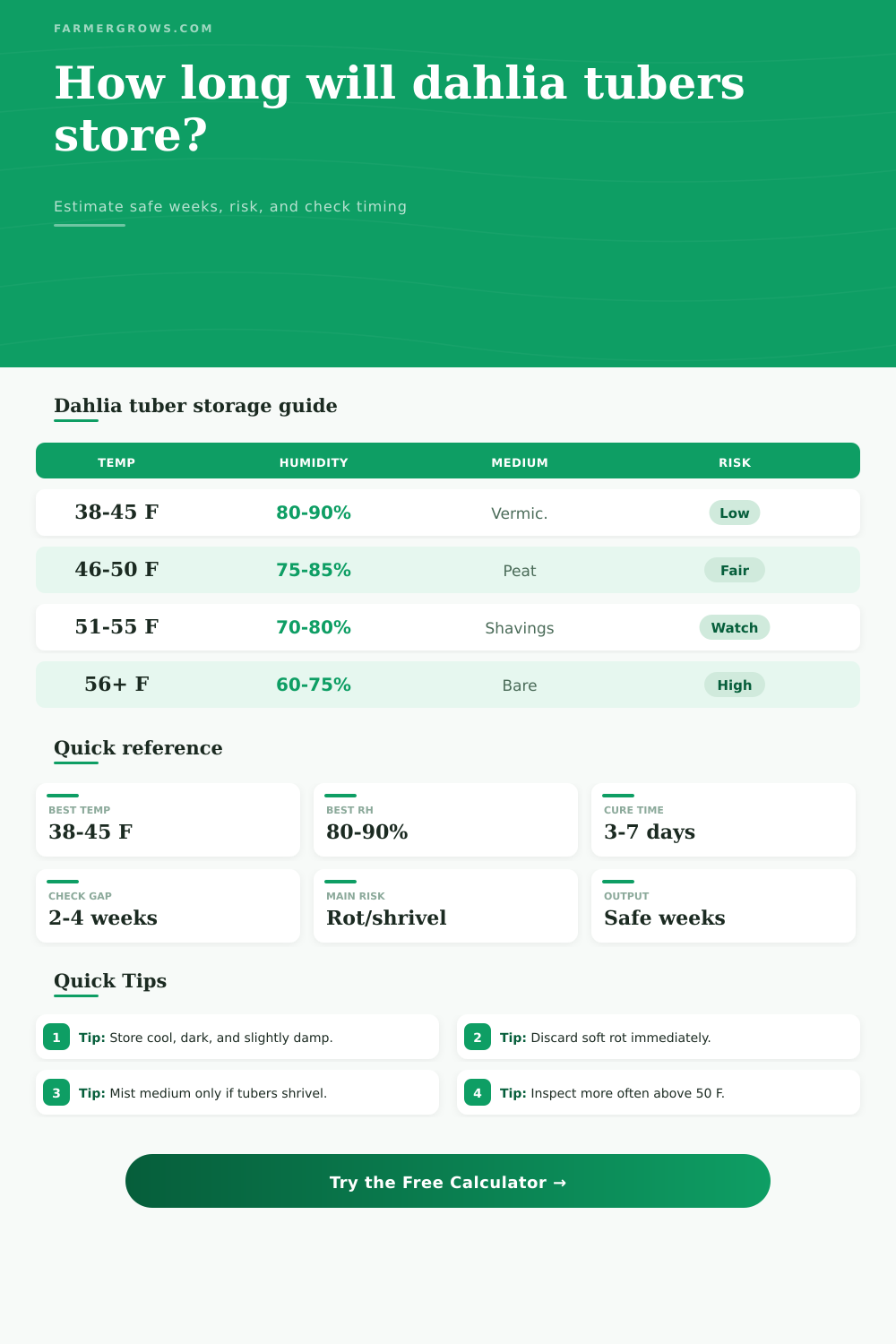
| Storage temp | Expected life | Main issue | Inspection pace |
|---|---|---|---|
| 35-37°F | 12-20 weeks | Chilling injury risk | Every 2 weeks |
| 38-45°F | 22-32 weeks | Best winter range | Every 3-4 weeks |
| 46-50°F | 18-28 weeks | More sprouting | Every 2-3 weeks |
| 51-55°F | 12-20 weeks | Shrivel and sprouts | Every 1-2 weeks |
| Over 55°F | 6-14 weeks | Fast decline | Weekly |
| RH level | Medium fit | Shrivel risk | Rot caution |
|---|---|---|---|
| Under 60% | Vermiculite or coir | High | Low |
| 60-74% | Coir, peat, paper | Moderate | Low-moderate |
| 75-90% | Vermiculite or peat | Low | Watch wet spots |
| 91-95% | Vent and inspect | Very low | Moderate-high |
| Over 95% | Dry medium needed | Low | High |
| Medium | Moisture buffer | Rot tendency | Best use |
|---|---|---|---|
| Vermiculite | High | Low-moderate | Most home storage |
| Peat or coir | High | Moderate if wet | Dry basements |
| Wood shavings | Low-moderate | Low | Humid rooms |
| Newspaper wrap | Low | Low | Short holding |
| Bare crate | Very low | Low | Humid cellars |
| Sealed plastic | Very high | High | Only with checks |
| Finding | Immediate action | Next check | Storage note |
|---|---|---|---|
| Firm tubers | Close box again | 3-4 weeks | Keep stable |
| Light shrivel | Slightly moisten medium | 2 weeks | Avoid wet tubers |
| Heavy shrivel | Raise humidity | 1 week | Consider potting early |
| Surface mold | Vent and remove mold | 1-2 weeks | Dry wet medium |
| Soft rot | Discard soft pieces | 3-7 days | Separate survivors |
If tubers are firm but slightly wrinkled, adjust the medium slowly. A damp handful of packing material is safer than misting directly onto crowns and necks.
Soft rot spreads fastest where damaged tubers touch. Remove soft pieces, dust off wet medium, and inspect the neighboring labels sooner than the normal schedule.
This calculator is a planning estimate for stored dahlia tubers. Local cultivar behavior, frost injury, washing method, and hidden neck damage can change real survival.
In late fall, you dig up your dahlias (clump after clump), then clean away the dirt and stash them for the winter. It’s not gardening so much as it is logistics: Get it right, or a tuber will dry out… Or rot. And become mush long before spring. This takes some of the guessing out; it’s a storage timeline for your storage space.
It all boils down to two conflicting forces. Too much moisture combined with heat mean rot. Dry air equals shrinkage. No amount of cooler air are going to fix it. If you try to cool things off too fast, or seal your tubers into plastic without any venting hole, condensation will form on their crown and neck. That’s an invitation to fungal infection.
How to Store Dahlias in Winter
Your set up, ambient air plus the packing medium you select, is what the tool tries to measure. Will you pack your tubers in dry wood shavings? Vermiculite? Peat moss? All hold moisture differently, affecting tuber firmness over time.
Most gardeners skip curing process. After digging, tubers needs to be left in a airy, cool spot for a few days (to allow for the callusing-over of cut surfaces). Leaving any moisture on their skins will become a source of rot when they’re packed. That’s why it’s a must if you want the tubers to last longer than just a few weeks.
How long did you cure your tubers? The calculator knows; based off that answer, it tweaks its estimate of the length of time the tubers is safe. A well-cured tuber should of make it through a milder winter in the basement where it gets a bit warm. An uncured one will likely only hold up a week or two before developing soft spots.
When humidity is high, as it is in tuber storage, the tubers will hold onto their moisture without getting wet. If the air dries out too much, tubers will gradually sweat off excess water over months, causing substantial tuber mass reduction and weakened plant in springtime. The best buffer is to keep air at 80 to 90 percent relative humidity, according to the reference tables. That’s why you’d use a moist medium such as vermiculite to hold humidity, but not one that are soaking wet; just stabilize their surroundings.
Don’t expect the initial setup to be perfect; rather, think about how and how often to check. Ideal conditions won’t last forever. What’s “ideal” in October may not is ideal in January. A box might have developed some dry pockets or hot spots along the way. Based on your storage risk profile, the tool recommends how often to inspect.
If you’re storing in a warmer garage with lower humidity, you should check frequently. If you catch it early, say, just a few tubers going soft, it’s not the end of the world. Get rid of those few infected pieces and don’t let them spread to the healthy ones around them.
Most people agree that for coolness, you want the high 30s or low 40s. Ideal is between thirty-eight and forty-five degrees Fahrenheit, but it’s also okay if your cool spot gets as warm than fifty. (That’s assuming you control the humidity.) What matters more is what happens when conditions change.
If that one unseasonably warm week occurs and your storage space heats up, all those sprouting seeds will take energy away from the tuber reserves that sustains the plants through their summer bloom season. You don’t want to save a museum piece, but rather maintain enough energy to sustain another season of blooms. Not all eyes (or even half) on each tuber will make it to next winter. Only the good ones that is still intact will survive.
That way, if some show signs of waking up extra-early, like sprouting, you can tell how far along they might be and thus when to begin potting them up. Or if things seem on the parched side, it’ll give you a clue to jump in there and help. This turns what was a sit-and-wait thing into an actively managed strategy.
In springtime, you’ll wish you’d paid attention to those three factors, temperature, dampness, and darkness, long beforehand, so thank yourself now. Actualy, it is naturaly better to be prepared for the moddern garden. You dont want any luxurius tubers to dissapear!