Cylindrical Tank Volume Calculator
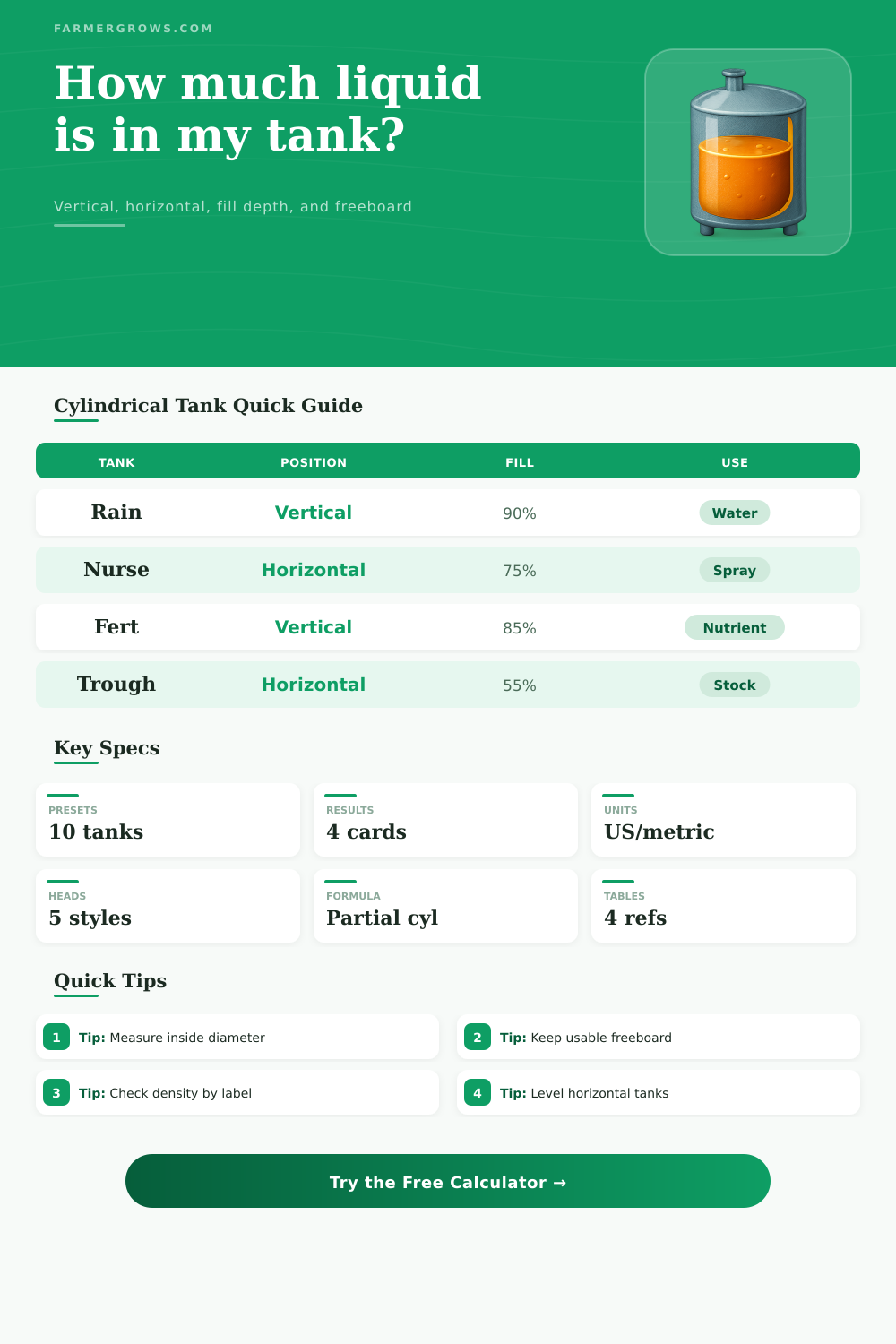
Estimate gallons, liters, fill percentage, freeboard reserve, liquid weight, and run time for vertical or horizontal cylindrical tanks with common head and end styles.
Load a common farm, garden, nursery, livestock, or spray-water tank, then adjust diameter, length, fill depth, head style, freeboard, density, and use rate.
Tank Volume Results
Enter tank dimensions to calculate volume, freeboard reserve, liquid weight, and run time.
This grid compares the same diameter, straight shell, head style, freeboard, and entered fill depth as if the tank were vertical or horizontal.
| Head or end style | Equivalent length added | Best use in this calculator | Field note |
|---|---|---|---|
| Flat ends | 0.00 x diameter | Plain vertical tanks, barrels, open cylinders | Most direct cylinder volume. |
| Shallow dished ends | 0.08 x diameter | Light domed poly tanks and shallow pressed heads | Small extra capacity beyond straight shell. |
| 2:1 elliptical heads | 0.25 x diameter | Pressure-style and smooth-end tanks | Approximation for both ends combined. |
| Conical ends | 0.17 x diameter | Cone-bottom or cone-ended farm tanks | Assumes two shallow cones at about one-quarter diameter depth. |
| Hemispherical ends | 0.67 x diameter | Capsule tanks with rounded ends | Two hemispheres equal one sphere. |
| Nominal tank | Approximate dimensions | Orientation | Planning use |
|---|---|---|---|
| 55 gal barrel | 23 in diameter x 34 in high | Vertical | Rainwater, rinse water, small fertigation mixes |
| 300 gal farm tank | 4 ft diameter x 3.2 ft high | Vertical | Greenhouse, orchard, or garden water storage |
| 500 gal sprayer tank | 5.5 ft diameter x 4.2 ft long | Horizontal | Spray carrier, transfer trailer, nurse wagon |
| 1025 gal nurse tank | 7.5 ft diameter x 3.1 ft long shell | Horizontal | Field nurse, irrigation chemical mix, livestock water |
| 2500 gal vertical tank | 7.5 ft diameter x 7.6 ft high | Vertical | Rain capture, well buffer, nursery irrigation |
| Liquid | Typical density | Metric density | Use the value for |
|---|---|---|---|
| Water | 8.34 lb/gal | 1.00 kg/L | Irrigation, livestock, rainwater, rinse tanks |
| 28% nitrogen solution | 10.65 lb/gal | 1.28 kg/L | Liquid fertilizer storage and tender tanks |
| 32% nitrogen solution | 11.06 lb/gal | 1.33 kg/L | Heavier fertilizer weight checks |
| Molasses | 11.5 to 12.0 lb/gal | 1.38 to 1.44 kg/L | Feed storage and ration mix tanks |
| Diesel or light oil | 7.1 to 7.3 lb/gal | 0.85 to 0.88 kg/L | Weight estimate only; follow fuel tank rules |
| Use case | Typical rate entry | Calculator result to watch | Planning note |
|---|---|---|---|
| Drip irrigation block | 100 to 1000 gal/day | Run time in days | Use actual emitter count and schedule where possible. |
| Livestock water trailer | 10 to 30 gal/head/day | Usable gallons with freeboard | Hot weather can raise demand sharply. |
| Sprayer fill tender | 200 to 1000 gal/batch | Remaining volume | Enter batch demand as the daily use rate for batch count. |
| Greenhouse reserve | 50 to 500 gal/day | Freeboard reserve and run time | Include misting, hand watering, and flush cycles. |
| Fertilizer storage | 100 to 2000 gal/day | Liquid weight | Confirm tank support, containment, and product label density. |
Wall thickness, molded domes, fittings, and sloped pads can change usable volume. Inside diameter and a level fill-depth measurement give the cleanest estimate.
Leaving headspace reduces overflow risk during transport, foaming, or filling. Dense fertilizer, molasses, and spray mixes can overload supports before the tank looks full.
Cylindrical tanks is often located on farm, in greenhouses, and behind barns. The reason that cylindrical tanks are typically used in these location is that the cylindrical shape provides more volume per foot of wall than a square tank would provide, and that the rounded sides of the tank are able to better handle pressure then the flat sides of a square tank. The efficiency of a cylindrical tank are important in locations where the liquid must be hauled to livestock, where the tank must store fertilizer, or to store the liquid as a reserve tank for periods of drought or dry week.
In calculating the capacity of a cylindrical tank, you must calculate the volume based off the diameter of the tank, the fill level of the liquid in the tank, and the empty space that is required in the tank to be left at the top of the tank. One of the most common method of measuring the volume of a cylindrical tank is to measure the outside of the tank. However, because many cylindrical tanks have thick wall, measuring the outside of the tank is typically inaccurate in measuring the actual volume of the tank.
How to Calculate and Use a Cylindrical Tank
The actual volume of the tank is based upon the difference between the inside diameter of the tank and the outside diameter of the tank, and the difference between these two measurement increases as the thickness of the walls of the cylindrical tank increases. Furthermore, it is necessary to leave empty space at the top of the cylindrical tank, as well. This empty space at the top of the tank is referred to as freeboard, and this space is required to prevent the liquid from overflowing from the tank.
The orientation of the cylindrical tank will impact how the volume of the liquid in the tank is calculated. The volume of the liquid in a vertical cylindrical tank will be filled in a straight line. In contrast, the volume of the liquid in a horizontal cylindrical tank will be filled in a curve.
As a result, the bottom and top portion of a horizontal tank will contain less volume than the middle portion of the tank. If a horizontal tank is treated as if it were vertical in relation to the fill depth of the tank, the horizontal tank may be underfilled, or the liquid in the tank may be entirely depleted before the desired level is reach. The weight of the liquid contained within the cylindrical tank is another factor to consider.
The density of the liquid will impact the weight of the tank, and the weight of the tank is a consideration in locations where the tank may be resting upon a trailer, a stand, or another structure. For instance, water has a density of approximately eight and a third pound per gallon. However, liquids such as fertilizer and molasses are much more denser than water.
Therefore, a three-quarter tank of either fertilizer or molasses may be too heavy for the trailer axle or a stand made of wood. The structure upon which the cylindrical tank is resting will experience the weight of the liquid in the tank, so the density of the liquid will impact the weight that the structure must support. In calculating the length of time that a liquid will last within a cylindrical tank, the usable volume of that tank can be used to calculate the length of time that the liquid will last.
However, the calculation is only accurate if the calculation include the depth of the freeboard in the tank and the actual depth of the liquid being filled into the tank. Common mistakes includes using the outside measurements of the tank rather than the inside measurement of the tank. Additionally, it is common for individuals to not account for the depth of the freeboard in the tank when calculating the amount of liquid that the cylindrical tank can contain.
Finally, another common mistake is to use the total capacity of the cylindrical tank rather than the working capacity of the tank. Each of these mistakes will impact the calculations made regarding the cylindrical tank, and the impact of each of these mistakes becomes more pronounced as the size of the cylindrical tank increase. The calculator that is provided will allow user to calculate the capacity of the liquid within a cylindrical tank.
Users will be able to enter the inside diameter of the cylindrical tank, the length of the tank, the depth of the liquid in the tank, and the amount of freeboard that the tank will have. Additionally, the calculator will allow the user to enter whether the tank is vertical or horizontal in relation to the liquid in the tank, as well as allow for the comparison of the capacity of the tank in each of these two orientations. Furthermore, reference table will include factors that relate to the head of the tank, sizes of common cylindrical tanks, and the densities of the liquids within those tanks.
A calculator will not replace the judgment of where the cylindrical tank will be located. The amount of freeboard that will be required for a cylindrical tank located on a slope will differ from the amount of freeboard that will be required for a tank located on level ground. Furthermore, the amount of freeboard that will be required for a tank that is mounted on a trailer will be greater than the amount of freeboard that will be required for a tank that is standing in a greenhouse.
Additionally, the amount of freeboard that will be required will change based upon the change in temperature of the liquid within the tank, as well as the amount of sediment that may be within the tank. Each of these variables will impact the actual use of the cylindrical tank. Therefore, it is important to measure the dimension of the tank, as well as the demand pattern of the liquid that will be stored within the tank.
By ensuring these two measurement are accurate, the cylindrical tank will become a reliable component of the operation.