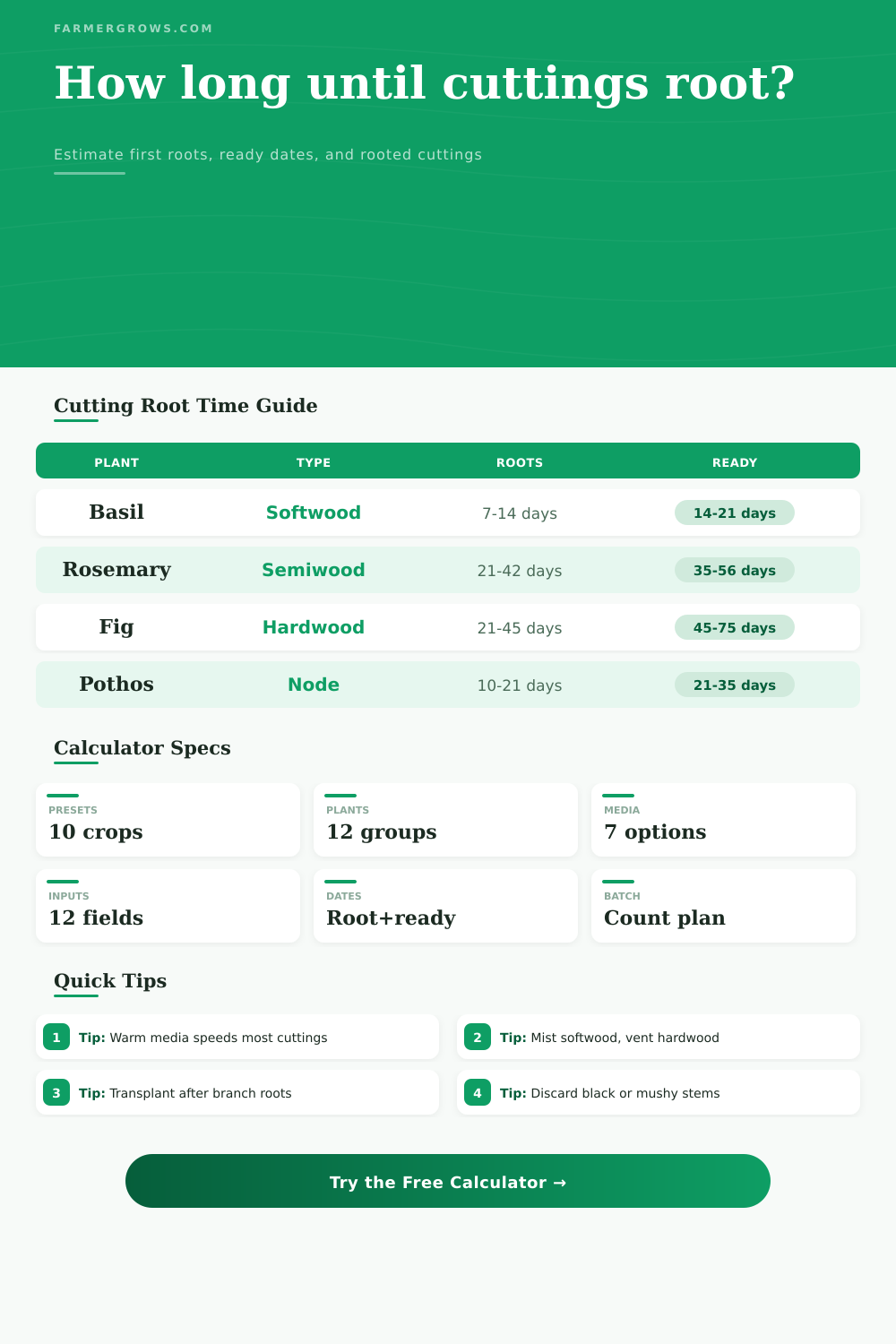
Cutting Root Time Calculator
Estimate when plant cuttings should callus, show first roots, become transplant-ready, and produce a usable number of rooted starts under your propagation conditions.
Choose a common cutting setup, then adjust the propagation media, warmth, humidity, light, hormone, and batch quality for your tray or jar.
Cutting Rooting Estimate
Adjust the setup above to estimate first roots and transplant timing.
Useful for basil, mint, pothos, and tomato, but water roots can stall after potting if left too long.
Excellent air-to-water balance for many herbs, ornamentals, and softwood shrubs under a dome or mist.
Keeps leaves hydrated while callus forms, especially for rose, coleus, and tender tip cuttings.
Dormant fig, grape, and blueberry sticks need longer root building before they can support shoots.
| Plant group | Typical cutting | First roots in good conditions | Transplant-ready range |
|---|---|---|---|
| Basil, mint, coleus | Herbaceous or softwood tips | 5-14 days | 14-28 days after sticking |
| Tomato suckers | Herbaceous stems | 5-10 days | 10-21 days after sticking |
| Pothos and vining houseplants | Single-node or two-node cuttings | 10-21 days | 21-35 days after sticking |
| Rose softwood | Softwood to greenwood stems | 21-42 days | 35-56 days after sticking |
| Rosemary and lavender | Semi-hardwood tips | 21-42 days | 35-63 days after sticking |
| Fig and grape | Dormant hardwood sticks | 14-45 days | 45-75 days after sticking |
| Blueberry | Hardwood or softwood, cultivar dependent | 35-70 days | 70-120 days after sticking |
| Environment factor | Good range | Too low | Too high |
|---|---|---|---|
| Root-zone temperature | 65-75°F for many cuttings | Slow callus and rot risk in wet media | Wilting, pathogen pressure, weak roots |
| Humidity around leaves | 80-95% for softwood; 60-80% for dormant wood | Leaf wilt before roots form | Fungal growth without venting |
| Light duration | 12-16 hours bright indirect light | Slow rooting from low energy | Leaf stress if heat rises under covers |
| Media moisture | Evenly moist with air space | Stem dries before callus forms | Black stems and oxygen-starved bases |
| Rooting medium | Best fit | Water holding | Rooting note |
|---|---|---|---|
| Water jar | Fast herbs and vining houseplants | Very high | Pot up before roots become long and brittle |
| Perlite or vermiculite | Herbs, softwood shrubs, mixed trays | Medium to high | Strong air space helps prevent basal rot |
| Peat/perlite mix | General nursery propagation | Medium | Balanced option when moisture is monitored |
| Seed-starting mix | Tender annuals and vegetables | Medium to high | Use sterile mix and avoid heavy fertilizer |
| Sharp sand or grit bed | Hardwood and Mediterranean cuttings | Low to medium | Drainage is strong but dryness must be watched |
| Rockwool or plugs | Tray systems and controlled propagation | High | Pre-moisten evenly and avoid standing water |
| Readiness sign | What to look for | Best action | What to avoid |
|---|---|---|---|
| Callus only | Swollen pale base, no roots yet | Keep steady moisture and warmth | Potting up too early |
| First white roots | One or two short roots visible | Wait unless water-rooting herbs | Hard tug tests that snap roots |
| Branched root tips | Several roots with small side branches | Harden off humidity, then pot up | Leaving water roots tangled too long |
| New shoot growth | Fresh leaves or buds expanding | Confirm roots before feeding heavily | Assuming top growth means full roots |
Time root checks around the slow end of the window. Clear cups, tray-edge cuttings, or drainage-hole roots are gentler indicators than pulling every cutting to test resistance.
Separate callus from transplant readiness. Woody sticks often swell or leaf out before they can absorb enough water, so wait for branched roots before potting into richer mix.
Soft-wood cell walls is flexible and alive, so the stem ends of these herbs root fast. Woody ones have less active cell walls that needs to callus first. This forms a protective covering for wounded tissue before roots grows.
Many beginning propagators quit here, not realizing there’s an invisible stage called callusing. The calculator accounts for this by dividing it out from rooting interval, allowing for fair guess.
Why Some Plants Root Fast and Some Take Long
Water is less important then temperature in determining rooting rate. For most houseplants and herbs, the ideal rooting zone, where cells divide fastest, is between sixty-five and seventy-five degrees F. High humidity won’t make up for thermal shock if your cuttings is resting on a cool floor. Use a heat mat. Or, set one into rooting tool to adjust its root-zone temperature and see how many extra days you might save.
Soft vs. Hardwood cuttings prefers different moisture levels. With tender tips such as those of tomato suckers or mint, keep them almost soaking wet to ensure that they don’t dry out before their nonexistent roots catches up. Keep these going while the callus develops under some sort of cover that maintains humidity, such as a humidity dome or plastic bag.
Woody plants (like grape or fig) have thicker bark that resist drying out in low humidity, but if it is too moist, they will rot. Humidity levels are included in success rate calculation, rewarding conditions that is less dry than softwood and punishing settings that are to tight for hardwoods.
The other twist: what do you choose as your medium? Woody cuttings needs some air space, like perlite or vermiculite (which also keeps their bottom wet). In water, which is great for quick rooting and seeing what’s happening, their roots is soft and don’t adapt well to life in soil. Often they just stop when transplanted into soil, since that’s a different set-up.
Here’s why this matters: the date when a rooted cutting will be ready depends on your choice of medium. Maybe you’ll get a few more days headstart if you root in water, but then lose more during the transfer. It’s a tradeoff between speed and resilience.
Remember, most people forget that the quality of starting material matters a lot. You want a healthy cutting with fresh nodes that isn’t wilted and has stored energy to spend on developing roots. If its stems are bruised or the tip is already beginning to die back, it has to devote resources to repairing itself before it can grow roots. Tweaking the %viability here in the batch section lets you adjust expected yield so that you don’t plan to optimistically.
Waiting for roots means waiting patiently, not forcefully. It’s tempting to tug at the stem to test resistance; don’t. A gentle tug could of break off tender root hairs and doom the cutting. Look for new top growth and a solid base with no blackness, which is evidence of roots below.
When? The “ready” date on the results shows when its root system should be branched enough to sustain separate lives. It is time to downsize by transplanting them into their own containers and backing off on the humidity.
Propagating isn’t about forcing something to happen against its nature; it’s about providing the right conditions so it can go ahead and do what it wants to do. The wait-and-see part of propagation; the silent weeks between now and then (is still on you).
Provide good care, though: keep the medium consistently moist but not soaked, the air comfortabley warm and not stinky-stagnant. Wait for the roots to say they’re ready, which they will. Eventually. Rosemary just has to get moving first.