Cucumber Seed Viability Calculator
Estimate how many cucumber seeds to sow from seed age, storage temperature, storage humidity, germination test results, warm-soil threshold, seed coating, and direct-seed or transplant plans.
📋Cucumber seed lot presets
Start from a real cucumber sowing situation, then adjust the packet age, storage, test count, soil warmth, and planting layout for your garden.
🥒Seed lot and storage inputs
Use a germination test when you have one. If not, the calculator estimates cucumber seed viability from age, storage temperature, storage humidity, packet condition, and seed coating.
🌱Planting method and warm-soil inputs
Cucumbers are warm-season seeds. Direct-sown seed needs soil that is reliably warm, while transplants need enough extra cells to cover weak seedlings and root-ball losses.
Cucumber seed viability result
Calculated cucumber seed lot summary appears here.
Detailed cucumber seed calculation
🧮Seed lot comparison
These cards compare the age estimate, germination test, storage score, and warm-soil score used in the final sowing recommendation.
📚Cucumber viability reference tables
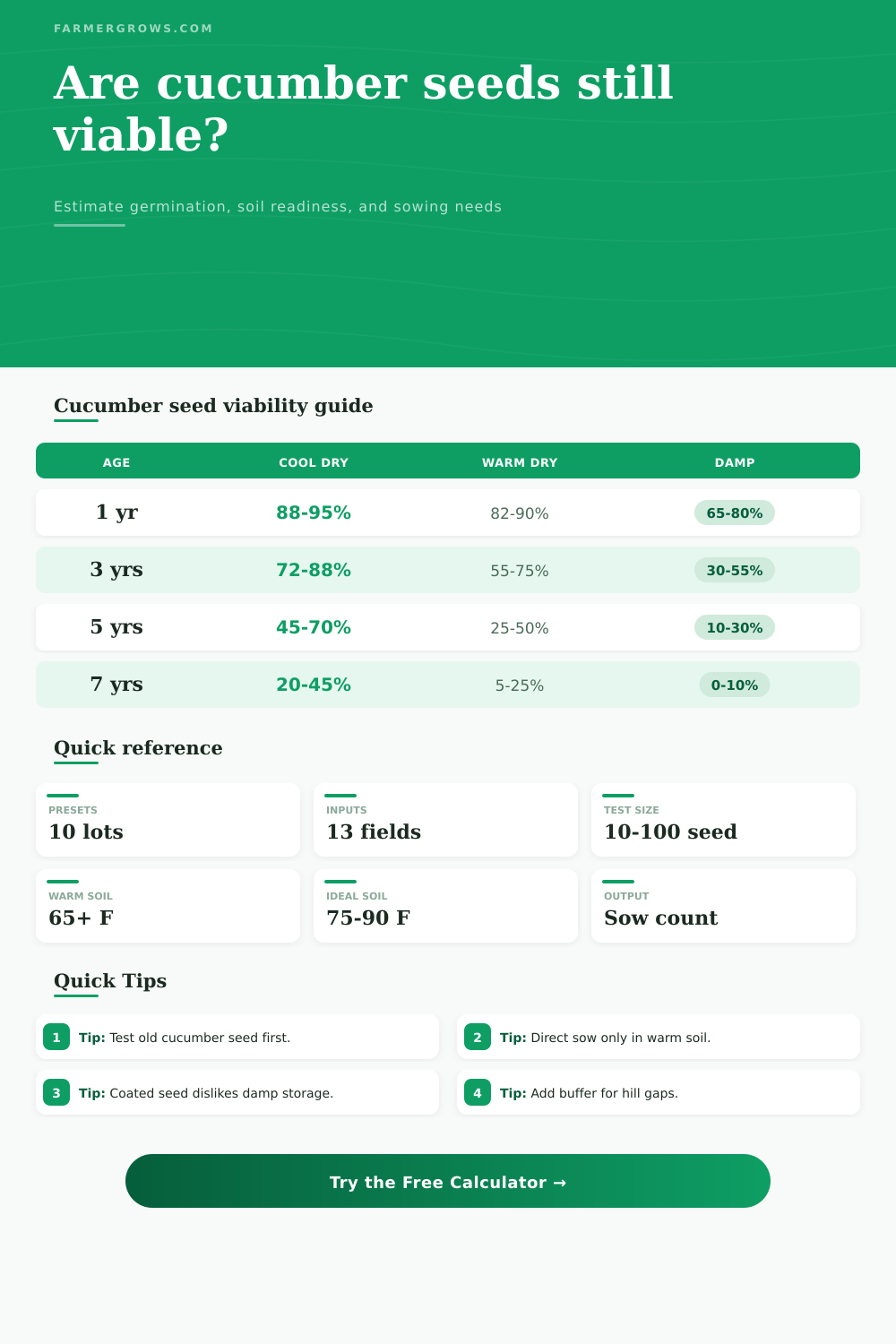
Use these tables to sanity-check old packets, direct sowing decisions, hill counts, and treated or coated cucumber seed lots.
| Seed age | Cool dry storage | Room dry storage | Warm or humid storage |
|---|---|---|---|
| 0 to 1 year | 88% to 95% | 82% to 90% | 65% to 80% |
| 2 to 3 years | 72% to 88% | 55% to 75% | 30% to 55% |
| 4 to 5 years | 45% to 70% | 25% to 50% | 10% to 30% |
| 6 to 7 years | 20% to 45% | 5% to 25% | 0% to 10% |
| 8+ years | Test before planting | Usually weak | Replace for stand crops |
| Soil temperature | Direct sow rating | Expected emergence | Action |
|---|---|---|---|
| Below 55°F | Too cold | Very poor | Wait or start indoors |
| 55°F to 64°F | Risky | Slow and uneven | Use cover or delay |
| 65°F to 69°F | Minimum warm | Fair | Add seed buffer |
| 70°F to 90°F | Strong | Good to excellent | Direct sow normally |
| Over 95°F | Heat stress | Erratic | Shade or cool beds |
| Method | Typical sowing | Keep | Best use |
|---|---|---|---|
| Direct hills | 4 to 6 seeds per hill | 2 to 3 plants | Warm beds, picklers, wide spacing |
| Trellis row | 2 to 3 seeds per station | 1 plant | Slicers, narrow spacing, easy thinning |
| Bush container | 2 to 3 seeds per pot | 1 plant | Patio pots and grow bags |
| Tray cell | 1 to 2 seeds per cell | 1 transplant | Cool nights or controlled starts |
| Greenhouse block | 1 seed plus backup cells | 1 transplant | High-value trained crops |
| Test size | Best for | Confidence | How to use it |
|---|---|---|---|
| 0 seeds | No test | Estimate only | Use age and storage |
| 10 seeds | Small packet | Rough | Add buffer |
| 20 to 25 seeds | Home garden | Useful | Plan hills or cells |
| 50 seeds | Market lot | Strong | Trust test more |
| 100 seeds | Seed saving | High | Compare stored lots |
🧪Coating, storage, and hill planning notes
Cucumber seed tests are most useful around 75°F to 85°F. Count normal sprouts after the expected window, not seed that only swells.
Pelleted, primed, and treated cucumber seed should be kept sealed and dry. Damp storage can damage the coating and the embryo together.
Extra hill seed is insurance. Thin crowded hills to the planned plant count once the strongest seedlings are clear.
Cucumbers dislike root disturbance. If starting cells, sow enough backup cells and transplant before roots circle the plug.
Calculator estimates are planning values for cucumber seed lots. Actual emergence can change with soil crusting, seed depth, diseases, watering, insects, and cultivar differences.
Cucumbers are an impatient crop; they require moisture and warmth. Digging around in a springtime bed and finding nothing to show for the seeds you planted is a form of heartbreak. One factor is that as cucumber seed ages, its viability window tighten each passing year. How long has yours been in storage? Is it last season’s leftover seed or older?
The big question is how many to plant to get a crop. Seed aging is more about storage conditions then just an expiration date. Knowing not just what year seed was harvested but also how it was stored are important. It’s not just guessing; it takes into account different factors such as temperature and humidity. It converts potential loss (which means sowing fewer seeds) into a number based off modeling cumulative exposure over time.
How to Check Your Old Cucumber Seeds
People presume that age is all that counts when your seeds fail to sprout, but really, moisture is far more critical. A packet aged five years in a dry cupboard may actualy outperform one that sat in a garage that got pretty wet during that last year. Cooler and drier conditions are much better for keeping an embryo alive than warmer and moister ones.
Since you can enter those storage temperatures and humidities into the calculator, it will tell you how many seeds to sow based on risk. Don’t just look at expiration date on the pack; think about where it was kept. The other inputs on the form will include whether the seed was treated or coated (pelleted). Commercial seeds is frequently both primed and/or pelleted to help ensure they emerge evenly and quickly, but those processes can be degraded by exposure to moisture. Primed seeds are particularly vulnerable because they were soaked in water before being packed, so changes in humidity during storage can affect whether they grow. Was your pack in a kitchen cabinet beside the range? That coating might of been weakened, compromising what’s beneath it.
To avoid underplanting and having gaps, planting too sparsely, the calculator accounts for such conditions, assuming less germination than the package claims. It also considers soil temperature when sown, since even live seed rot in cold ground. For cucumbers, the soil should be more than sixty-five degrees F when they’re planted; seventy-five to eighty degrees is even better for reliable germination. Sowing too early in cold soil is not just slower going, it’s risky.
Those figures are grounded in reality after running a germination test first; place 20 seeds between two moistened paper towel, and warm them for several days (four to five). Toss aside anything that rots or just swells; count only seeds with shoots and healthy-looking roots. That’s your actual percent viable, which you can enter into the tool.
For instance, if your germination test indicates half of the seeds was alive, you’ll have doubled what the calculator recommends as your sowings. Skipping this part, however, means trusting strictly to theory… Their average age and how long they’ve been stored. Maybe it will work out anyhow; more likely not, and then you haven’t prepared for what is really occuring underground.
Transplanting requires less seed because you don’t have to thin plants or fill holes where seeds failed to grow. Direct sowing require more seed. Dropping in four or six seeds and then thinning them to two or three good plants per hill once they appear is classic hill planting. This method acts as insurance against empty spots, but it wastes seed if the germination rate isn’t high.
With the calculator, you can figure out how many seeds per hill will get you to desired number of plants at harvest time, plus some extra for loss along the way. The idea is to have plenty of plants without crowding them, whether they are pickling cucumbers in wide rows or slicing cucumbers on a trellis. Crowded vines fights each other for light and air, leading to lower yield and inviting disease. How much space? Proper spacing starts with knowing how many seeds you are planting.
CUCUMBERS are no exception: the science of growing cucurbits is all about understanding the biology of the seed (as well as the conditions it will encounter). Decade-old seed stored in a damp shed won’t compare to fresh seed, just as you can’t make cool soil beds act like warm ones. Tackling the math, and applying what we learn to smart sow-when tactics, translates uncertainty into a workable plan. A handful more seeds you decided to sow based off that information might mean the difference between a bounty and barely anything at all. Believe the math, test your stash first, and withhold till the soil warms up before you make that investment.