Cucumber Plants Per 5 Gallon Bucket Calculator
Estimate how many cucumber plants fit in 5-gallon buckets from bucket count, cucumber type, trellis support, root volume, mix depth, spacing, sun, water demand, fertility, and airflow.
Load a common patio, porch, greenhouse, or backyard bucket setup, then adjust the container depth, spacing, support, and season pressure for your own cucumber plan.
Bucket Cucumber Plan
Your cucumber bucket estimate will appear here.
Best for one standard plant or two compact plants when support, water, and airflow are carefully managed.
Gives slicers and English cucumbers more moisture reserve, with less wilting in hot weather.
Drains well and improves oxygen, but may dry faster than a plastic bucket during peak fruiting.
Roots spread wider, spacing can follow variety guidance, and water swings are usually less severe.
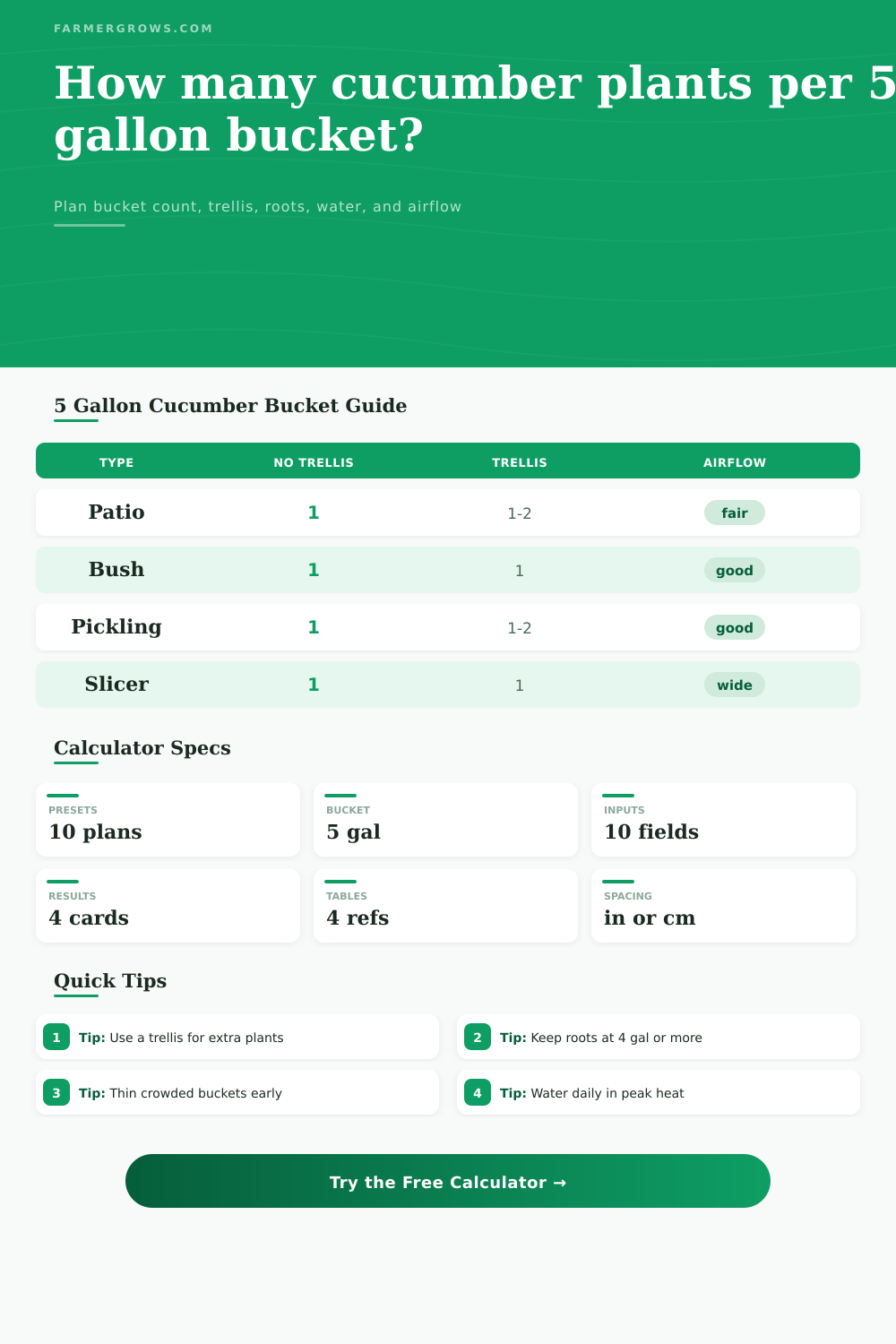
| Cucumber type | Typical 5-gallon count | Trellis need | Bucket note |
|---|---|---|---|
| Patio or dwarf cucumber | 1 plant; 2 only with excellent care | Cage or short trellis | Small vines make this the best candidate for two plants in one bucket. |
| Bush cucumber | 1 plant per bucket | Optional cage | Bushy leaves still need rim space and airflow, so two plants are rarely worth it. |
| Pickling cucumber | 1 plant; 2 if trellised and pruned | Vertical trellis preferred | Short fruit and regular picking can work at higher density with steady feeding. |
| Standard slicing cucumber | 1 plant per bucket | Strong trellis | Use one plant for best root volume, fruit shape, and disease control. |
| English or greenhouse cucumber | 1 plant per bucket | Strong vertical support | Large leaf area and heavy fruit load make extra plants risky in 5 gallons. |
| Mini seedless cucumber | 1 plant; 2 in ideal conditions | Vertical trellis preferred | Can be dense when pruned to a leader and watered very consistently. |
| Usable mix per bucket | Depth clue | Planting effect | Recommended action |
|---|---|---|---|
| Under 3.5 gallons | Shallow fill or false bottom | One small plant at most | Add mix or reduce plant count before transplanting. |
| 3.5 to 4.2 gallons | About 9-11 inches deep | One plant with careful watering | Use compact types and mulch the surface. |
| 4.3 to 4.8 gallons | About 11-13 inches deep | Strong one-plant baseline | Works for most trellised bucket cucumbers. |
| 4.9 to 5.2 gallons | Filled close to the rim | Best chance for two compact plants | Leave watering space and avoid burying the crown. |
| Over 5.2 gallons | Heaped or oversized bucket | Treat as larger than standard | Confirm the actual container size and drainage. |
| Condition | Low pressure | High pressure | Container response |
|---|---|---|---|
| Watering demand | Cool weather, young vines | Peak heat, heavy picking | Higher demand lowers safe density unless daily water is reliable. |
| Fertility strength | Tired mix or weak feed | Lush nitrogen-heavy growth | Steady balanced feeding supports yield without excess leaf crowding. |
| Disease airflow | Open sunny location | Humid wall, corner, or cramped trellis | Poor airflow should cap buckets at one plant even for compact types. |
| Trellis support | No trellis or floppy vines | Strong panel, A-frame, or string | Good support moves leaves upward and opens the bucket rim. |
| Spacing at rim | 8 inches or more | Under 6 inches | Tight crowns reduce airflow and make watering less even. |
| Bucket setup | Plants per bucket | Bucket spacing | Best use |
|---|---|---|---|
| Single standard cucumber | 1 | 18-24 inches between buckets | Slicing, English, vigorous pickling, or uncertain conditions. |
| Two compact cucumbers | 2 | 24-30 inches between buckets | Patio and mini types with pruning, steady water, and strong support. |
| No trellis container row | 1 | 30 inches or more between buckets | Bush plants or trailing vines that need room around the container. |
| Vertical panel line | 1-2 | 18-24 inches along trellis | Pickling or mini cucumbers trained upward and harvested often. |
| Humid greenhouse corner | 1 | 24 inches or more with pruning | Use fewer plants to protect leaves from mildew pressure. |
Thin by week three: If two seedlings are fighting for the same light and rim space, keep the stronger cucumber and remove the extra plant before roots tangle heavily.
Water the full column: Bucket cucumbers fail quickly when only the top inch is wet. Water until the mix is evenly moist and drainage starts, then var excess drain away.
A five gallon bucket, that’s all it takes, right? That’s what you think when imagining a big harvest. There are many cucumber on those sprawling vines. But you have only so much space on your patio. To make up for the lack of room, you want to plant two or three vines in each bucket, get more yield out of less space. And that is usually where things go wrong.
The calculator does the math for you, in your own specific conditions. No need to guess at conversions and coefficients; no need to wonder if your plants will just survive or thrive.
How to Grow Cucumbers in Buckets
The bucket is rated for five gallons of soil, right? No. In fact, you have to subtract the air gap beneath the rim, the drainage holes, and the thinness of those plastic walls. Most people realizes their actual capacity is less than five. So you get to about 4½ gallons, not bad for one plant if your goal were just one plant per pot. If you plan on more than one plant, then you’re even further down from five.
Cucumbers likes consistent moisture and food. Less volume means each gets less. Each gets a portion of what any would require to go wild with fruit set. The risk score in the tool flags this crowding early, warning you before you even break ground. It also alerts you before you sow.
But what happens when you add trellising? It alters the shape. Vines without a vertical structure spread out. What do they do? They gobble up the rim space. They cast shade on lower foliage. They generate a humid microclimate, and that humid microclimate invites fungal problems like powdery mildew.
Choosing a sturdy trellis in the tool provides greater density. It lifts the vines, which means better air circulation around the stems. But it doesn’t provide increased root space by lifting the vines. You’re left with the finite amount underground. And this is where people go wrong. They fix the leaf issue but forget about root starvation.
Watering is another variable that increases with heat. A gallon of water every other day may be enough for a single plant growing in a five-gallon bucket during cool weather. In high summer, however, that same bucket can go bone-dry in just hours. Soak up some sunshine? Yes, it’s relentless. Dry things out fast.
The calculator will guess how much water you’ll want each week based off your conditions. That way you can see if you have an irrigation system set up or enough time to do all that watering. Is the number cruncher telling you you’ll need to water heavily every week? Maybe this isn’t the year for that second plant. Better to cut back a full, fat vine than nurse a limp one back into shape. You won’t take back the damage done by a plant that fried while you were away at work.
The same goes for fertility. Once cucumbers begin to set fruit, they become heavy feeders (especially in pots). A poor diet; whether that’s a weak routine of fertilizers, or a tired potting mix, will spell trouble for the plants. Your feeding strength adjusts the tool’s recommendations accordingly. When there aren’t enough resources in the soil, it makes sure you don’t overplant. There are lots of leaves but no fruit; lush plants that produce nothing is their own sort of failure.
The first line of defense is variety selection. For small areas, select compact patio or bush cukes; in general these do better in high density situations different than more vigorous slicing varieties. Check the type comparison chart on the page for how each size does in confined conditions. A long vine and aggressive slicing cucumber isn’t a good match for the situation. A mini seedless cucumber is closer to that size. Better to choose a plant whose traits suit the confines then try to force a bad fit.
Bucket gardening is all about balance. Not only do plants fit in buckets, but so do their roots, the air, the water…you get the idea. If your support (e.g., trellis) is really sturdy and you have good air flow, you may be able to fit as many as two plants per bucket; then there’s the watering routine to adhere to. On the other hand, if any single component is weak, the whole thing falls apart.
That’s where the tool comes in: it helps you visualize the balancing act. It translates the vague hope of “I’ll grow some stuff” into real planning. If you’re new to this, start simple, with a single healthy plant per bucket. Add more if you like…but you can’t reverse rootbound stress. Aim to harvest steadily rather than letting too many plants crowd each other out. You should of known that earlier.