Cucumber Plants Per Acre Calculator
Estimate cucumber plant population from bed centers, rows per bed, in-row spacing, usable field area, stand percentage, seed buffer, transplant trays, and expected yield.
Use plantable acreage, not the deeded farm size. Headlands, lanes, wash areas, irrigation paths, and skipped wet spots should be removed before calculating seed or transplant needs.
1 Choose a cucumber spacing preset
2 Common cucumber systems
Usually one row per bed with enough air movement for picking crews and disease management.
Shorter in-row spacing and tight row centers can raise plant population for once-over or frequent harvest.
Wider in-row spacing supports canopy access, tying, pruning, and repeated harvest passes.
Two crop lines per bed increase plant sites without changing tractor bed centers.
3 Field size and planting layout
Cucumber planting estimate
Calculated from your spacing, bed layout, and plantable area.
Detailed breakdown
4 Cucumber spacing reference
5 Plants per acre by spacing
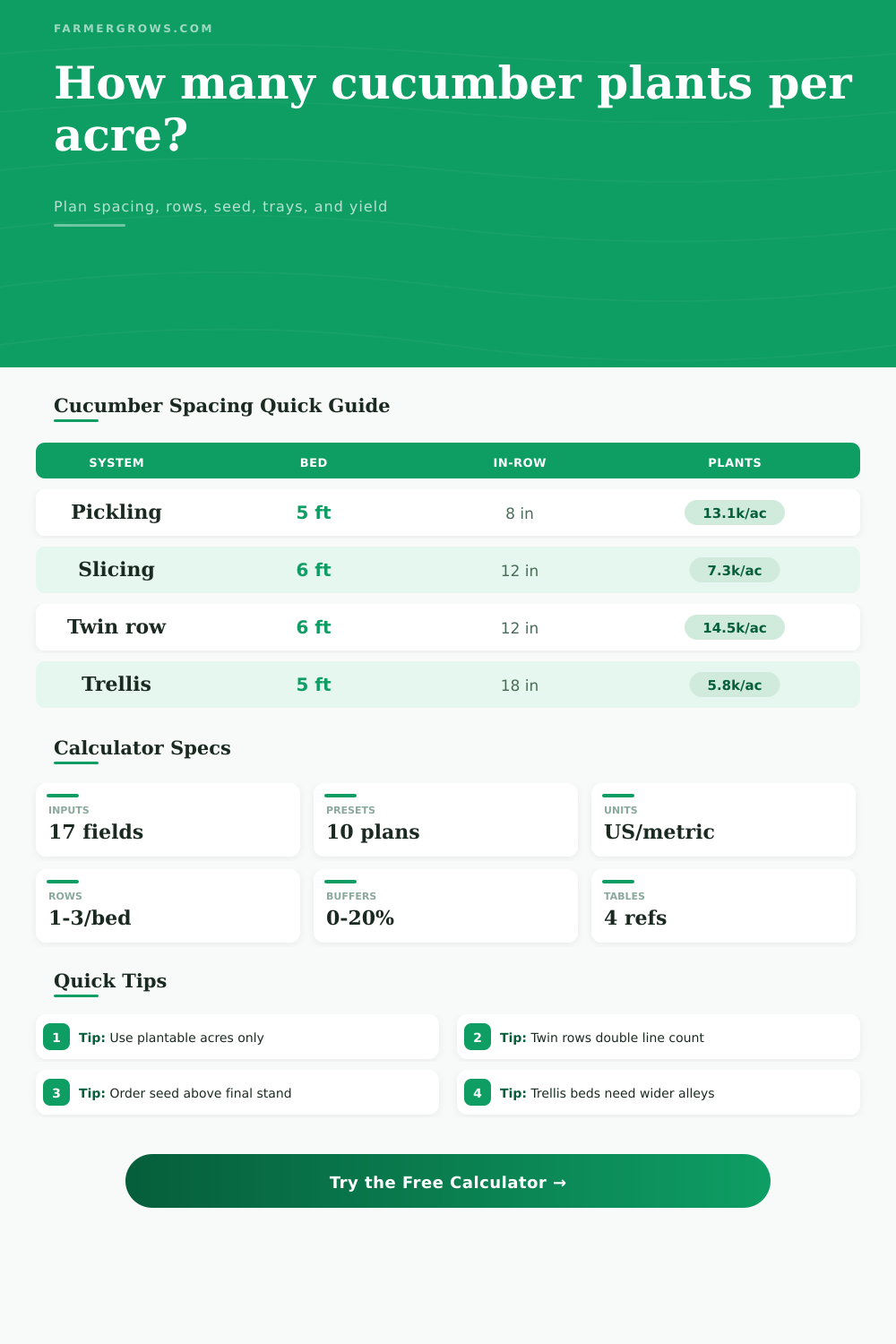
| Bed or row center | Rows per bed | In-row spacing | Plant sites per acre |
|---|---|---|---|
| 5 ft | 1 | 8 in | 13,068 |
| 5 ft | 1 | 12 in | 8,712 |
| 6 ft | 1 | 12 in | 7,260 |
| 6 ft | 2 | 12 in | 14,520 |
| 7 ft | 1 | 18 in | 4,149 |
| 8 ft | 1 | 24 in | 2,723 |
6 Seed, tray, and row-foot formulas
| Planning item | Formula | Use it for | Notes |
|---|---|---|---|
| Plant sites per acre | 43,560 ÷ bed center × rows ÷ in-row ft | Density | Rows per bed multiply crop lines. |
| Net plantable acres | gross area × usable share | Real field count | Removes lanes and headlands. |
| Seed order | sites × seeds per station ÷ germination × buffer | Direct seeding | Round up to full seed pack size. |
| Tray order | sites ÷ tray cells ÷ tray fill × buffer | Transplants | Round up to whole trays. |
| Crop row feet | net area ÷ bed center × rows | Drip tape, trellis, picking | Metric row meters are shown too. |
7 Typical cucumber population targets
| Cucumber use | Typical spacing | Population range | Management note |
|---|---|---|---|
| Fresh slicer on bare ground | 5-6 ft rows, 12-18 in plants | 4,800-8,700/ac | Good air flow lowers leaf disease pressure. |
| Pickling cucumber | 4-5 ft rows, 6-10 in plants | 13,000-26,000/ac | High density suits small fruit and frequent picks. |
| Trellised fresh market | 5-7 ft rows, 16-24 in plants | 3,100-6,500/ac | Lower density leaves room for training and harvest. |
| Twin-row plasticulture | 6 ft beds, 10-18 in plants | 9,700-17,400/ac | Useful where bed centers are fixed. |
| Protected low tunnel | 4-6 ft beds, 12-18 in plants | 4,800-10,900/ac | Ventilation and pollination access still matter. |
8 Example plant counts at common field sizes
| Plantable size | Slicer 6 ft x 12 in | Pickling 5 ft x 8 in | Twin-row 6 ft x 12 in |
|---|---|---|---|
| 0.10 acre | 726 sites | 1,307 sites | 1,452 sites |
| 0.25 acre | 1,815 sites | 3,267 sites | 3,630 sites |
| 0.50 acre | 3,630 sites | 6,534 sites | 7,260 sites |
| 1.00 acre | 7,260 sites | 13,068 sites | 14,520 sites |
| 3.00 acres | 21,780 sites | 39,204 sites | 43,560 sites |
9 Field planning notes
This calculator estimates plant population and planning quantities. Local cultivar habit, disease pressure, fertility, pollination, pruning, harvest interval, and irrigation uniformity can change the best spacing for your farm.
The first time I sowed seeds for cucumbers, I put down so many seeds that I envisioned a plush green carpet to yield more cucumbers than any expert would of dare suggest was sensible. Instead, you grew a steamy jungle of mildew, and the pathetic, stunted fruits shriveled on the vine before they were ripe enough to harvest. Too much density do not equal efficiency in the cucumber patch. It’s a minefield waiting to catch your sprayer wheels in its knotted foliage.
Get the population right. You have to realize that the gaps between each plant is not just a “waste” of space; they are a necessary part of the crop.
Why Space Matters for Cucumbers
Gardeners begin with some estimate of how many plants can be packed into one square foot. Multiply that figure by the number of square feet in an acre. But wait: Your field isn’t a perfectly rectangular shape. There’s room for an irrigation lane, a tractor turning radius, and a couple wet spots where no root want to grow. The calculator does the math when you enter your bed layout; you don’t have to guess at conversions and coefficients. In fact it makes you draw out the plantable area first… The thing most people skip entirely.
Want to buy too much seed? What if you calculate based off five acres of land you own but use only three acres to garden? Then you’ll order too much by forty percent. This tool allow you to input a usable percentage, which removes all the noise. It also ensures your seed order matches the dirt you can actualy work.
The other variable: Spacing is a negotiation between yield and disease pressure. A farmer selling slicing cucumbers at the farmer’s market requires ample aisle space so her pickers can rush about without bashing any fruit. The plants require air flow, too, to dry their foliage if she irrigates in the evenings.
With pickling cukes, which might be picked by a big crew or even mechanically, the emphasis shifts to maximum biomass per unit area. Generally speaking, the more plant the better. They can be planted closer together because each plant doesn’t count for much as long as there are plenty of them. That’s what the chart on that page illustrates, how you can go twice as heavy with your cucumber plants but maintain same bed centers if you shift your system toward pickling. The loss of individual plant size is balanced against gain in overall output.
But then there’s the issue of whether you’re growing from seed or transplants, which also impact the math. With direct sowing, you need a safety margin if some seeds don’t come up. Even the best seeds won’t always touch the soil perfectly. A few will end up buried too deeply; others not deeply enough; still others won’t wake up when they should. You can specify your expected actual number of plants by adjusting the “expected final stand” on the calculator, and it takes that into account. If you expect only 90 percent success rate, say, it will add an extra ten percent to your seed purchase, preventing that panicky moment in mid-season when you realize there are holes in the rows where nobody has grown.
Growing from transplants eliminates much of this risk… But creates another equation: all those trays. How many do you need to order? Enough, but not more than you’ll use, or else what happens with the rest besides sitting in your closet getting brittle with age?
There’s another wrinkle: trellises. Growing up vertically gets the fruit out of the dirt and helps air circulate to limit disease. But it demand more space between plants within the row, space for each vine to climb, and for a harvester to reach its fruit. When you check a trellis system, the calculator notes this by reducing the number of plants per row because you are paying for both width and height. It is a bit of a tradeoff, but it usually pays off with a longer harvest window and higher-quality fruit.
And then there’s the question of harvest window: How fast do these plants produce? Can they handle higher densities, or would that mean leaving them in the ground for several more months with no breathing space? The plant density per acre will be too high if you are growing a long-season crop that shades the late fruit and exhausts the soil of all its goodies.
You can see how it works, and it even projects yields given your assumptions about what you’ve put in. No, not just plants; it estimates weight of the harvest those plants can realistically support. Cuke cultivation is more about providing room and less about cramming them in. Your eyes are the gauge of success; the numbers will tell you how many seeds to order. Plan on starting, then keep the distance, and let them grow into their own skins. Yes, that blank area between plants is what produces the harvest.