Cucumber Plants Per Person Calculator
Estimate how many cucumber plants to grow for fresh eating, refrigerator pickles, full pickling batches, trellised vines, bush types, succession sowings, losses, spacing, and harvest length.
Cucumber plant count depends on household appetite, cucumber type, support method, expected pounds per plant, harvest weeks, losses from beetles or mildew, and whether you plant one big crop or stagger sowings. Use the presets as starting points, then tune the numbers for your garden.
Your Cucumber Planting Plan
Rounded up for whole plants, succession sets, expected losses, and realistic garden spacing.
| Type | Common goal | Typical lb per plant | Best spacing note |
|---|---|---|---|
| Vining slicer | Fresh salads and slicing | 8 to 15 lb | Train on a trellis at 12 to 18 inches apart. |
| Pickling cucumber | Small fruit for jars | 6 to 12 lb | Pick often at 3 to 5 inches to keep plants producing. |
| Mini or snack cucumber | Lunchbox and fresh snacking | 4 to 10 lb | Use close trellis spacing if vines are compact. |
| English or greenhouse | Long slicing fruit | 10 to 20 lb | Single-leader training can support high yield. |
| Bush cucumber | Containers and patios | 3 to 7 lb | Give wider ground spacing or a large container. |
| Household cucumber use | Pounds per person | Plants per person | Planning note |
|---|---|---|---|
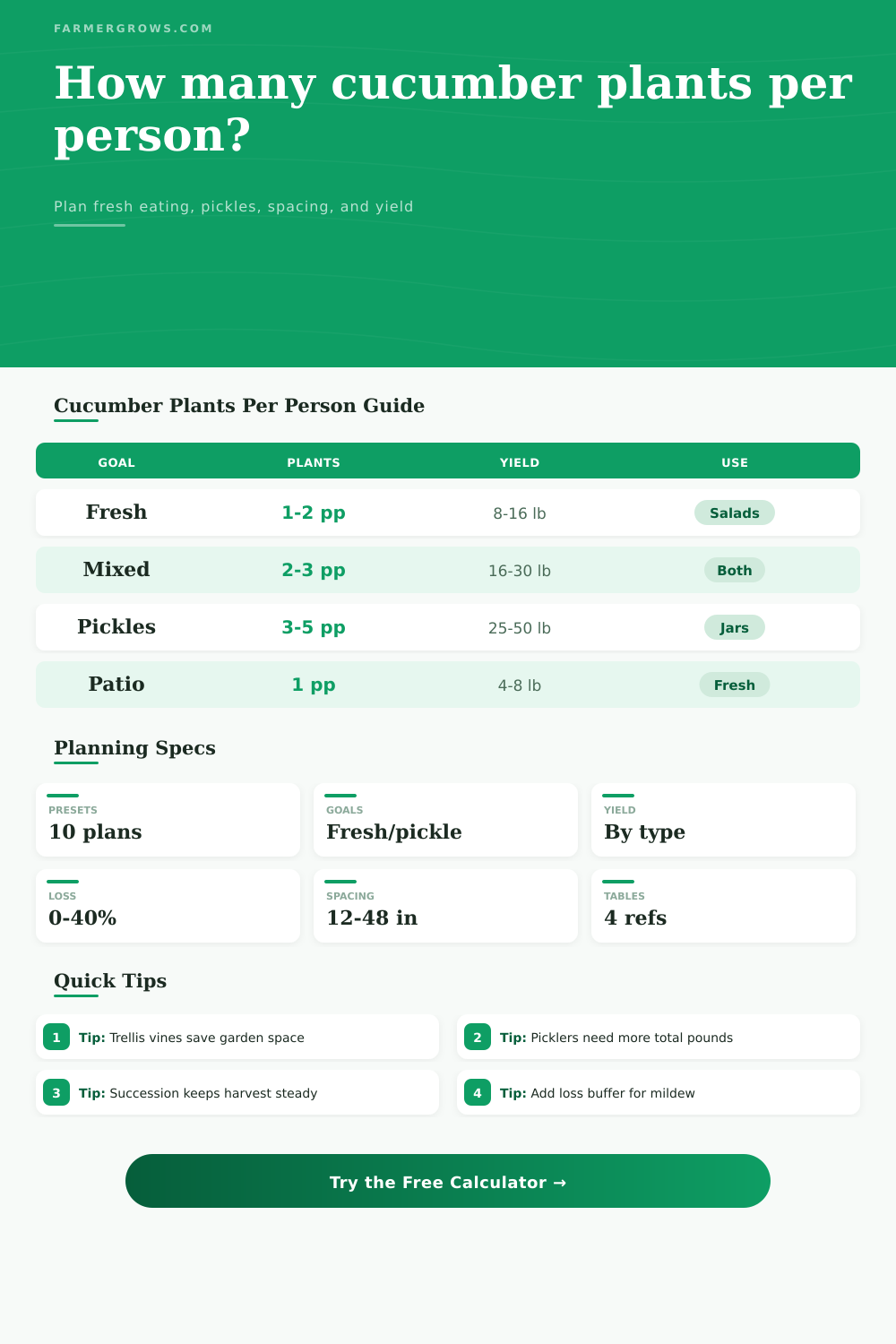
| Light fresh eating | 5 to 10 lb | 1 plant | Good for occasional salads and sandwiches. |
| Steady fresh eating | 10 to 18 lb | 1 to 2 plants | Best with frequent picking and trellis support. |
| Fresh plus refrigerator pickles | 18 to 30 lb | 2 to 3 plants | Use one or two succession sowings for steady fruit. |
| Regular canning or fermenting | 30 to 50 lb | 3 to 5 plants | Pickling types and staggered sowings improve batch timing. |
| Sharing harvests | 50 lb or more | 5 or more plants | Plan extra trellis length and disease-resistant varieties. |
| Growing method | In-row spacing | Row spacing | Space per plant |
|---|---|---|---|
| Trellised vining cucumbers | 12 to 18 in | 30 to 36 in | 2.5 to 4.5 sq ft |
| Low fence or partial support | 18 to 24 in | 36 to 48 in | 4.5 to 8 sq ft |
| Sprawling vines | 30 to 48 in | 48 to 72 in | 10 to 24 sq ft |
| Bush cucumbers | 24 to 36 in | 36 to 48 in | 6 to 12 sq ft |
| Large patio container | 1 plant per pot | n/a | 5 gal or larger |
| Plantings | Best use | Spacing between sowings | Harvest effect |
|---|---|---|---|
| 1 planting | Small fresh harvest | None | One main flush with a shorter peak. |
| 2 plantings | Fresh plus some pickles | 3 to 4 weeks | Extends harvest and reduces summer gaps. |
| 3 plantings | Pickling batches | 2 to 3 weeks | Creates overlapping fruit for jars and ferments. |
| 4 or more plantings | Market or sharing harvest | 2 weeks | Requires more space, seed, and regular picking. |
Trellis first when space is tight: Vertical cucumbers usually need less ground area, keep fruit straighter and cleaner, and make daily picking easier. If you do not trellis, increase spacing and expect more garden area per plant.
Use loss buffer honestly: Cucumber beetles, powdery mildew, heat stress, and missed picking can reduce usable harvest. A 10 to 25 percent buffer is realistic for many home gardens.
Are you tempted to sow too many cucumber? Picture it: crunchy salads every day, and then pickles in winter. Buy your seeds and sow them freely. Usually what happens: a brief flurry of bounty, and then weeks or months of yawns. Yes, those vines gets big, but so does the bitterness of the fruit. It was too much of a good thing.
It is not realy because you didn’t do enough, though. You failed to account for how much one strong cucumber plant will yield. Trellised vines makes a LOT of fruit, and most home gardeners don’t have any idea. Ten to fifteen pounds per vine is typical for a well-tended slicing cucumber. Multiply that by two (or more…) plants per person, assuming they’re for fresh eating, and that’s a lot of salad. Unless you expect to give most of it away, three plant is overkill.
How Many Cucumber Plants to Grow
Use the calculator to adjust your appetite to the biology of the beast. Stop wasting soil with vines you’ll never get your money’s worth out of. Turn craving fresh cucumbers into how many starts you need. If you’re growing pickling cucumbers instead of fresh-eating ones, it will adjust again. Each jar holds fewer pounds of pickles because they are smaller. This means you will need more plants to get enough fruit to fill same number of jars.
And since picklers grow fast; whether you ferment them for the pantry or make refrigerator pickles… You’ll have to consider their growth rate when planning your goal. For example, a two-medium-slicer-a-week variety may give you 6 little picklers. The goal is to achieve a certain batch weight. You can toggle from one of those goals back and forth in the tool, and it recalibrates based off what kind of crop you plan to grow.
Other variables like spacing also become an issue. Vines spread out and require a lot of space. Left growing on the ground, they will occupy twenty square feet of garden bed space. Twenty! In a small yard, that’s some pricey real estate.
Growing them upward using a trellis changes this calculation. You could pack in as many plants in one-quarter the space. Your chosen support method goes into the calculator. Using a trellis lowers the amount of square footage each plant take up. This is a big deal when every inch counts, such as with patio or raised bed.
And then there’s the other side of it: loss. Loss means that no garden is perfect. Things happen, heat waves stress the plants; beetles show up; mildew appears. To assume a zero-percent loss rate is optimistic to the point of foolishness. A buffer of fifteen to twenty percent allows for losses (plants that don’t thrive) and rot (fruit that doesn’t make it off the vine). This allows you to reach your harvest target.
The tool includes this buffer in the final plant count. Instead of giving you the most seeds you could possibly plant, it gives you a more realistic number.
The secret weapon is succession planting. Each cucumber vine reaches its peak production period typicaly within a month or so. This is roughly four to six weeks. Then it tapers off. You can’t count on just one sowing if you’re after cucumbers all summer long. By planting at different times, you get a steady supply of cucumbers.
Split up how many plants you plan to grow and make multiple sowings. That not only prolongs the harvest, but also stretches out the work time. You will have no more mid-summer glut or later-onset drought.
How many? What kind? Cucumbers come in many varieties. Minis and English cucumbers are two extremes. Within every variety, there is bush options for convenience in pots or vining options for higher production. Depending on the variety, you might get more cucumbers, fewer cucumbers, or smaller ones with fewer per plant overall. The reference table on the page details these variations, so you know what to anticipate from each variety.
Adjust your expectations. You will still deal with weather, pests, and soil conditions. They’ll cope with soil and weather and maybe even some pests. Planning doesn’t mean controlling things. It means eliminating the guesswork. Knowing you have enough plants eliminates the pressure. You no longer plant by hope but by data. A garden works for you, not against you.
You get the fresh crunch you had in mind. Those pickles you’d planned on. And you have room to plant something else, too. That’s the victory. It is not that you’re growing more cucumbers. You should of grown just the right amount.