Cucumber Plant Lifespan Calculator
Estimate cucumber first harvest, peak picking window, plant decline, replacement timing, and next succession date from plant type, planting method, disease pressure, heat stress, trellising, and harvest rhythm.
📋Cucumber lifespan presets
Start with real cucumber production situations: early bush rows, trellised slicers, parthenocarpic tunnel vines, direct-seeded picklers, beetle pressure, powdery mildew, heat waves, and planned successions.
🥒Planting, cucumber type, and first harvest
Use the date the crop was seeded outdoors or transplanted into its final bed. Transplants receive a partial age credit because cucumber roots slow down after moving.
🌡Growing conditions and decline pressure
Cucumber lifespan usually ends from leaf disease, heat stress, cucumber beetle feeding, moisture swings, or exhausted vines. Trellising and steady harvest stretch the productive window.
📅Harvest rhythm and succession plan
Frequent picking keeps cucumbers in production. The succession recommendation uses the next planting method to place a replacement crop before the current vines fall below useful yield.
Cucumber harvest and replacement estimate
Calculated from cucumber type, planting method, disease pressure, heat stress, trellising, and harvest rhythm.
Calculation breakdown
📊Current crop signals
First harvest drivers
Window reducers
Extension factors
📚Cucumber lifespan reference tables
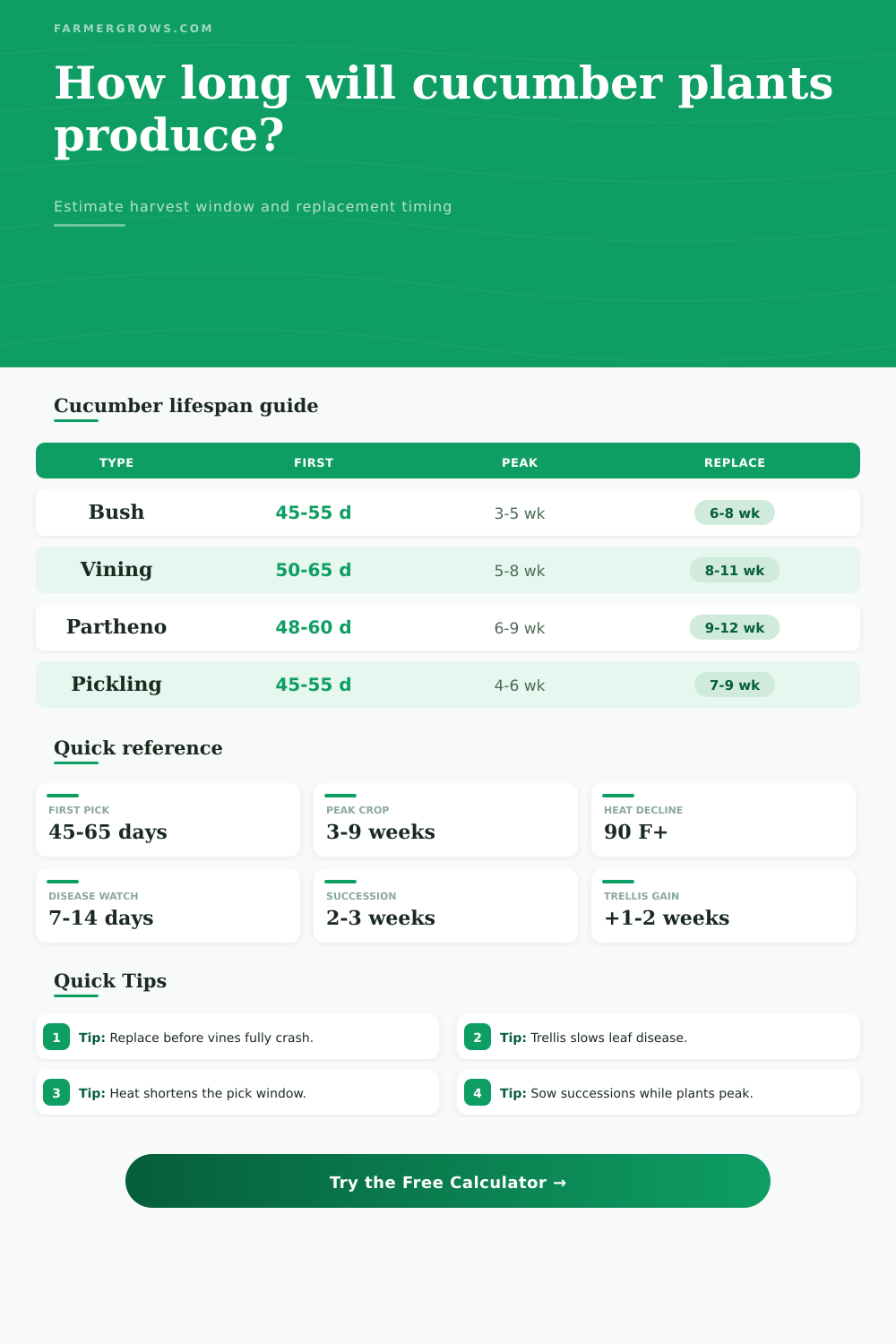
| Type | First harvest | Peak window | Lifespan notes |
|---|---|---|---|
| Bush slicer | 45-55 days | 3-5 weeks | Compact, early, usually finishes fast. |
| Vining slicer | 50-65 days | 5-8 weeks | Longer when trellised and picked often. |
| Pickling cucumber | 45-55 days | 4-6 weeks | Heavy set, frequent harvest needed. |
| Parthenocarpic | 48-60 days | 6-9 weeks | Best in protected culture or steady weather. |
| Pressure | Low | Moderate | High |
|---|---|---|---|
| Powdery mildew | 0 weeks | -1 week | -2 to -4 weeks |
| Heat over 90°F | 0-1 day | -1 week | -2 weeks |
| Cucumber beetles | 0 weeks | -0.5 week | -1.5 weeks |
| Water swings | 0 weeks | -0.5 week | -1 to -2 weeks |
| Goal | Direct seed | Transplants | Use when |
|---|---|---|---|
| No gap | 3-4 weeks after first crop | Start cells at first flowers | Warm summer garden. |
| Short gap | 4-5 weeks after first crop | Start 2-3 weeks before decline | Limited bed space. |
| Disease escape | Before mildew spreads | Use clean new site | Humid regions. |
| Fall crop | Count back 60 days | Count back 45 days | Before cool nights. |
| Signal | Keep picking | Start next crop | Replace |
|---|---|---|---|
| New flowers | Many fresh flowers | Fewer female blooms | Mostly male or none |
| Leaf canopy | Green, open airflow | Lower leaves spotted | Canopy collapsing |
| Fruit shape | Straight, filling well | More curved fruit | Bitter or misshapen |
| Harvest rate | Steady daily picks | Half of peak | Few marketable fruit |
For steady cucumbers, start the next crop while the current vines are still producing well, not after leaves collapse.
Vertical cucumbers usually last longer because leaves dry faster, fruit stays cleaner, and harvests are easier to keep frequent.
When downy mildew or bacterial wilt is active, replacement timing should follow crop health more than catalog days.
During long hot spells, expect shorter peak harvests and plan successions tighter than spring or protected-culture crops.
There’s always a certain moment in the summer where your cucumber patch run out of steam. The vines is still alive and green, but somehow, the cucumbers turn small and crooked. Where will you find a straight one now? Will it ever happen? Is it just the naturaly life span of the cucumber plants? Not quite.
Here’s what you need to know: While peppers, tomatoes, and other vegetable can be marathon runners, cucumbers is more like sprinters. Cucumbers only produce for so long. This depend on their genetics, heat, disease pressure, and whether or not you’ve harvested them enough.
Why Your Cucumber Plants Stop Producing
With just your location plugged into the calculator above (and which method of growing you used), it do the math for you. It eliminates the guessing, is today the day I yank out the vines, or should I give it another week? And it takes into account things like trellising (which slows down growth and prolongs vines) versus ground sprawl (which hastens vine decline due to heat stress). All these inputs are important. A vining variety growing up a vertical string in the greenhouse won’t behave the same than a bush variety grown right in the ground.
Plus: The tool calculate your earliest possible date to pick, along with the peak period for picking, providing a concrete timeline so you don’t have this vague sense of “when is it going to start petering out?”
The most frequent cause of a shortened season are heat, even if everything looks fine on the surface. Heat typically pushes beyond 90°F, which causes cucumber flowers not to set fruit. The existing foliage cook off too quickly to replace itself with new. Thermal stress reduce your productive window substantialy, sometimes reducing it by several weeks versus a mild spring. The calculator take that into account, allowing you to enter the average high temp in each week. Know your fate if you are hot: Plan for your peak harvest to come in fast and furious, but in a shorter time. That means tight succession planting to fill up fridge.
The other silent killer is disease, specifically powdery mildew. That begins as white dust on the foliage and then runs amok when conditions become humid. Even healthy vine will tolerate it for some time, but stressed vines succumb quickly. The trellis helps in that regard; it increase air flow so leaves can dry faster after being watered or rained on. Damp, tangled-up foliage is a lot easier for fungal spores to grab onto than dry foliage. If they’re sprawled on the ground, you’re fighting an uphill battle with poor ventilation and lots of leaf contact. Keep the canopy clean, and you buy yourself extra weeks of production by lifting them up.
Harvest rhythm is a surprisingly large factor in how long your plants last. If you leave fruit on the vine long enough, the plant ‘thinks’ it’s succeeded in reproduction and sends no more energy to flowers but focuses entirely on ripening the already oversize fruit. This stress the vine, and also slows overall production. Pick often; ideally daily in high season, and every other day otherwise; and trick the plant into thinking it’s succeeding in reproduction; it’ll keep trying. One of the quickest ways to abort the season early is to neglect harvest.
Professional growers don’t wait each time to get a vine up and going from scratch. Instead, they succession plant by sowing another row when the previous one start to fade, or by starting more plants from seed while their predecessors are still providing good pickings. They keep up this way so that you never have an empty moment in your harvest calendar.
When? Use transplants as soon as they is big enough to handle them, or use direct-sowing once the soil can be worked. How many spots do you have room for? Faded leaves are not the only signs that it is time to act. Knowing these other signs will tell you whether you should of pulled out a crop and try again. For example, you might see this if the new fruit is consistently bitter or oddly shaped. Waiting till the vines turn totally brown and die out means you’ve wasted weeks of harvest potential. By keeping tabs on disease pressure and noting the date of your earliest pick, you’ll be able to plan the replanting right when it’s necessary.
That will turn a chaotic summer garden into a reliable source of fresh cucumbers from early June through late September. Yes, it takes watching, but oh, those straight-up crisp fruits instead of bitter disappointment. Knowing what’s really going on under the surface, beyond just how the vines look, is key.