Cubic Yard of Compost Weight Calculator
Estimate compost weight from cubic yards, feedstock, moisture, screen size, bulk density, maturity, amendment rate, coverage area, overage, and hauling capacity.
Choose a compost job to load realistic starting values, then fine tune the yardage, moisture, density, and application rate for your pile or delivery.
Compost Weight Estimate
Enter compost volume and density details to estimate weight.
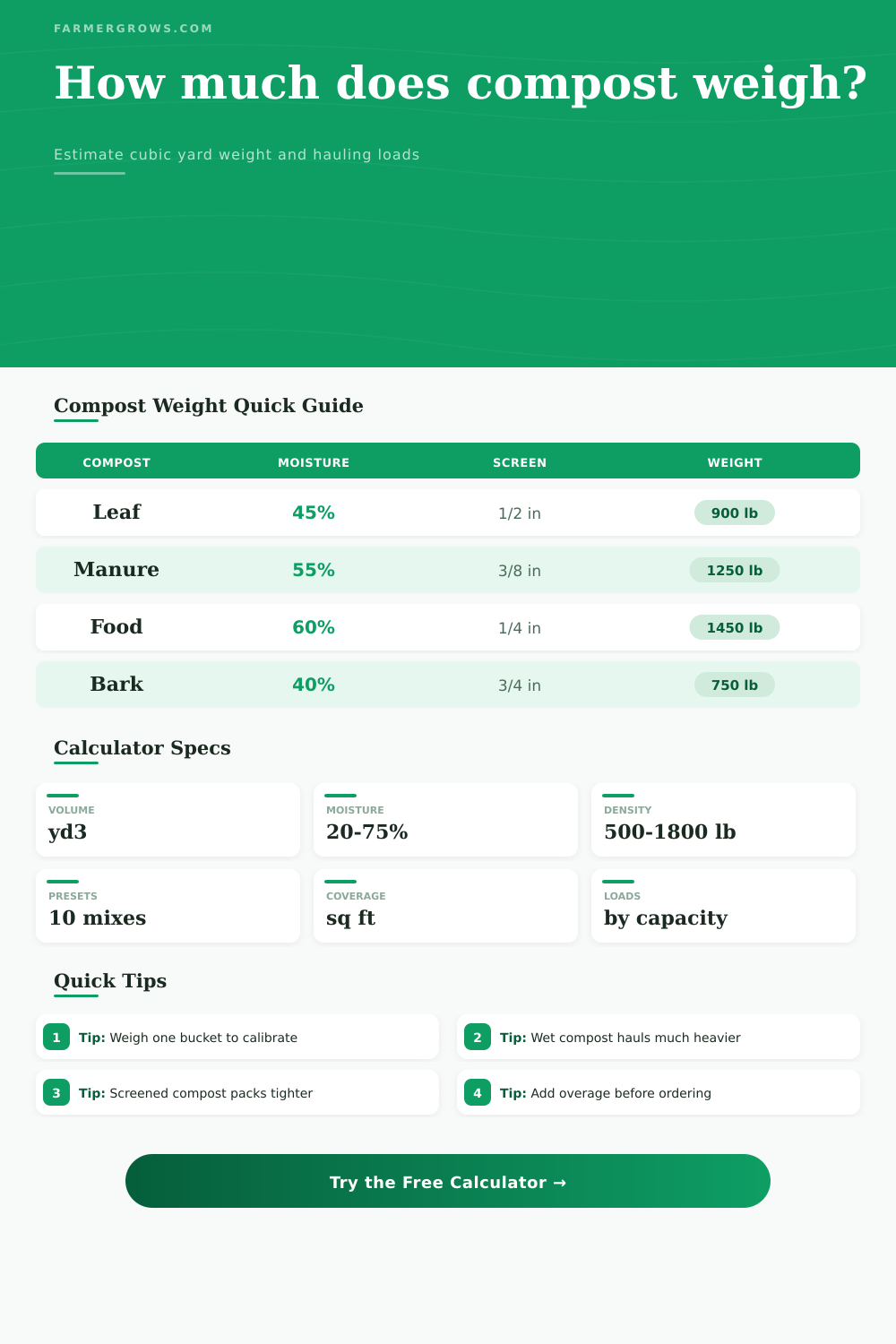
Leaf-based compost is often lighter because the feedstock has more fibrous structure and more air space after curing.
A general landscape compost range for grass, leaves, brush fines, and municipal yard trimmings after screening.
Manure-based compost usually carries higher mineral content and moisture, so loader buckets can get heavy quickly.
Food residual compost can be dense when wet and fine screened. Check trailer payload before taking a full yardage load.
| Moisture reading | Weight effect | Handling cue | Best use |
|---|---|---|---|
| 25% to 35% | Lighter than typical | May blow or spread unevenly | Blending into potting mixes |
| 40% to 55% | Normal field range | Holds shape when squeezed | Beds, lawns, and orchards |
| 56% to 65% | Heavy as delivered | Check dump bed payload | Immediate field spreading |
| Above 65% | Very heavy and wet | Drain or mix before hauling | Only when site access is firm |
| Application depth | Sq ft per yd³ | Common compost use | Weight note at 1,000 lb/yd³ |
|---|---|---|---|
| 1/4 inch | 1,296 sq ft | Lawn topdressing | About 0.77 lb per sq ft |
| 1/2 inch | 648 sq ft | Annual bed refresh | About 1.54 lb per sq ft |
| 1 inch | 324 sq ft | New garden bed top layer | About 3.09 lb per sq ft |
| 2 inches | 162 sq ft | Soil building application | About 6.17 lb per sq ft |
| 3 inches | 108 sq ft | Heavy raised bed fill | About 9.26 lb per sq ft |
| Vehicle or container | Practical payload | Yards at 900 lb/yd³ | Yards at 1,400 lb/yd³ |
|---|---|---|---|
| Small pickup bed | 1,000 to 1,500 lb | 1.1 to 1.7 yd³ | 0.7 to 1.1 yd³ |
| Half-ton pickup | 1,500 to 2,000 lb | 1.7 to 2.2 yd³ | 1.1 to 1.4 yd³ |
| Utility trailer | 2,000 to 3,500 lb | 2.2 to 3.9 yd³ | 1.4 to 2.5 yd³ |
| Dump trailer | 5,000 to 10,000 lb | 5.6 to 11.1 yd³ | 3.6 to 7.1 yd³ |
| Project | Area and rate | Cubic yards | Estimated weight range |
|---|---|---|---|
| Four raised beds | 256 sq ft at 1 inch | 0.8 yd³ | 640 to 1,120 lb |
| Small lawn topdress | 2,500 sq ft at 1/4 inch | 1.9 yd³ | 1,520 to 2,660 lb |
| Market garden strip | 5,000 sq ft at 1/2 inch | 7.7 yd³ | 6,160 to 10,780 lb |
| New vegetable plot | 1,000 sq ft at 2 inches | 6.2 yd³ | 4,960 to 8,680 lb |
Calibrate density when payload matters. Fill a 5 gallon bucket level with the same compost, weigh it, subtract the bucket, then multiply pounds per bucket by about 40.4 for lb per cubic yard.
Plan hauling from wet weight. Compost ordered by volume is often loaded wet. Use the high moisture estimate before driving on soft soil or loading a pickup near its rating.
You ask the supplier for four cubic yards of compost. They send a truck and a bill. You attempt to raise a shovel full, and understand why they has those heavy-duty tires on the truck. Compost is dirt-looking stuff…but far heavier. All the more so if it’s damp.
A yard is volume measurement, not a weight measurement. The difference between two makes for a busted pickup axle. Or, it makes for a pleasant afternoon in the garden. That’s where the calculator here comes in; it help connect yards to real-life pounds, and loads.
Why Compost Weight Is Important
Variables can make one yard seem heavy; another seem light. Water is the single largest variable. Heavier compost with more water mean more weight. Fluffier compost with less water weigh less. The bulk density change depending on how wet or dry your compost is.
You don’t need a lab for that. A bucket will tell you if it’s too heavy to be wrung out with gloves on, and the moisture reading jump several hundred pounds/yard as you go from 40 percent to 60 percent. The tool adjusts the bulk density according to the moisture percentage you input.
Why? Because suppliers often sell by volume while you pay for weight with your back or your truck capacity. If you neglect to account for moisture weight, you may accidentaly order more than you can fit into your trailer. Compost is usually sold by volume and paid for by the pound… Either in your truck, or on your back.
If you neglect to account for the moisture weight, you may accidentally order more then you can fit into your trailer. Another thing that throws people off: How finely screened is it?
The compost is coarse, with leaves and other large bits in it. There is lots of air space among all that material. Air are light. Push the same stuff through a quarter-inch fine screen. No more voids. It compact into a tighter mass. That’s why there’s a screen size option on the calculator.
Even if you’re starting from exact same material, a coarse landscape screen will weigh less per yard than a finer garden one. Same organic matter, only squished.
There’s also the factor of maturity. Material that comes off an actively steaming heap is still light and fluffy. It is not settled. Compost taken out of a stockpile, which has aged for months, will be denser. To account for this fact, the tool include multipliers for maturity. Take fresh windrow material; expect a lighter load than if you’re going to an old pile tucked away at the back of yard somewhere.
You can see how different feedstocks (like manure versus leaf mold) vary by base density in the reference tables on the page. Manure blends is heavier because they pack down tightly as the mineral content and other small particles settle. Leaves are fibrous and contain air, so leaf mold are lighter by nature.
The math comes into play here for your wallet: you need to plan out how much coverage you want and how much material to purchase. How thick do you want things covered? Topdress lawns with a half inch or less. Do you want to build up raised beds and improve their soil? Plan on two inches.
The calculator calculates your rate and area, then tell you whether you’ve got sufficient material. And it includes a buffer for overage.
Spreading isn’t exact. You always lose some to spillage, uneven ground, or simply because of the wind. Add ten percent onto your estimated volume. That way you’ll avoid having that uncomfortable “we’re-out-of-material” conversation mid-job. You should of planned for more.
The last limiting factor is hauling capacity. If you are using a standard half-ton pickup, your payload limit is around two thousand pounds (which might only be one and a half yards of wet manure compost). Maybe three yard of dry leaf mold. How much can your truck carry? Once you know, you’ll know if you need to make one trip or two. Save time; protect your vehicle.
You can plug in your truck capacity or your trailer capacity into the tool to figure out how many loads you’re facing. It eliminates the guessing on the logistics side.
It all comes down to knowing that what you measure really matters. Space equals volume. Mass equals weight. The mass within the same space (with varying amounts of moisture, density, and maybe some screening mixed in) affect the mass in another way entirely. Don’t take for granted a yard is a yard. If you can borrow a bucket… weigh it out. Compare that measurement to what you know. That is far better than an estimate.
From there you can figure the rest of the plan. How much do I need to order? How do I spread it around? How much can I fit in my truck to haul it home? It turns the chaos of delivery into a well-planned project.