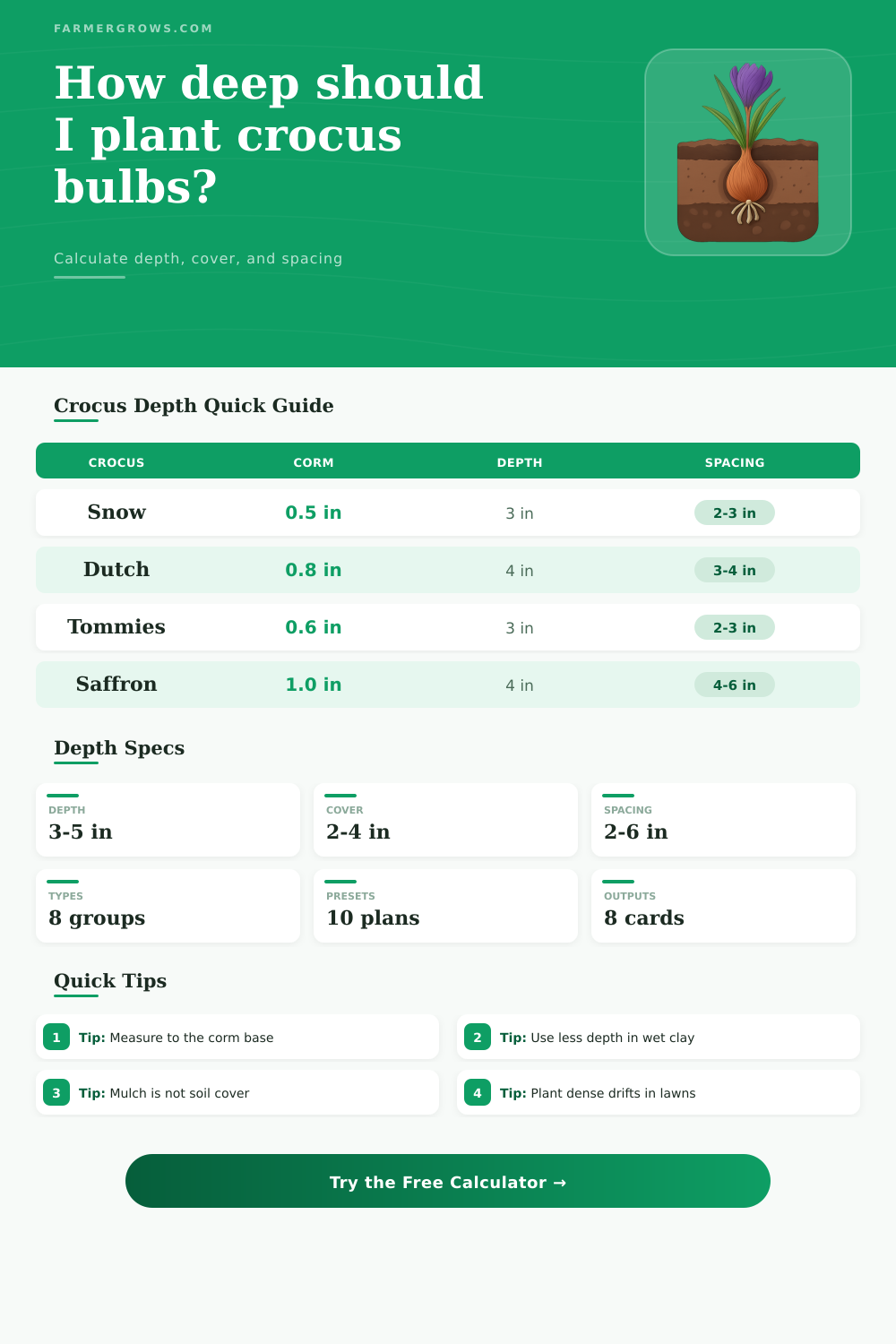
Crocus Bulb Planting Depth Calculator
Estimate crocus corm hole depth, soil cover, spacing density, planting quantity, soil removed, mulch allowance, container clearance, and frost-heave risk for spring, fall, lawn, border, and saffron crocus plantings.
Crocus depth is best measured from the finished soil surface down to the base of the corm. This calculator also shows soil cover above the corm top because small crocus corms can be planted too shallow in cold, loose, or lawn soils.
📋Crocus Planting Presets
⚖Depth Method Quick Guide
Total depth from the finished soil surface to the corm base after the corm is set point side up.
Soil above the corm tip. Mulch is tracked separately because it settles and does not replace firm soil cover.
Cold zones and exposed lawns usually need a deeper anchor or mulch to limit freeze-thaw lifting.
Crocus displays look best in clusters, so this calculator converts spacing and area into an estimated corm count.
⚙Crocus Depth Inputs
Crocus Planting Depth Results
Your recommended crocus planting depth will appear here.
🌼Crocus Reference Cards
📘Depth And Spacing Tables
Crocus type depth guide
| Crocus group | Typical corm | Base depth | Common spacing | Best use |
|---|---|---|---|---|
| Snow crocus | 0.4-0.6 in tall | 2.5-3.5 in | 2-3 in | Lawns, early pollinator patches, rock gardens |
| Large Dutch crocus | 0.7-0.9 in tall | 3.5-4.5 in | 3-4 in | Borders, patio beds, formal color blocks |
| Crocus tommasinianus | 0.5-0.7 in tall | 3-4 in | 2-3 in | Naturalized drifts and under deciduous trees |
| Saffron crocus | 0.9-1.2 in tall | 4-5 in | 4-6 in | Sunny, warm, sharply drained fall beds |
Soil and site adjustment guide
| Condition | Depth adjustment | Why it matters | Planting note |
|---|---|---|---|
| Heavy clay or winter-wet soil | 0.25-0.5 in shallower | Reduces rot risk around small corms | Improve drainage or raise the bed before planting |
| Sandy or fast-draining soil | 0.25-0.5 in deeper | Limits drying and gives a firmer anchor | Water after planting so soil settles around corms |
| Cold exposed lawn | 0.25-0.75 in deeper | Helps reduce frost heave and mower exposure | Delay mowing foliage until it yellows naturally |
| Container or bowl | Use shallow end | Root room below the corm is limited | Keep at least 2.5-3 in of mix below corm bases |
Corm count by spacing
| Spacing | Grid corms per sq ft | Drift corms per sq ft | Best display |
|---|---|---|---|
| 2 in | 36 | 41 | Very dense bowls and small showcase clusters |
| 3 in | 16 | 18 | Lawn pockets, pollinator patches, informal drifts |
| 4 in | 9 | 10 | Large Dutch crocus in borders or under shrubs |
| 6 in | 4 | 5 | Saffron rows and low-maintenance sparse plantings |
💡Planting Notes
For crocus, a small difference matters. In wet clay, protect corms from rot first; in cold loose soil, protect them from heaving upward.
Naturalized crocus usually looks better in uneven drifts than straight rows. Use the count as a planning target, then scatter and plant where corms land.
How deep should you plant a crocus corm? Sometime in late autumn, if you’ve forgotten where they go, you might be panicked by that question. And then remember: Dig as deeply as you can, right? Gardeners tend to think that bulbs wants to be buried three times their own height in the ground. They believe deeper is better to hide the bulb from the cold and let it wait out springtime. But crocus planted too deeply is all too likely to leave us disappointed in April with a hole instead of a flower.
Why? Because it’s not just a matter of inches…or feet…but rather a matter of anchoring points. Here’s the trick: What am I measuring? Enter the size of your corms and nature of your soil into the calculator above and it does the math for you. You will no longer wonder if 3 or 4 inches is required in your particular kind of soil.
How Deep To Plant Crocus Corms
What it does focus on, because most everyone muddles these two measures, is what we’re actualy measuring: How deep should the corm be planted (base depth)…and how much soil should cover its top (soil cover). Not the same thing. Base depth is where the roots begin to reach downward, anchoring the plant to the ground so it doesn’t blow around in winter. Soil cover means how far the top of the corm is protected from a lawnmower blade or frozen air. To succeed, you must know both numbers, which is exactly why a single generic advice column rarely helps anyone planting in real life. That doesn’t work in real life when planting.
This is also where soil texture matters. Heavy clay soils that don’t dry out over winter is risky to plant deeply. Moisture pools up at the bottom of hole and drowns the corm before it can push a green shoot upward. It is safer to plant shallow, but you take your chances on frost heave. (That’s why people do the wrong thing: They think frost heave is something that occurs only in places where there is no snow.) Small crocus corms, particularly, can be ejected from ground entirely in nearly every zone where the ground freezes and thaws repeatedly, even if no snow covers it. The tool adjusts for winter severity and exposure to calculate a risk score. This score may tell you to plant a bit deeper then normal or add some mulch to anchor it firmly in place.
Another factor is spacing, which seems obvious until you go shopping for bulbs. Obviously, the closer together we plant, the thicker the wash of color becomes. Crocus also spread underground, multiplying by division each year as runners. What looks sparse at first, planted just two inches apart in a lawn, will be a full carpet of gold or blue-purple by year three.
The details of the different kinds’ habits are explained plainly enough in reference tables on the page. There, you can see why the bigger-flowered ones like the Dutch crocus require more space than tiny snow crocus. The snow crocus has smaller blooms and leaves that splay around up top. Don’t worry about remembering all those ratios. Pick your kind, and use the “how much to get” part of the density planning exercise to calculate how many actual corms will fit into an area of X square feet. Avoid overbuying, but it is worse to under-buy, which is the mistake you are much more likely to make.
The rules change again when it comes to saffron crocuses. In addition to being pretty flowers, they are grown for their flower parts called stigmas. This means good drainage is absolutely essential. No matter what kind of crocus you’re growing, they despise wet feet, but the fancy ones especially do. If the calculator says your drainage is bad and your soil is heavy, its recommendation for how deep to plant will be reduced. Telling you that perhaps you shouldn’t try to grow them until you amend the bed first.
It also takes into account growing in containers, where it makes sense that things would go differently, since a potted corm doesn’t have the advantage of many inches of earth beneath it to get moisture from. Depth isn’t as important here. Clearances are key. You want enough space beneath a pot-bound corm for roots to expand, but not so deep that they hit the cold bottom of the container.
At the end of the day, though, there’s no exact science to planting crocus; only what looks appropriate in context. What can you see through the tool? Your conditions are the starting place and the place where the tool tells you to begin. But finally, down there at ground level with a trowel in hand, let your eyes be the judge. Is the soil moist? Go a little shallow. Is there a lot of wind blowing across the slope? Dig a bit deeper. Take the numbers as guidance, not gospel. And then wait for spring. Those first flashes of color will seem to come out of nowhere if you do it right. They will be worth every moment of calculation time.