Corn Silage Tonnage Calculator
Estimate wet tons, dry matter tons, and storage volume from bunker, pile, bag, or silo dimensions.
Quick Presets
Inputs
Calculation Results
Calculation Breakdown
Storage Type Grid
Loose pack, best used when inventory is temporary.
Low to moderate packing with higher shrink risk.
Solid baseline for most farm inventories and feed plans.
Good target when tractors and packing time are adequate.
Tighter pack with less air and stronger feedout stability.
Vertical storage with steady fill and good preservation.
Balanced density with practical feedout and handling.
Enter your own measured or estimated dry matter density.
Reference Tables
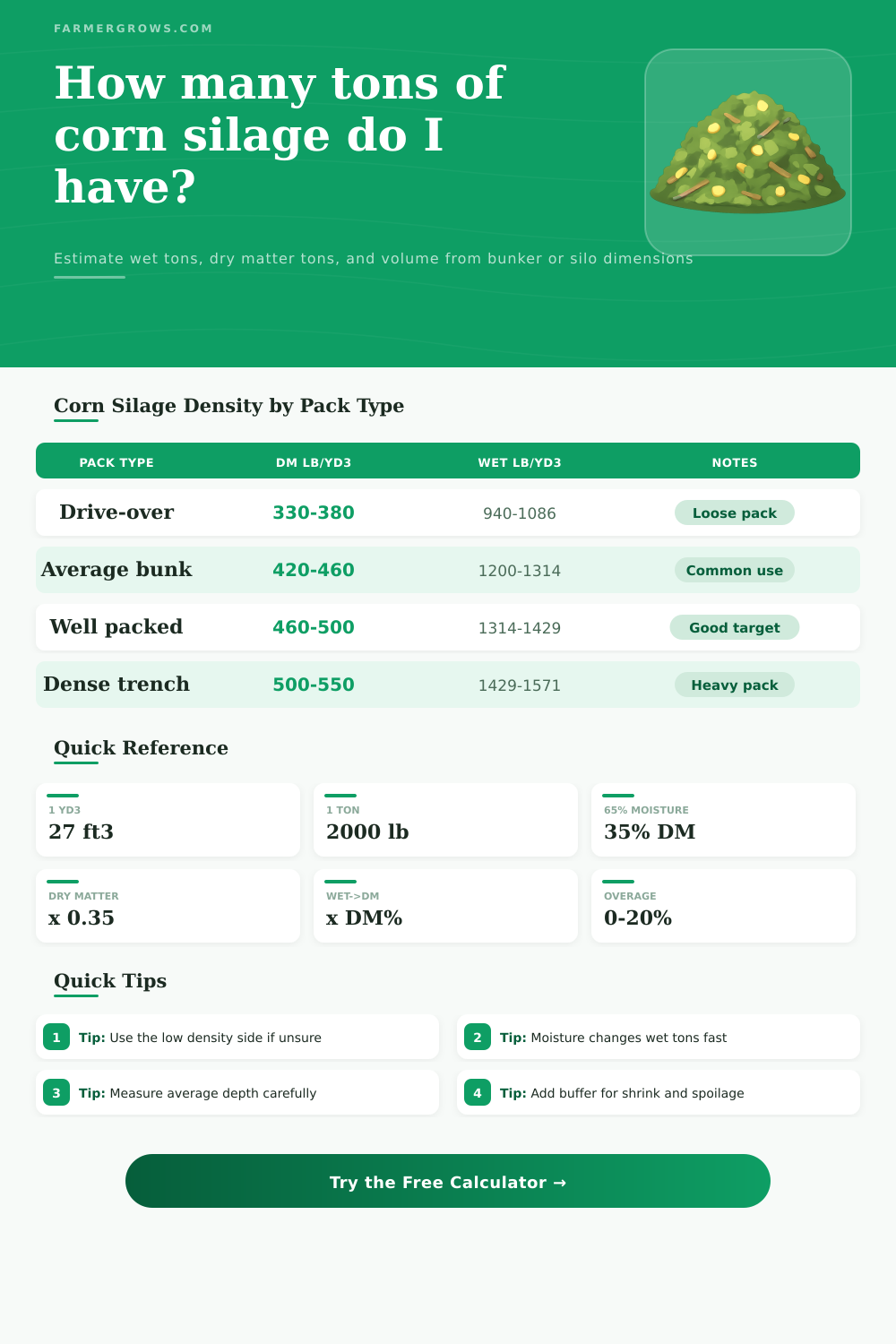
| Pack type | DM lb/yd3 | Wet lb/yd3 @65% | Wet lb/ft3 @65% |
|---|---|---|---|
| Drive-over pile | 330-380 | 943-1086 | 34.9-40.2 |
| Loose bunker | 380-420 | 1086-1200 | 40.2-44.4 |
| Average bunker | 420-460 | 1200-1314 | 44.4-48.7 |
| Well-packed bunker | 460-500 | 1314-1429 | 48.7-52.9 |
| Dense trench | 500-550 | 1429-1571 | 52.9-58.2 |
| Upright silo | 430-480 | 1229-1371 | 45.5-50.8 |
| Silage bag | 400-440 | 1143-1257 | 42.3-46.6 |
| Custom density | Measured | Depends | Depends |
| Moisture | Dry matter | Wet x DM% | DM x Wet |
|---|---|---|---|
| 60% | 40% | 0.40 | 2.50 |
| 62% | 38% | 0.38 | 2.63 |
| 65% | 35% | 0.35 | 2.86 |
| 68% | 32% | 0.32 | 3.13 |
| 70% | 30% | 0.30 | 3.33 |
| Example | Footprint | Volume | Wet tons |
|---|---|---|---|
| Calf bunker | 12 x 40 x 6 | 2,880 ft3 | 53-60 |
| Small bunker | 18 x 80 x 8 | 11,520 ft3 | 213-241 |
| Mid bunker | 24 x 100 x 10 | 24,000 ft3 | 444-503 |
| Large bunker | 30 x 120 x 12 | 43,200 ft3 | 800-905 |
| Upright silo | 16 dia x 40 | 8,042 ft3 | 149-169 |
| Drive-over pile | 40 x 90 x 8 | 28,800 ft3 | 533-604 |
| Wedge pile | 28 x 12 x 60 | 10,080 ft3 | 186-211 |
| Metric bunker | 6 x 24 x 2.4 | 345.6 m3 | 145-164 |
| Shape | Area formula | Volume formula | Use case |
|---|---|---|---|
| Rectangle | L x W | Area x depth | Bunker trench |
| Circle | pi x r2 | Area x depth | Upright silo |
| Triangle | 0.5 x B x H | Area x length | Wedge pile |
| Custom | Enter area | Area x depth | Odd footprint |
Practical Tips
Every farmer that grows corn for feed should understand corn silage tonnage. Simple rule says that one bushel of corn with 15 percent moisture matches around 0.135 tons of corn silage with 65 percent moisture Field with expected output of 170 bushels per acre can give about 23 tons corn silage. To estimate the grain amount, you can observe neighboring fields when planning before.
When grains lack or almost do not exist, every foot of plant height delivers one ton corn silage per acre. You should not include the tassels when measuring the height of the plant. Both modes assume 30 percent dry matter at harvest for the as-fed value.
How to Estimate Corn Silage Yield and Price
For corn plants without ears or with bad pollinated ears, you estimate around one ton of dry matter per acre.
Good corn silage commonly reach around 20 tons per acre. Corn specially planted for corn silage can arrive at almost 30 tons per acre. In many regions the usual range is 15 to 25 tons per acre, depending on the seed kind.
Some BMR hybrids require only 27,000 plants per acre, while others require a bit more. For dairy or high-quality feed, BMR hybrids deserve attention. For beef cattle the demands are not so sevree.
The seeding rate also affects the corn silage quality and the tonnage. In one study, 32,000 seeds per acre gave the maximum tonnage in 2020, while 48,000 seeds per acre did that in 2019.
In UW studies, the grain for one ton of 65 percent corn silage ranged from 0 to 11 bushels per ton for separate cases. Prior tests showed that traditional grain hybrids give more grain per ton of corn silage when the corn silage tonnage per acre grows. Converting whole plant corn silage to bushels per acre is hard, because it is very different from grain.
Fast mode to estimate the price of corn silage is to multiply the price of corn grain by 8 to 10. Factor of 8 to 9 works best for prices at the field. At 3.50 dollars per bushel of corn, corn silage value is around 31.50 to 35.00 dollars per ton.
If chopping, hauling and storage costs 10 dollars per ton, the value for the buyer drops so.
Storage is important. Bunker silos with density under 14 pounds of dry matter per cubic foot cause losses of 17 to 20 percent. Corn silage you must feed quickly to escape spoilage.
It costs more to grow, but the tonnage and energy of corn silage give clear advantage over crops like barley for cattlefeeding.