Space Between Corn Rows Calculator
Plan corn row spacing from plot width, row length, crop type, planter or sweet-corn block layout, pollination rows, equipment width, population target, in-row spacing, and headlands.
Load a named corn layout, then adjust the field width, row length, row spacing, target stand, equipment width, and headland allowance for your actual plot.
Corn Row Spacing Results
These results use the usable plot width, adjusted row length, row spacing, in-row spacing, corn type, and stand percentage entered above.
More canopy and high population potential, but cultivation and residue flow must match the system.
Often used for narrow-row grain or silage corn when equipment and harvest heads support it.
The common field-corn baseline, with easy planter, sprayer, cultivator, and combine compatibility.
Useful for sweet corn blocks, hand weeding, drip lines, and walk-in harvest in small plots.
| Corn type | Typical row spacing | Common target stand | Planning note |
|---|---|---|---|
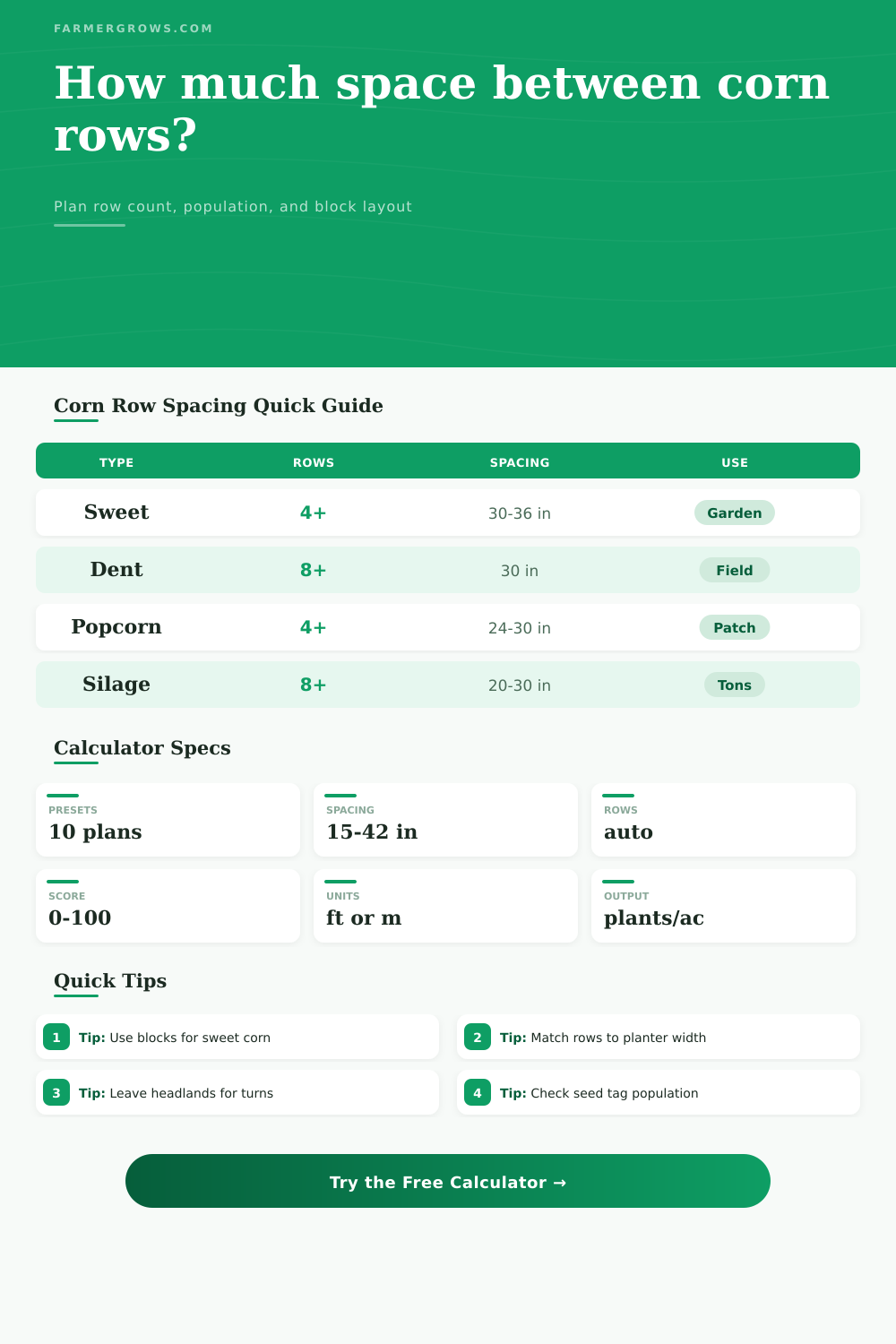
| Sweet corn | 30 to 36 in rows | 18,000 to 26,000 plants/ac | Plant in blocks of 4 or more rows for better pollen movement. |
| Field corn or dent corn | 20 to 30 in rows | 26,000 to 36,000 plants/ac | Match row spacing to planter, corn head, yield environment, and hybrid. |
| Popcorn | 24 to 30 in rows | 20,000 to 30,000 plants/ac | Use isolation distance or timing if keeping varieties pure. |
| Silage corn | 15 to 30 in rows | 30,000 to 40,000 plants/ac | Narrower rows may close canopy quickly in high-yield forage systems. |
| Three Sisters corn | 36 to 48 in rows or hills | Lower than field corn | Leave space for beans and squash instead of forcing maximum stand. |
| Equipment setup | Best row spacing | Pass width example | What to check |
|---|---|---|---|
| One-row garden seeder | 30 to 36 in | Walked row by row | Leave room for hoeing, drip tape, and harvest buckets. |
| Two-row planter | 30 in | 5 ft pass | Keep plot width in even row groups when possible. |
| Four-row planter | 30 in | 10 ft pass | Use row counts divisible by 4 to avoid partial passes. |
| Six-row planter | 30 in | 15 ft pass | Plan headlands wide enough for the tractor turn. |
| Narrow-row drill | 15 to 20 in | variable | Confirm seed singulation, harvest head, and residue clearance. |
| Row spacing | Target 22,000/ac | Target 30,000/ac | Target 36,000/ac |
|---|---|---|---|
| 20 in rows | 14.3 in in-row | 10.5 in in-row | 8.7 in in-row |
| 24 in rows | 11.9 in in-row | 8.7 in in-row | 7.3 in in-row |
| 30 in rows | 9.5 in in-row | 7.0 in in-row | 5.8 in in-row |
| 36 in rows | 7.9 in in-row | 5.8 in in-row | 4.8 in in-row |
| Layout | Rows in block | Pollination strength | Best use |
|---|---|---|---|
| Single long row | 1 row | Weak | Avoid for sweet corn unless wind and neighbors help. |
| Two row strip | 2 rows | Fair | Works better than one row, but ears may be patchy. |
| Small block | 4 rows | Good | Reliable garden layout for sweet corn pollen shed. |
| Market block | 6 to 12 rows | Very good | Strong pollen coverage and efficient harvest lanes. |
| Field planting | many rows | Excellent | Population and equipment fit matter more than block width. |
Tip: For sweet corn, a compact block usually beats one long row because wind-blown pollen lands on nearby silks from several directions.
Tip: Match row spacing to the narrowest tool that must enter the crop, especially cultivators, sprayers, and harvest equipment.
Plug in the dimensions of your plot into the calculator above and it do all the math for you (no more guessing at conversion factors or coefficients). From there, you’ve got a real plan based off your constraints. And what’s the plan? The plan is to turn that hunk of ground that longs to be corn into corn.
While the seed is still in bags, the ground is tilled, and now you’re thinking about dropping a kernel every which way when the predicted weather are looking kindly upon us. But first: How wide will those rows be? It seems like a basic geometry exercise. Plants gets plopped into a box, then you adjust until they fit.
How to Plan Your Corn Rows
Reality include some give-and-take between your wish for a full ear, your pollination plan, and your available equipment. Most people believe 30 inches is best because that is what all the implement dealers sells. It is best for a reason: it matches combine head, the sprayer, and the planter width. In other words, if you are growing field corn for silage or grain, the 30-inch spacing make everything fit into one system.
But if you’re growing sweet corn in a small market garden or even a home backyard, that same 30-inch spacing may result in half-filled ears. Why? Pollen. To form kernels in sweet corn, the pollen must be blown by the wind from tassels to the silks. With only a single long row, the pollen blows over heads and misses silks. You want width. Not just length. That’s where the idea of a pollination block comes in.
You can set it so that several rows runs next to each other with the tool. A single long row is a gamble; four or more are dense enough that there is a good chance the pollen lands on silk. The calculator scores the block strength, which shows how likely it is that what you’re laying out will result in fully developed kernels. If it’s low, you’ll get a lot of barren tips. That’s why most gardeners don’t make it. They worry about how much space they have in feet of row, not how many rows is next to each other.
And then there’s the issue of equipment fit. Science says it’s best to grow in narrow rows because they hold light better and close the canopy more quickly. But if your sprayer are designed for thirty-inch lanes and your tractor won’t take anything wider than a two-row planter, you’re fighting against yourself. Sounds like narrow rows should of been efficient…except that the table on the page makes it clear: Different spacings line up with common passes from different pieces of equipment. Choose a spacing that matches what your tools will allow, not some hypothetical yield advantage that your equipment won’t support, because, c’mon, we’ve got to drive the tractor, haven’t we?
The other side of that equation is in-row spacing: How many do I fit down the line? And row width: how many fit across the field? With a target population (say, 30,000 plants per acre), the calculator ties those two together; if you opt for wide rows, then you’ll need closer in-row spacing to make up the number, since there is fewer plants across the field. Choose narrow ones, and each plant has more space to spread out. This will affect how easy it is to walk through the field for weeding or harvest, as well as the competition for nutrients and water early on.
Don’t forget aisleways and headlands. It’s rare that the total width of your property matches its usable width. You must have ways to get around (turnaround space) and through (walking space that doesn’t trample the crop). With this tool you can subtract these margins from what you draw, so you can calculate how many rows you’ll be able to grow, based on real life, not some idealized shape of your land. A couple of feet per side may not sound like much; but at 100+ rows, it amounts to quite a different number of plants overall.
There’s no magic number for planning corn, but it’s actualy about not making dumb decisions. What kind of corn are you growing? Field corn goes in with standard equipment. Sweet corn likes a block layout. Silage needs close quarters. Plug those numbers into the calculator and see how they fit on your land.
It’s one small step that can save all kinds of heartache down the line. You’ll be happy you considered the turns even before thinking about the seeds. On harvest day, there is straight rows, full ears, and the machinery glides right along without any misses. It starts from a patch of dirt and ends with a workable plan.