Copper Sulfate Pond Calculator
Estimate pond volume, treated acre-feet, copper sulfate product weight, and practical safety flags for algae treatment planning.
Important: This calculator is an estimating aid, not a pesticide label. Copper sulfate use is regulated. Follow the exact product label, local rules, water-use restrictions, and professional guidance. Avoid treating low-alkalinity waters because copper can become toxic to fish and other aquatic life.
Treatment Estimate
Results use acre-foot volume, the selected treatment fraction, target ppm as copper sulfate product, product purity, and chemistry safety checks.
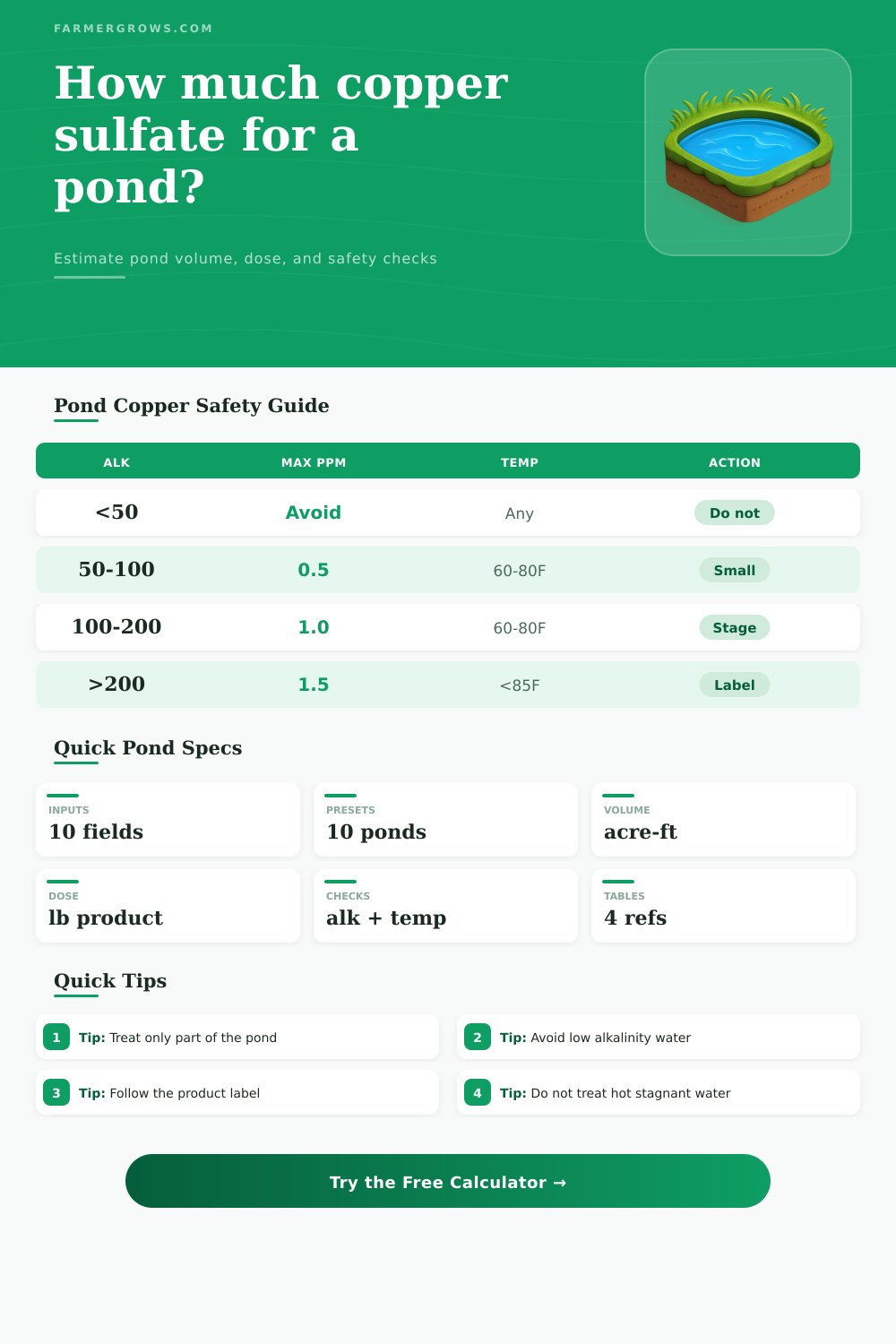
| Total alkalinity | Planning cap for this calculator | Fish risk note | Recommended action |
|---|---|---|---|
| Below 50 mg/L as CaCO3 | 0 ppm | Copper is more toxic in poorly buffered water | Do not treat with copper sulfate unless a qualified professional and the label allow it |
| 50 to 100 mg/L as CaCO3 | 0.50 ppm | Use extra caution with fish, invertebrates, and soft water | Start with small areas and stay within the strictest label limit |
| 100 to 200 mg/L as CaCO3 | 1.00 ppm | Moderate buffering, but hot weather and heavy algae still matter | Stage treatment and monitor oxygen conditions |
| Above 200 mg/L as CaCO3 | 1.50 ppm | Higher alkalinity can reduce copper activity and toxicity | Use the label rate, verify efficacy, and avoid unnecessary repeat dosing |
| Pond volume term | Formula or factor | Example | Why it matters |
|---|---|---|---|
| Acre-feet | Surface acres x average depth ft | 1 acre x 6 ft = 6 ac-ft | Dose is based on water volume, not just surface area |
| Gallons per acre-foot | 325,851 gallons | 2 ac-ft = 651,702 gal | Useful for comparing pumps, tanks, and dilution water |
| Liters per acre-foot | 1,233,482 liters | 1 ac-ft = 1.23 million L | Connects ppm to product weight |
| 1 ppm in 1 acre-foot | 2.72 lb active product | 0.5 ppm = 1.36 lb/ac-ft | Base conversion used by the calculator |
| Treated fraction | Typical use | Oxygen risk | Field note |
|---|---|---|---|
| 10% spot treatment | Small patches near docks, banks, or inflow points | Lowest | Best when algae is localized and water movement is limited |
| 25% quarter pond | Fish ponds, warm weather, or heavier algae | Low to moderate | Wait and observe before treating the next section |
| 50% half pond | Moderate algae with acceptable chemistry | Moderate | Useful compromise when full-pond treatment would be too aggressive |
| 100% whole pond | Light growth, good chemistry, label-permitted use | Highest | Avoid if algae is dense, water is hot, or fish are stressed |
| Water temperature | Oxygen concern | Treatment planning | Practical caution |
|---|---|---|---|
| Below 60F | Usually lower immediate oxygen stress | Algae control can be slower | Confirm the species and label timing before applying |
| 60F to 80F | Moderate oxygen risk | Often the most practical treatment window | Morning applications are commonly preferred when allowed |
| 80F to 85F | Higher oxygen stress risk | Treat smaller fractions and monitor fish | Aeration may be needed when algae biomass is high |
| Above 85F | High risk from low dissolved oxygen | Delay or use professional guidance | Avoid broad treatment of dense algae in hot stagnant water |
Label and regulation check: Use only products labeled for the site and water use. Follow local rules for irrigation, livestock water, fish ponds, discharge, and application records.
Water chemistry check: Do not treat low-alkalinity or very soft water with copper sulfate. If alkalinity is below 50 mg/L as CaCO3, seek professional guidance instead of dosing.
Copper sulfate is an chemical that is often used to manage algae in ponds. Copper sulfate is effective at killing algae because copper sulfate work quickly to kill the algae when the water chemistry in the pond are correct. However, if you apply copper sulfate without first checking the water chemistry in the pond, it can be risk to apply copper sulfate to the pond.
There is many factors that affect copper sulfate’s ability to kill algae in a pond. Factors to consider when treating a pond with copper sulfate include the alkalinity of the pond, the hardness of the water in the pond, the temperature of the pond, and the total volume of the pond. Each of these factors can change the outcome of treating a pond with copper sulfate, so it is important to use a calculator that account for each of these variables before applying copper sulfate to the pond.
How to Safely Use Copper Sulfate in a Pond
The volume of the pond has a major impact upon the amount of copper sulfate that should be used to treat the pond for algae. You must calculate the volume of the pond prior to treating the pond with copper sulfate. Calculators that determine the amount of copper sulfate to use calculate the volume of the pond in unit of acre-feet.
The acre-feet unit is used to determine the total volume of the pond. The volume of the pond that should be treated with copper sulfate should be only a portion of the pond at a time. If you use copper sulfate to treat the entire pond at once, the dead algae may decrease the amount of dissolved oxygen in the pond.
By treating only a small portion of the pond with copper sulfate, you can avoid the dissolved oxygen in the pond dropping too quick. The amount of copper sulfate that is recommended for treating ponds for algae is in units of parts per million of the copper sulfate product. The amount of copper sulfate that is calculated may change depending upon the purity of the copper sulfate product.
For instance, copper sulfate that is 99% pure will have a different amount of copper sulfate required than copper sulfate that contains many filler. Additionally, the alkalinity of the pond can have an impact upon how much copper sulfate is safe to use in the pond. If the alkalinity of the pond is below 50 mg/l, it is unsuitable for copper sulfate treatments.
If the alkalinity of the pond is between 50 and 100 mg/l, the limit of copper sulfate that is safe to use is less than ponds with alkalinity above 100 mg/l. If the alkalinity of the pond is above 200 mg/l, the pond can handle more copper sulfate treatments, but not necessarily the maximum amount of copper sulfate that is safe to use in ponds with high alkalinity. The temperature of the pond is another factor to consider prior to applying copper sulfate treatments.
Warm water holds less dissolved oxygen than cold water. Therefore, if the pond temperature is above 80 degrees, the safety margin for copper sulfate should be reduced. Additionally, soft water increases the toxicity of copper sulfate to fish and invertebrates in the pond, so you should avoid copper sulfate treatments or the dose of copper sulfate should be reduced in ponds with low water hardness.
The sensitivity of the fish to copper sulfate is another factor to consider. For example, koi and trout is more sensitive to copper sulfate than other species of fish that live in ponds, so copper sulfate treatments should be limited if these types of fish is in the pond. Additionally, water exchange rate may impact copper sulfate treatments.
For instance, if the pond has an influx of water moving into the pond, the copper sulfate treatments should be increased to ensure that the pond reaches the target level of copper sulfate to kill the algae. Using a calculator prior to using copper sulfate will allow an individual to see the trade-offs of applying copper sulfate to a pond. For instance, copper sulfate treatment may recommend that only 25% of a pond be treated if the water temperature is above 80 degrees and the alkalinity are moderate.
However, if the water temperature is between 50-60 degrees and the alkalinity is high, the calculator may recommend treating a higher percentage of the pond with copper sulfate. Thus, using the calculator will allow individuals to avoid under-dosing or over-dosing the pond with copper sulfate. Common mistakes in the use of copper sulfate include treating the entire pond at once with copper sulfate and failing to test the alkalinity of the pond prior to treatment with copper sulfate.
If you apply copper sulfate to the entire pond at once, the dissolved oxygen in the pond may drop to levels that is unsuitable for the fish in the pond. Additionally, if you dont test the alkalinity of the pond prior to treatment with copper sulfate, the level of copper sulfate that is used may reach levels that is harmful to the pond and its inhabitants. Staged applications of copper sulfate to a pond are better than applying copper sulfate to the entire pond at once.
By treating portions of the pond at a time, the dissolved oxygen in the pond will not drop too quickly. Furthermore, staged applications will avoid swinging the water in the pond between an algae problem and a fish problem. In addition to staged applications, it is also important to monitor the temperature of the pond prior to treatment with copper sulfate.
Copper sulfate treatments applied to a pond on an 85-degree day may lead to a loss of the fish that live in the pond. The factors that can be controlled when applying copper sulfate to a pond is the volume of the pond, the fraction of the pond that is to be treated, and the purity of the copper sulfate that is to be used. These variables that cannot be controlled are the alkalinity, hardness, and temperature of the pond water.
A copper sulfate treatment calculator can assist an individual in managing these variables; a calculator assists in determining if copper sulfate treatment is safe to apply to the pond. If copper sulfate treatment is safe, the calculator can assist in determining how much of the pond can be covered in one pass with copper sulfate treatment.