Concrete Fence Post Calculator
Estimate concrete bags, gravel base volume, post count, hole diameter, embedment depth, and displacement for line posts, corners, ends, and gate posts.
Use this as a material estimator before digging. Local codes, frost-line maps, wind exposure, soil bearing, utility markings, and fence manufacturer requirements should still control the final post design.
Concrete Post Estimate
Results include cylindrical hole volume, embedded post displacement, gravel base volume, load-adjusted post groups, selected bag yield, and waste allowance.
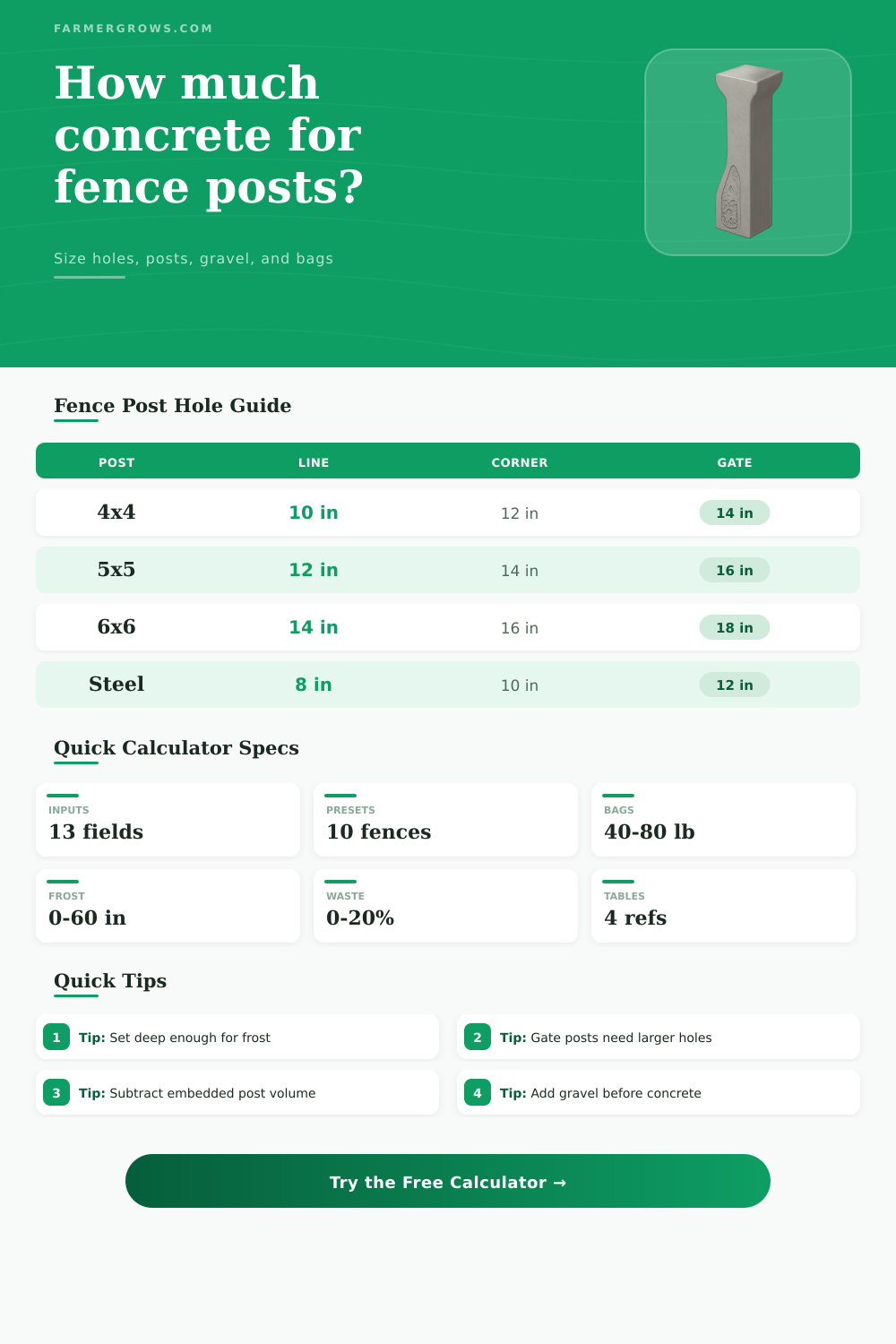
| Post type | Line hole | Corner or end hole | Gate post hole | Typical use |
|---|---|---|---|---|
| 4x4 wood or 4 in round | 10 to 12 in | 12 to 14 in | 14 to 16 in | Garden, rail, light privacy |
| 5x5 wood | 12 in | 14 in | 16 in | Heavier rail and livestock panels |
| 6x6 wood | 14 in | 16 to 18 in | 18 to 20 in | Gates, solid fences, brace posts |
| 2 3/8 to 2 7/8 in pipe | 8 to 10 in | 10 to 12 in | 12 to 14 in | Chain-link, welded wire, pipe gates |
| Bag size | Approximate yield | Bags per cubic yard | Concrete weight represented | Estimator note |
|---|---|---|---|---|
| 40 lb bag | 0.30 cu ft | 90 bags | 3,600 lb per cu yd | Useful for small repairs, slow for long fences |
| 50 lb bag | 0.375 cu ft | 72 bags | 3,600 lb per cu yd | Middle size where lifting weight matters |
| 60 lb bag | 0.45 cu ft | 60 bags | 3,600 lb per cu yd | Common general-purpose fence post bag |
| 80 lb bag | 0.60 cu ft | 45 bags | 3,600 lb per cu yd | Fewer bags, heavier handling per lift |
| Frost depth band | Typical climate signal | Minimum embedment rule used | Gravel base | Planning caution |
|---|---|---|---|---|
| 0 to 12 in | Warm or mild winter areas | 1/3 fence height or 24 in | 4 to 6 in | Still check drainage and wind load |
| 18 to 30 in | Moderate freeze areas | Frost depth plus 6 in | 6 in | Common for many temperate farms |
| 36 to 48 in | Cold northern areas | Frost depth plus 6 in | 6 to 8 in | Deep holes may need wider auger cleanup |
| 54 to 60 in | Very cold interior areas | Frost depth plus 6 in | 8 in | Confirm with local building authority |
| Fence height | Base embedment guide | Heavy load adjustment | Severe load adjustment | Typical post spacing |
|---|---|---|---|---|
| 3 to 4 ft | 24 to 30 in | Add 3 in depth | Add 6 in depth | 6 to 10 ft |
| 5 to 6 ft | 30 to 36 in | Add 4 in depth | Add 8 in depth | 6 to 8 ft |
| 7 to 8 ft | 36 to 48 in | Add 6 in depth | Add 10 in depth | 5 to 8 ft |
| Brace or gate post | 36 to 60 in | Add 6 in depth | Add 12 in depth | Per gate layout |
Hole shape matters: Augered holes often bell out or crumble in loose soil. The waste allowance is meant to cover irregular sides, spill, and slight over-digging.
Depth is not all concrete: This calculator treats the gravel base as drainage volume below the concrete. The post displacement is subtracted only through the concrete embedment depth.
Calculating the amount of concrete needed for fence post is a necessary part of the construction processes. The amount of concrete that is required to set fence posts can depend on a variety of different factors. Some of these factor includes the type of soil where the fence will be constructed, the depth of the frost line in that location, the weight of any gate that will be install in the fence, the amount of exposure that the fence will have to the wind, and the shape of the fence posts themselves.
If any of these factor are not considered in determining the amount of concrete that will be needed, the fence posts may lean or fail after a few season of constructing the fence. Many people will attempt to calculate the amount of concrete by simply guessing at the distance between fence posts. However, the distance between fence posts will lead to error in the estimation of the amount of concrete that will be needed.
How Much Concrete Do I Need for Fence Posts?
For example, line posts, corner posts, and gate posts will require different amount of concrete. Line posts only have to resist the sideways pressure of the fence, while corner posts must be able to resist the tension of the fence from two different direction. Additionally, gate posts must be able to support the weight of the gate and the action of the gate when it is open and closed.
Therefore, gate posts will require more concrete than line posts if they are all to be treat the same. The depth at which the posts will be place into the ground is another factor that will impact the amount of concrete that is needed. In locations where the soil experiences heavy freezing, the fence posts will have to be placed beneath the frost line to prevent the soil from heaving the fence posts upwards and out of the ground.
In areas with milder climates, however, the height of the fence will determine the depth that the fence posts are placed. A calculator is available that can calculate the depth of the concrete beneath the ground in the fence posts, given the height of the fence and the depth of the frost line in that location. Additionally, gravel should be place at the bottom of the holes where the fence posts will be placed.
Placing gravel at the bottom of the holes will allow for drainage of any water that may fall within the fence line, preventing the water from pool against the fence posts. The shape and size of the fence posts itself will impact the amount of concrete that is required. For instance, the volume of concrete that is required will be less if a round steel pipe is utilized for the fence posts as compared to a square fence post of the same size.
However, the diameter of the holes in the ground where the fence posts will be placed will have to be large enough to ensure that the concrete adequately gripped the fence posts. The volume of the fence posts will have to be subtracted from the total volume of the holes in which the fence posts will be placed. Additionally, some allowance for concrete waste will have to be made for the volume of concrete that will be needed.
The volume of concrete will not be able to be poured into the holes in the ground which are not perfect cylinder. The bags of concrete that you’ll utilize for constructing the fence will also impact the amount of work that will have to be performed in the mixing of the concrete. Bags of concrete that weigh 80 pounds contain more volume of concrete than bags of concrete that weigh 40 pounds.
However, the 80 pound bags are heavier to have to move to mix the concrete. The 40 pound bags are easier to move, but more bags have to be mix to achieve the same total volume of concrete as compared to using the 80 pound bags. A calculator will allow the individual to determine the total volume of concrete that is required to construct the fence posts, as well as to determine the number of bags of concrete that will be needed to provide that total volume.
It is recommended that the amount of concrete is calculated prior to beginning to dig hole for the fence posts. Calculating the amount of concrete that is required will allow the individual to make any adjustments to the construction plan prior to spending the money to purchase the concrete. For instance, if a gate is to be made wider, or if a corner post is to be moved, any adjustment to the amount of concrete that is required and the depth of the holes that are dug for the fence posts can be calculated in advance.
These change will be visible on paper, thus allowing for the individual to maintain an honest list of the materials that are required for the fence construction project. Once poured and cured, the concrete will remain underground and invisible to the individual constructing the fence; however, it will ensure that the fence posts remains stable.