Composting Time Calculator
Estimate how long a compost pile, bin, tumbler, manure pack, or leaf mold batch will need based on volume, recipe balance, moisture, particle size, turning, season, and curing target.
Choose a real pile style, then adjust the recipe and management choices to match what is in the bin today.
Compost Time Estimate
Your compost estimate will appear here.
Best for gardeners who can build a full pile, monitor moisture, and turn weekly or more.
Good for mixed household and garden waste when speed matters less than steady processing.
Works well for chopped kitchen scraps and browns, but small batches cool quickly.
Turns autumn leaves into crumbly soil conditioner with little nitrogen and little effort.
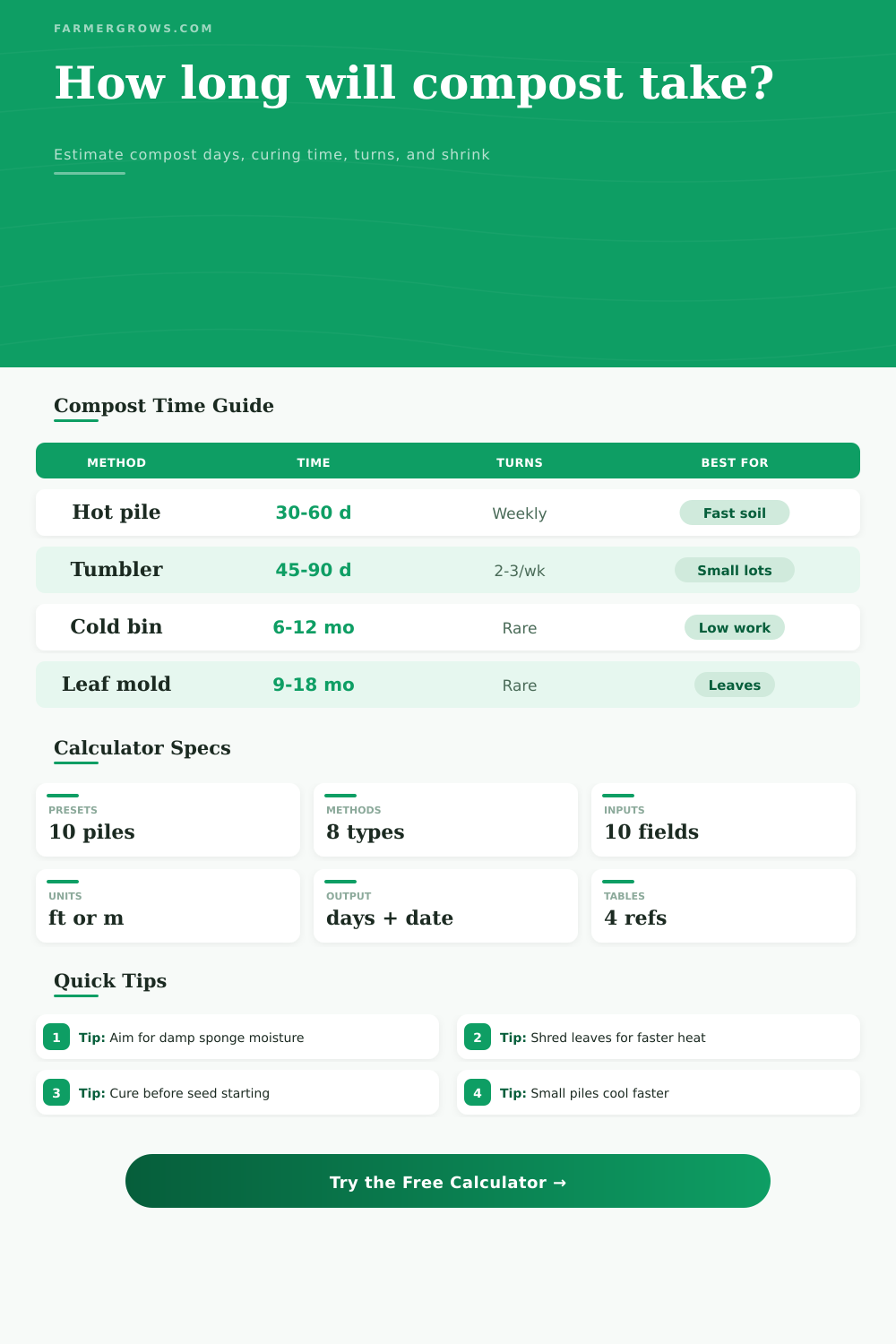
| Method | Typical managed time | Best volume | Turning pattern |
|---|---|---|---|
| Hot turned pile | 30 to 60 active days plus curing | 1 to 4 yd³ | Every 3 to 7 days during heat |
| Hot static aerated pile | 45 to 80 active days plus curing | 1.5 to 6 yd³ | Little turning if airflow is built in |
| Managed warm bin | 75 to 140 active days plus curing | 0.5 to 2 yd³ | Every 1 to 3 weeks |
| Cold backyard bin | 6 to 12 months | Any steady household bin | Rare mixing, mostly layering |
| Batch tumbler | 45 to 90 active days plus curing | 0.1 to 0.5 yd³ | Several spins per week |
| Leaf mold | 9 to 18 months | Loose cages or bags | Rare turning, keep damp |
| Material | Approx C:N ratio | Speed effect | Composting note |
|---|---|---|---|
| Fresh grass clippings | 15:1 to 20:1 | Fast but can mat | Mix thin layers with dry leaves or straw |
| Vegetable scraps | 12:1 to 25:1 | Fast green feed | Bury in browns to avoid odor and pests |
| Coffee grounds | 20:1 to 25:1 | Moderately fast | Blend with bulky browns for airflow |
| Dry autumn leaves | 40:1 to 80:1 | Medium to slow | Shredding can cut months from the batch |
| Straw bedding | 60:1 to 100:1 | Slower carbon | Works well with manure nitrogen |
| Wood chips and prunings | 200:1+ | Very slow | Best for mulch piles or long fungal compost |
| Condition | Fast zone | Slow sign | Correction |
|---|---|---|---|
| Moisture | 50% to 60% | Dusty, dry center or sour wet smell | Add water while turning, or add dry browns |
| Airflow | Fluffy structure with pore space | Compacted layers or ammonia pockets | Turn, fluff, and add stems or coarse browns |
| Particle size | Pieces under 2 inches | Whole leaves and woody stems remain intact | Chop, mow, shred, or screen oversized pieces |
| Temperature | 130 to 150°F for hot compost | Cool pile after fresh build | Add greens, enlarge pile, or insulate in cold weather |
| Problem | Likely cause | Time impact | What to do |
|---|---|---|---|
| Pile will not heat | Too small, too dry, or too much carbon | Adds 2 to 8 weeks | Add green material, water, and rebuild to 3 ft high |
| Rotten smell | Too wet or compacted | Adds 1 to 4 weeks | Turn in dry browns and open the structure |
| Food scraps remain | Large pieces or cold edges | Adds 2 to 6 weeks | Chop scraps and bury them in the hot center |
| Finished compost reheats | Not fully stable yet | Needs more curing | Keep it damp and cure before seedlings or pots |
Measure time from the last major feed. Adding a bucket of scraps resets part of the active clock. For faster finished compost, build a batch, then stop adding fresh material while it heats and cures.
Curing is not wasted time. Compost that looks dark may still contain active acids or unstable nitrogen. A quiet curing period makes it safer around seeds, transplants, and potting mixes.
It begins with a bagful of leaves in the back yard, or a messy kitchen, and ends with dark, crumbly soil (how long it takes is the variable). How fast do you want it to happen? That’s up to you, and also subject to the forces of biology, physics, and the effort you put in along the way.
Enter the size of your pile and how you plan to manage it (above). Let the calculator do the rest. It saves you from guessing whether your heap will grow or rot. Composting isn’t just about waiting… It’s about controlling rate of decay.
How to Make Compost Faster
How big? It’s bigger than you realize. Heat is what drive compost heating, which is engine of quick composting. And heat dissipates from exposed surfaces. So unless your composting heap has mass to retain warmth, it cool down faster then it can get warm again. It stalls. That’s why the tool considers volume when it figures things out: It knows that larger piles retains heat longer than little ones do (you enter length, width and height to calculate volume). You’re up against thermodynamics if you have anything smaller than a cubic yard. That’s why the table of references in the middle of the page shows how hot compost piles take far less time then cold compost bins. It is not magic; it is insulation.
The second lever is recipe balance. For example, if you have a lot of nitrogen (which feeds the microbes), but not enough carbon (to fuel them), your pile will be wet and smelly. If you have too much carbon (as with mostly dry leaves), the pile will be slow and cold. Setting estimated C:N ratio in calculator should fall somewhere between twenty-five and thirty-five, depending on how fast you want things broken down. That’s not precise; it’s a balance. Want to add a bunch of grass clippings? Soak up some of that moisture by layering dry leaves, so there’s something for the heap to hold its shape. Got mostly leaves, and want more heat? Add some greens to get things going.
The other variable on compost time is the moisture content of the heap. Breakdown happens when microbes has access to pore spaces between materials. Without moisture they don’t flow, so no breakdown occurs. With too much moisture, the pile suffocates. Think of it like a wrung-out sponge: good. Dry, no go. Soggy, no go. The moisture content adjusts the estimate for speed on the calculator. If you’re in a wet climate, perhaps you’ll require improved drainage, or more cover. In a desert? Water more frequently. It’s all in the steady hand, right? But real life isn’t always steady. Adjust accordingly if the weather goes wild.
Frequency matters. Oxygen matters. Microbes need oxygen to do their work, and as they devour, they gives off heat. If there’s no new oxygen, the pile runs out of air (meaning it rots; it doesn’t compost). How frequently will you aerate (or turn) the heap? That’s the question the calculator poses. Turn it weekly (or make sure it gets plenty of air otherwise), and it stay hot (and cooks quickly). Leave it be, and it’ll take months, and process will be cold and slow. The trade-off is obvious: Speed up your compost with more work. Patience will get you compost with less work. Time vs. Speed: What’s more valuable to you?
And season. Biological activity is slower when it’s cold out. If you start a pile in winter it will take longer to get going and maintain temperature. That is where the tool sets a fair expectation based off average conditions. No amount of insulation or heating can force spring biology in the middle of winter. Start in warmer months if you want things faster.
And last: Curing is not wasted time. Finished compost should appear earthy and dark. However, it may still be biologically active. If used too early, it will tie up nitrogen in the soil or even burn seedlings. The total number of days in the calculator includes a curing phase. It’s quiet time for compost to regain its balance. If you rush it, you risk harming your plants. Have patience; it’ll pay off later.
That’s all: a number and a number. It is a volume. It also includes a date. As material breaks down, the volume decreases. From a large pile, you arrive at a smaller bagful of gold. Don’t freak out when that heap dwindles! This is normal shrinkage; it means the process are working. Because nature varies, the calculator provides a range. Think of it as a guideline, not a promise. Plan your garden timetable around its results. Be able to say when the compost will be available, when you need it.
Compost is the language of decay… And we’re all speaking it. You provide the conditions, and the materials. Microbes provides the transformation (and time). With the calculator, you get to translate: what you put in gets translated into a time. Yes, you still must do the work. Turn the pile; check the moisture level. But you’ll know what to expect: what starts as a heap of stuff will become soil; one day at a time.
Does waste turn into wealth? That’s compost. When it’s done, you’ll have the proof.