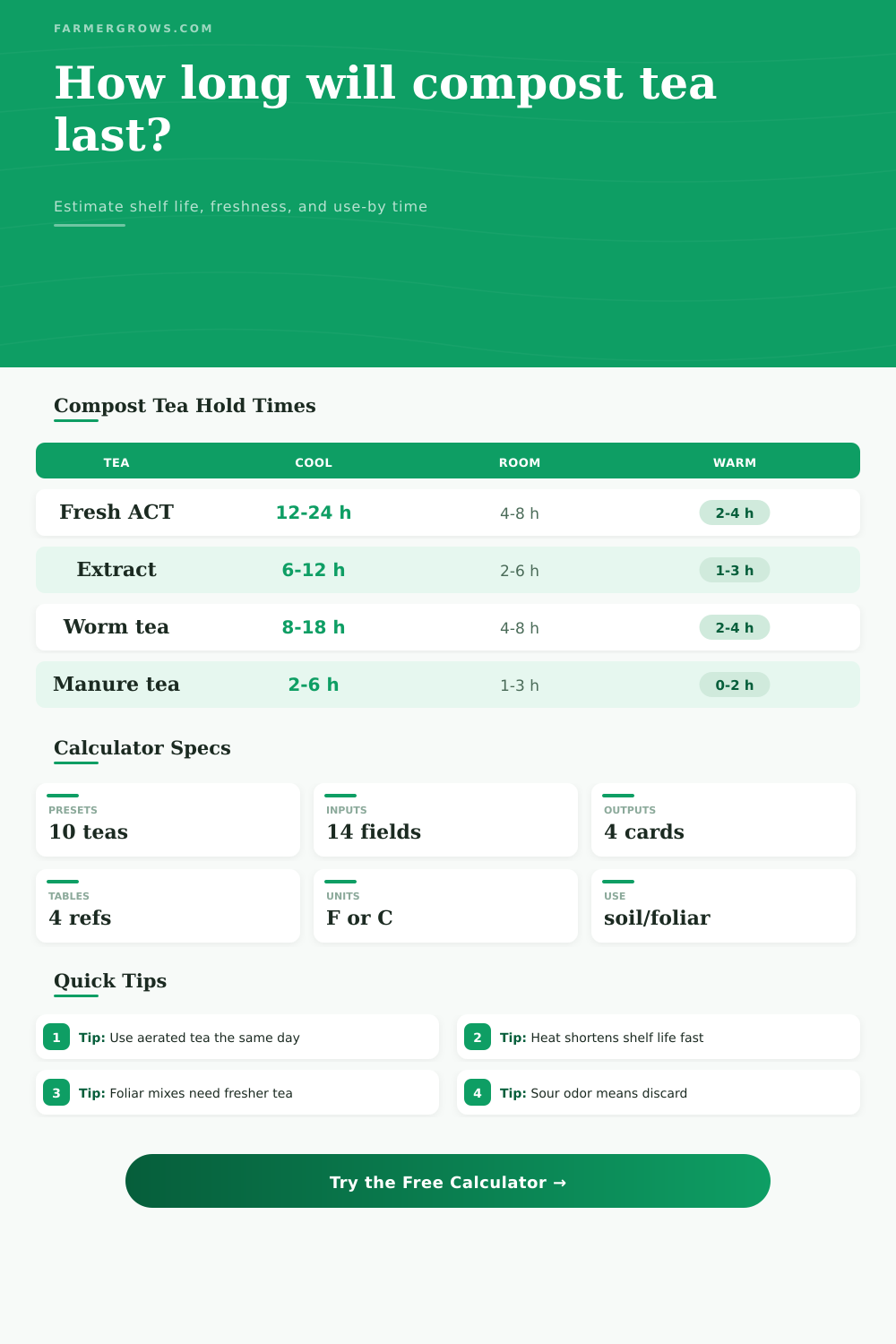
Compost Tea Shelf Life Calculator
Estimate how many usable hours remain after brewing compost tea by accounting for tea type, oxygen, storage temperature, container headspace, food level, water source, light exposure, and application target.
Load a real compost tea storage situation, then fine-tune the batch age, temperature, aeration, and target use.
Compost tea shelf life estimate
Results update as you adjust the batch conditions.
Earthy tea with oxygen still moving is best applied right after brewing, especially for foliar spray or seedling-sensitive uses.
Cool, shaded tea with a loose lid can be held briefly for soil drench work when it still smells clean.
Refrigeration slows change but does not make compost tea stable. Treat chilled tea as a short delay, not storage.
Sour, rotten, slimy, hot, sealed, or old tea should not be sprayed on edible leaves or tender seedlings.
| Tea type | Typical same-day window | Best use | Main shelf-life risk | Calculator base |
|---|---|---|---|---|
| Aerated compost tea during active air | 8 to 24 hours if still aerated | Soil drench or immediate foliar use | Oxygen loss after air stops | 10 hr |
| Aerated tea after air stopped | 4 to 8 hours at room temperature | Same-day soil drench | Rapid oxygen drop | 7 hr |
| Non-aerated compost extract | 2 to 6 hours | Soil drench after mixing | Lower oxygen reserve | 5 hr |
| Worm casting tea | 4 to 8 hours at room temperature | Gentle soil drench | Warm or sealed storage | 7 hr |
| Fungal compost extract | 3 to 8 hours | Woody beds and orchard soil | Heat and sunlight | 6 hr |
| Manure-based tea | Shortest practical hold | Non-edible soil areas only | Pathogen and odor risk | 3 hr |
| Diluted irrigation tea | 2 to 5 hours | Immediate irrigation run | Dilution plus tank residues | 5 hr |
| Mixed foliar spray tank | 1 to 4 hours | Fresh spray only | Leaf-contact sensitivity | 4 hr |
| Storage temperature | Approx adjustment | What it means | Best handling | Watch for |
|---|---|---|---|---|
| 32 to 40°F / 0 to 4°C | 1.8x | Biology slows but does not stop | Use chilled tea within one day | Flat smell after warming |
| 41 to 50°F / 5 to 10°C | 1.45x | Cool storage buys time | Keep loosely vented | Sediment compaction |
| 51 to 70°F / 11 to 21°C | 1.0x | Normal same-day window | Apply soon after brew | Oxygen decline |
| 71 to 80°F / 22 to 27°C | 0.72x | Warm tea changes quickly | Use promptly or aerate | Sour aroma |
| 81 to 90°F / 28 to 32°C | 0.45x | Short hold window | Avoid foliar spraying old tea | Film, heat, odor |
| Over 90°F / 32°C | 0.28x | High-risk storage | Use immediately or discard | Anaerobic smell |
| Storage setup | Adjustment | Good sign | Bad sign | Use note |
|---|---|---|---|---|
| Continuous air stone | 2.2x | Gentle bubbling | Foam collapse with odor | Still apply soon |
| Light aeration or loose vent | 1.35x | Earthy smell | Stale bucket smell | Good for short delay |
| Occasional stirring | 1.05x | No sourness | Sediment turns slimy | Soil drench only if fresh |
| No added air | 0.80x | Clean and cool | Flat or yeasty | Do not stretch the hold |
| Sealed jug or lid | 0.45x | Rarely ideal | Pressure or rotten odor | Discard if questionable |
| Dirty sprayer tank | 0.60x | Clean screen and nozzle | Residue, clogs, smell | Short foliar window |
| Use target | Freshness threshold | Acceptable age | Stricter because | Fallback |
|---|---|---|---|---|
| Foliar spray | 70+ score | Freshest tea only | Direct leaf contact | Use plain water instead |
| Seedlings or potting media | 75+ score | Very fresh, clean smell | Tender roots and closed media | Use finished compost |
| Soil drench | 45+ score | Same day when earthy | Soil buffers more change | Apply to compost pile |
| Compost inoculant | 30+ score | Older but not sour | Not applied to crop tissue | Pour on active pile |
| Discard check | Any sour score | Condition decides | Odor beats the timer | Dilute and dispose away from leaves |
Plan compost tea as a same-day input. The calculator can estimate a holding window, but brewed tea is not a shelf-stable fertilizer. Mix it when beds, sprayers, or irrigation lines are ready.
Let smell overrule the clock. If the tea smells sour, rotten, or swampy, treat it as spent even when the calculated hours look acceptable. Apply questionable leftovers to an active compost pile, not leaves.
Compost tea starts as mixture of oxygen, water, and organic matter, which then brews up into liquid loaded with beneficial microbes. Wait awhile…then out comes a solution to pour onto your plants. It’s all so mysterious-sounding: it’s like magic!
Until you look at the time. Because here’s the truth about that microbial soup: It’s alive, and highly perishable. Freshness is its greatest asset…but also its biggest liability. Stop brewing, and it’s a race against time. It is not really a ticking clock, but more like a stopwatch that depends on exactly how you store it. If you can understand the science underneath the math, though, the calculator (above) will do calculation to save your harvest.
How to Keep Compost Tea Fresh
Oxygen is main factor affecting shelf life. Aerobic bacteria; the microbes within compost tea, require air to live. Once the air pump stops, however, the leftover dissolved oxygen get rapidly consumed by the microbes. As the oxygen level fall, anaerobic organisms kick in. These are not the helpful ones you tried to grow. They will damage roots and cause unpleasant odors. That’s what makes post-brew oxygen intake such an important factor. A sealed jar will hasten the crash. Constant airflow greatly prolongs time. (And no, you don’t store it as if it were bottled water.) The air stone isn’t just a brewer’s device; it acts as a preservative, too.
This is also a biological engine that has a throttle called temperature. Metabolic rates increases with increasing temperatures, and the warmer it gets the faster the microbes are going to use their oxygen supplies and eat up their food stores. The difference between a bucket stored in warm direct sun vs. A shady cool spot in garage makes a huge difference. Spoilage will occur in a fraction of time. See the reference table on the page. They lays out the drastic effect temperature has. A 20 degree differential in storage temps will reduce your usable window by half or more.
Slowing down the decay process is a factor, but it’s not just a matter of keeping the liquid comfortabley. It also takes into account length of time that remains before the need to use it, because not all teas are created equal when it comes to shelf life. A freshly brewed, aerated compost tea will keep longer than an aged, non-aerated extract. That extract will last longer than something mixed from manures, which tend to go bad more quickly due to its higher starting microbe count.
Freshness is the most critical aspect. Consider what you want to do with the tea. Foliar sprays must be freshest, since there’s nothing between them and the tender leaf tissue, while a non-foliar, ground-applied one may have some wiggle room. In other words: a marginal tea may work in soil but burn/infect on leaves. That’s why the calculator asks what you’re planning to apply it to. Based off the answer, it’ll adjust the “safety” margin accordingly.
The bottom line: Your nose is the final judge. There’s no replacing your sense of smell with an algorithm. If it smells like a swamp, sour, or yeasty, it’s finished. Even though the calculator may say it still has another couple of hours before it turns bad, you should of tossed it. That sense test is last line of defense.
Time your brewing so you use it within several hours after making it. Consider it a same-day ingredient, not something you store up for later. All that work keeping it alive will pay off by providing more vibrant soil ecosystem (and healthier plants).
Compost tea isn’t fancy. It’s fresh, or it’s junk.