Compost Shelf Life Calculator
Estimate how long stored compost remains useful, whether it needs reconditioning, and which garden use fits its age, moisture, storage style, smell, and biology risk.
Compost rarely becomes useless on a single date, but stored compost can lose nitrogen, dry out, go anaerobic, grow nuisance insects, or become too inconsistent for seedlings. This calculator turns those practical checks into a shelf-life estimate.
Compost Storage Assessment
Use the shelf-life estimate, score, and use recommendation to decide whether to spread now, recondition first, or reserve the compost for less sensitive jobs.
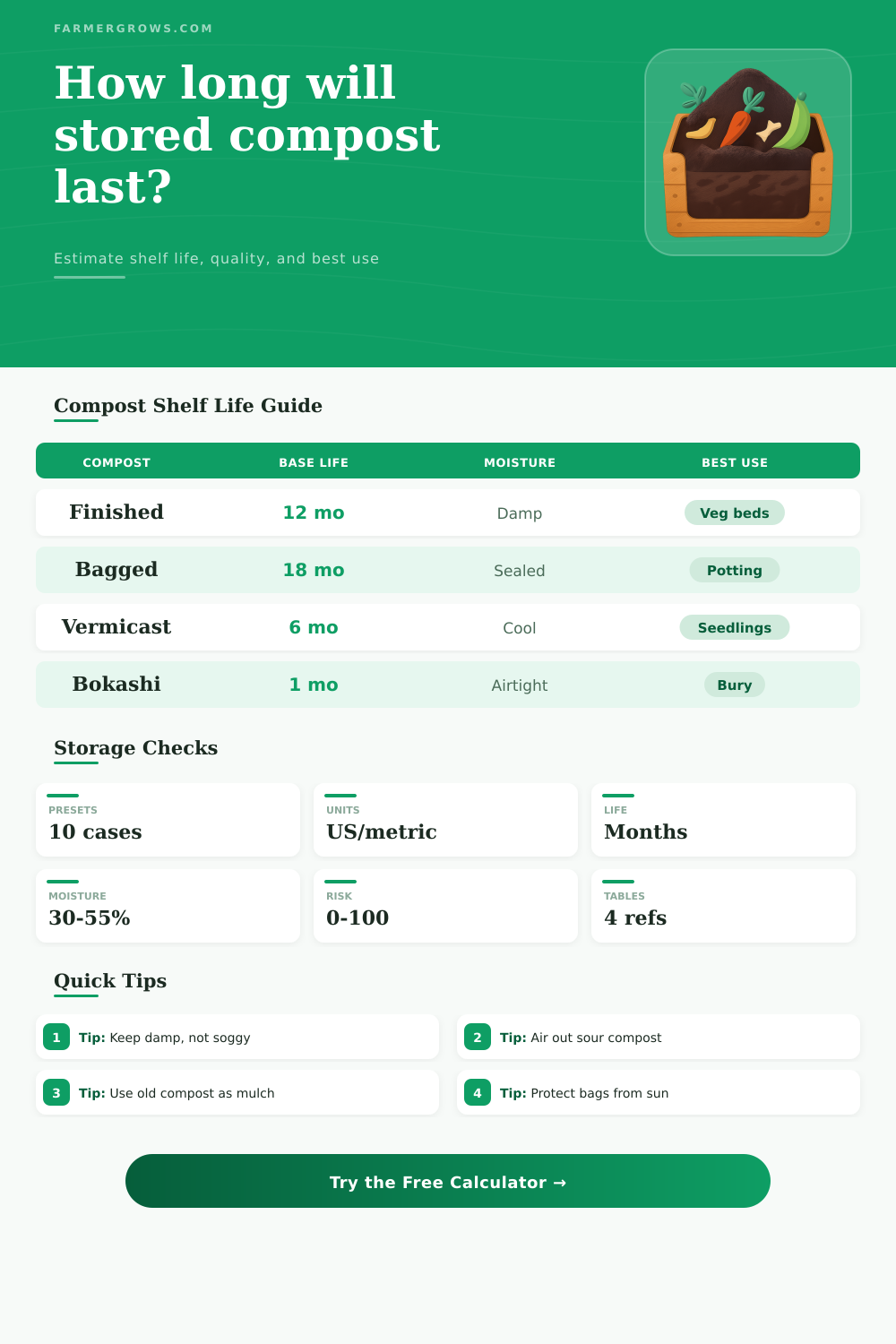
| Compost material | Typical base shelf life | Most sensitive loss | Use when older |
|---|---|---|---|
| Finished backyard compost | 9 to 15 months | Nitrogen and moisture balance | Vegetable beds, shrubs, mulch |
| Screened bagged compost | 12 to 24 months | Anaerobic odor after opening | Beds and outdoor containers |
| Vermicompost or castings | 3 to 9 months | Microbial activity in heat or dryness | Potting mix after rewetting |
| Composted manure blend | 6 to 12 months | Salt concentration and odor risk | Established beds before planting |
| Leaf mold or leaf compost | 18 to 30 months | Drying and fungal matting | Soil conditioner and mulch |
| Bokashi pre-compost | 2 to 6 weeks | Needs soil finishing, not direct pot use | Trench, bury, or finish composting |
| Moisture or smell check | What it suggests | Shelf-life effect | Reconditioning move |
|---|---|---|---|
| Earthy and crumbly | Air and water are balanced | Normal or slightly extended | Store covered until use |
| Dry and dusty | Biology is dormant, not dead | Moderate quality decline | Mist, mix, and rest 3 to 7 days |
| Wet and clumpy | Low air space and leaching risk | Shortened storage window | Drain, fluff, add dry leaves |
| Sour or rotten odor | Anaerobic pockets are likely | Major quality warning | Aerate 1 to 3 weeks before use |
| White fungal threads | Often normal fungal activity | Usually minor if smell is earthy | Break up mats before mixing |
| Average storage temperature | US range | Metric range | Expected effect |
|---|---|---|---|
| Cool indoor or winter shed | 35 to 55°F | 2 to 13°C | Slows drying and biology loss |
| Mild shaded storage | 56 to 75°F | 13 to 24°C | Best all-around storage range |
| Warm garage or summer pile | 76 to 90°F | 24 to 32°C | Faster moisture loss and odor risk |
| Hot sunny bag or bin | Over 90°F | Over 32°C | Shortens shelf life sharply |
| Quality score | Seed starting | Vegetable beds | Mulch or trees |
|---|---|---|---|
| 85 to 100 | Use if screened and mature | Excellent | Excellent |
| 70 to 84 | Blend lightly, test first | Good | Very good |
| 55 to 69 | Avoid for seedlings | Use after reconditioning | Good topdress |
| 40 to 54 | Not recommended | Use cautiously after airing | Mulch only |
| Under 40 | Do not use | Finish composting first | Compost again |
For dry compost: Rewet slowly, mix thoroughly, and rest it a few days so hydrophobic clumps soften before blending into potting media.
For wet compost: Spread it shallow, add dry leaves or shredded cardboard, and wait for an earthy smell before using it near active roots.
For old compost: Prioritize shrubs, fruit trees, perennial beds, and mulch layers before seed trays or small containers.
For unopened bags: Store them shaded, off wet ground, and away from summer heat to slow nutrient loss and bag condensation.
This is the frustration of springtime gardening: You turn over what you composted last fall, and either it’s too wet (slimy with rot) or too dry (like flour). This is one reason we need to keep track of shelf life in the garden. If you know how long something was stored under what conditions, the calculator up top will do the math for you. No guessing whether that bag is still OK to sow with seedlings. Is the compost ready for use in the vegetable beds? Will it require reconditioning first?
What is compost? Everyone thinks it’s inert, waiting for use. Not so. After the decomposition heat subsides, what remains alive continues to evolve: First moisture escapes; then nitrogen volatilizes; microbes goes dormant. If stored as a heap or pile, the contained biology will quickly dry out from exposure to air, and this is where people make their mistake. They assume compost that won’t absorb moisture in the soil means it’s dead; but no, it’s merely dormant. Usually resuscitation works if given time (a couple of days of rest, plus rewetting slowy). Storage in a closed space, saturated with water, poses its own risk: Oxygen is forced from the pore spaces and bacteria that live without air prevails. Smell it before you see it.
How to Store Compost Correctly
The bottom line: Smart storage decisions depends on understanding the effect of temperature on biological changes. Cooler compost stores retains their biological activity. A warm shed or garage speeds up that process. This speeds up nutrient depletion and potential development of unpleasant odors. The chart on the page demonstrates how even modest warmth greatly reduces your usable time. Since vermicompost depends not just on stabilized organic material but also active living microbes, it’s extra-sensitive. Don’t let the worm castings get baked in sun, or go bone-dry; both conditions kills the biological activity you’re paying for.
Backyard finished compost fares better, though nutrients will begin to shift with time as well. The resulting quality score tells you whether to use something for a less important role. Just because the score is low doesn’t mean the stuff isn’t good, it just no longer suits as-important-a-use. For instance, old, broken-down compost makes great mulch for under trees and for topping up over existing perennials that don’t need super-fresh stuff. Young compost holds its nutrients best. Save it for your seed-starting trays where tender baby roots can’t handle ammonia spikes or pH changes from broken-down materials. In effect, you’re sorting your garden materials based off what they are capable of now.
Sometimes it’s not so much when as how: Practical handling habits matter far more then any exact date. Once stored, turn the pile once a month (to bring in some oxygen), and don’t let the middle go sour. Keep bags of compost cool and dry (off concrete slabs and away from direct sunlight) for longer-lasting life. Squeeze a handful now and again, which is a good way to check the moisture level; you want it moist but not sodden, like a wrung-out sponge. Add water gradually if it disintegrates into dust. If it’s dripping wet, tip in a layer of shreddable cardboard or dry leaves to soak up extra water. Those little tweaks will help maintain the biological balance, and avoid those drastic declines in quality that spoil a batch.
Compost management boils down to treating this living resource, not commodity, with respect. Think: You’re preserving an environment for millions of microscopic creature that will in turn nourish your plants. When those critters are happy, you’ll know by checking the compost’s texture and smell, and making sure it’s stored correctly. Then when needed, it’s there in the right condition, ready for the right garden job before weather and time ruin it. It’s all about paying close attention to the details, to make the compost happy, and that careful stewardship is what separates a good harvest from a great one. You should of checked more often.