Compost Per Square Foot Calculator
Estimate compost topdressing or amendment volume by area, depth, compost type, bag size, and settling buffer.
Compost calculation breakdown
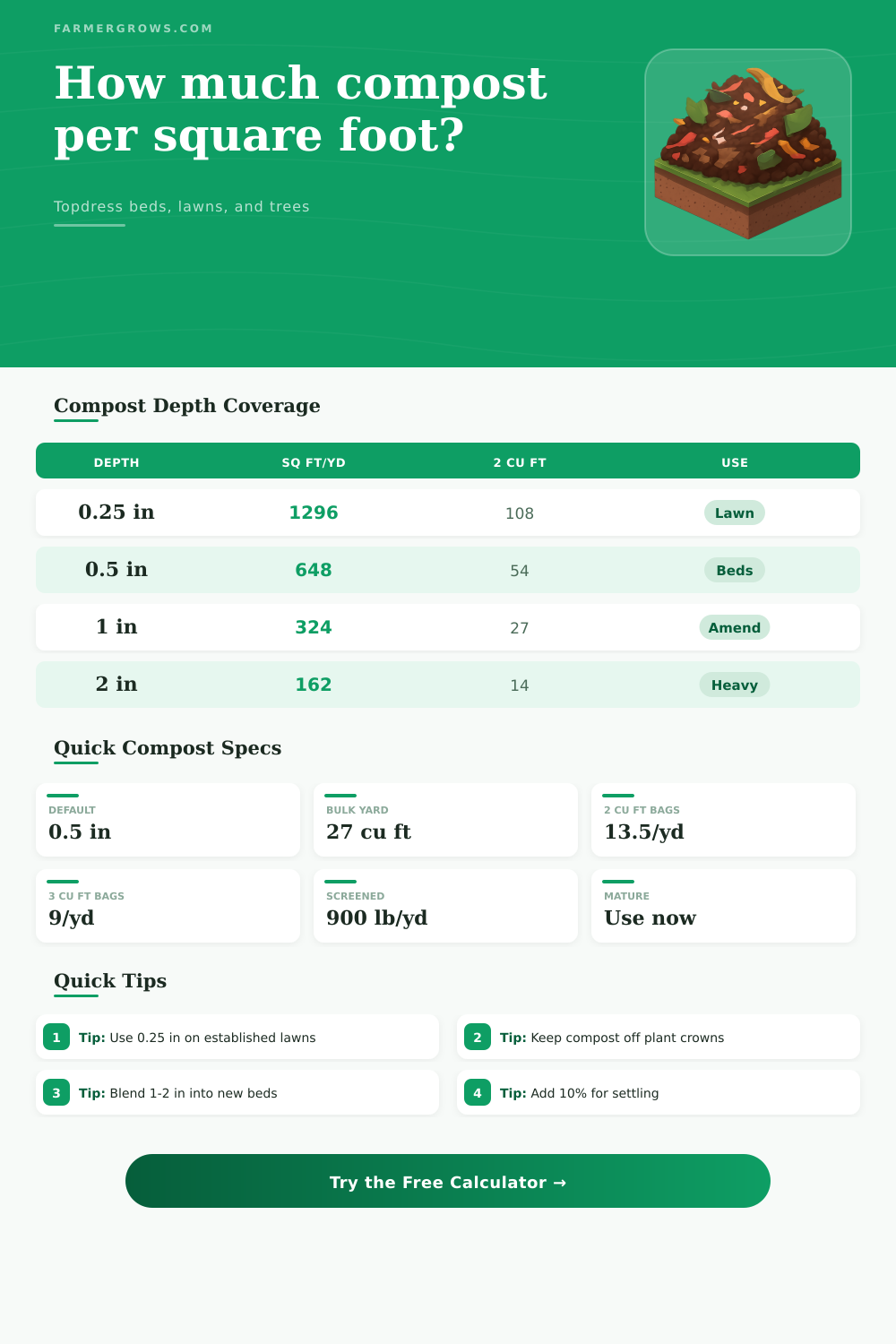
| Compost depth | Coverage per cubic yard | Coverage per 2 cu ft bag | Best topdressing use |
|---|---|---|---|
| 1/8 in | 2,592 sq ft (241 m²) | 192 sq ft (17.8 m²) | Very light lawn correction after aeration |
| 1/4 in | 1,296 sq ft (120 m²) | 96 sq ft (8.9 m²) | Routine lawn topdressing or seed cover |
| 1/2 in | 648 sq ft (60.2 m²) | 48 sq ft (4.5 m²) | Established beds, roses, perennials |
| 1 in | 324 sq ft (30.1 m²) | 24 sq ft (2.2 m²) | Annual vegetable bed amendment |
| 2 in | 162 sq ft (15.1 m²) | 12 sq ft (1.1 m²) | New beds before incorporation |
| 3 in | 108 sq ft (10.0 m²) | 8 sq ft (0.7 m²) | Deep rebuild only when tilled in |
| Compost package | Volume each | Units per cubic yard | 1/2 in coverage each |
|---|---|---|---|
| Small compost bag | 1 cu ft (0.028 m³) | 27 bags | 24 sq ft |
| Standard compost bag | 1.5 cu ft (0.042 m³) | 18 bags | 36 sq ft |
| Large compost bag | 2 cu ft (0.057 m³) | 13.5 bags | 48 sq ft |
| Nursery bulk sack | 3 cu ft (0.085 m³) | 9 bags | 72 sq ft |
| Bulk compost yard | 27 cu ft (0.765 m³) | 1 cubic yard | 648 sq ft |
| Project | Typical area | Compost at 1/2 in | 2 cu ft bags |
|---|---|---|---|
| 4 ft × 8 ft raised bed refresh | 32 sq ft | 0.05 yd³ | 1 bag |
| 10 ft × 12 ft vegetable bed | 120 sq ft | 0.19 yd³ | 3 bags |
| 6 ft diameter tree ring | 28 sq ft | 0.04 yd³ | 1 bag |
| 3 ft × 40 ft berry row | 120 sq ft | 0.19 yd³ | 3 bags |
| 25 ft × 40 ft lawn panel | 1,000 sq ft | 1.54 yd³ | 21 bags |
Lawn topdress
Use 1/8 to 1/4 inch of fine, screened compost so grass blades remain exposed after raking.
Bed topdress
Use 1/2 inch around established plants, leaving a small open collar around stems and crowns.
Annual amend
Use 1 inch over vegetable beds when replenishing organic matter before a planting cycle.
New-bed mix
Use 2 inches only when blending into native soil rather than leaving a thick surface mat.
COMPOST: Most of us purchase it enthusiastically, then apply it with regret. Why did I just lug all those bags home when there was barely enough to cover one raised bed, never mind the half-acre of lawn crying out for attention? It doesn’t feel real until you are standing in your driveway, staring at your sinking car amid a sea of new soil, while the ground around it is still bare.
Compost is not cheap; its volume can be estimated incorrectly by sight; so get it right. Stop doing math in your head or fiddling with unit conversions. The calculator does that arithmetic for you, so you can concentrate on how to apply result. It will translate square footage and desired depth into bag count or cubic yardage for your space.
How to Measure and Use Compost Correctly
Whether a circle under a tree, or a rectangle where lawn meets mulch bed. Simply choose what shape your area is, whether it’s a rectangular lawn strip or a circular tree ring, along with the thickness you intend to apply. It might be two inches thick when layered over bare ground. Not like half an inch over turf.
Either way, you need to calculate the volume accuratley; having too much or too little would of been wasteful. Why does knowing what’s an amendment versus topdressing matter? Because it tells you just how little you might need (or more). Topdress” indicates something applied to the surface only, feeding the soil’s living organisms, but not smothering any growing things already there; for lawns, this often means one-eighth to one-quarter inch of finely screened compost, for instance. When applied on turf, too-thick applications suffocates the blades by covering them with sediment instead of enriching the soil below.
That’s why choosing your inputs according to weight… The tool’s density, is important. Compost materials vary greatly in how heavy they are per cubic yard; the more it has broken down and contains moisture, the lighter the material is. Manure blends pack down denser due to their mineral content, unlike leaf mold, which is light and airy. The reference table at left makes all that clear, explaining how a ton of anything can cover very different distances. How many inches of compost equals a cubic yard?
With new garden beds, however, the story is different than a lawn with years on its back. With virgin soil, your objective may be to incorporate up to six inches of amended material into the first six inches of native soils, the kind of thing you’d do when building bulk in a sandy substrate that’s run-off prone, or structure into a clay heavy soil. And so the tool can go deeper (and buffer for settling).
Fresh compost sets after rainfall and compacts while curing, which means what we put down as two inches today could be an inch next spring. Factor in that the terrain is lumpy rather than flat. We also add a ten percent overage to compensate for the physics and the fact that a human hand cannot spread anything evenly.
The other factor in how you should think about buying is bag size. A one-cubic-foot bag is easy to handle, but it is expensive per volume for big projects. There is also more packaging, so you get less material for your money. Bulk sacks or buying by the yard save on both cost and labor, but they require serious muscle or mechanical equipment to get home. Once you select a bag size, the calculator will turn your total volume into the number of bags you’ll need. This helps you decide if you can carry several heavy bags back and forth or if you should rent a cart instead.
When it comes to composting, both quantity and timing can make the difference. Compost is best applied when plants are actively growing so that the organic matter can be broken down by microbes as the plant takes up nutrition from the ground. Lawns benefit from applying compost in late fall. The material will sit on top of the lawn all winter long and slowly mix into the soil when growth picks up again in the spring.
Do not pile compost right next to the crowns of plants or the trunks of trees; compost holds moisture in contact with stems and bark, which invites disease and rot. Leave an area slightly open at their base to allow air circulation while still benefiting the roots below.
Another thing to take into account: How mature is the compost you’re about to spread? The finished stuff will be dark, with an earthy smell, and won’t have any large pieces of its original ingredients visible (no manure chunks, no leaves). Immature compost may actualy tie up some of the soil’s nitrogen when its microbes is busy breaking down any remaining tough fibers, starving your plants a bit. The maturity adjustment in the tool helps measure that possibility and suggests adding more volume to stabilize things if your compost is still a little green.
Building biology gradually by making only modest regular inputs to the soil is far better than dumping on a bunch of stuff all at once (good soil management has nothing to do with how much “organic matter” you dump on things). Usually a thin layer spread evenly will work better than a thick one in an odd spot here and there. This is because it connects better with the biology and the existing root systems already beneath.
If in doubt, go small. More next year; you can’t remove too many piles of compost from a lawn without damaging it. Whether your herb garden is contained in one pot or covers an acre of pasture land, the same rules apply: measure once; think twice; do things carefully. You’ll have more fertile, well-drained soil that’s also better structured. And when you go out to look at all that stuff you piled in the driveway, you’ll know just how far it’ll go before sinking into the earth.