Compost Coverage Calculator
Estimate compost coverage by area, depth, bulk density, moisture, screening loss, placement method, bag equivalents, bulk order volume, nutrient contribution, and overage.
Pick a farm or garden scenario, then adjust the shape, depth, compost type, moisture, screening loss, and overage to match the material on hand.
Compost Coverage Results
Run the calculator to estimate compost volume, weight, bags, and nutrient contribution.
These values are planning estimates. Use a supplier analysis or lab report when nutrient loading, salts, or certified organic rules matter.
Good all-purpose topdress with moderate density, low debris, and steady nutrient release for beds and rows.
Lower fertility but excellent tilth. Often chosen for seed beds, woodland gardens, and soil structure.
Higher nitrogen and phosphorus contribution. Keep layers measured around seedlings and sensitive crops.
Useful organic matter, but salts and pH can be higher. Blend lightly for sensitive plants.
Rich amendment usually applied in thinner layers or bands instead of deep blanket coverage.
Often consistent by volume when certified. Check screen size and finished maturity for topdressing.
Good for rough beds and erosion-prone strips, with extra screening loss for fine applications.
Can carry meaningful nutrients. Follow local crop, grazing, and certification restrictions.
| Compost depth | Coverage per yd³ | Coverage per m³ | Common use |
|---|---|---|---|
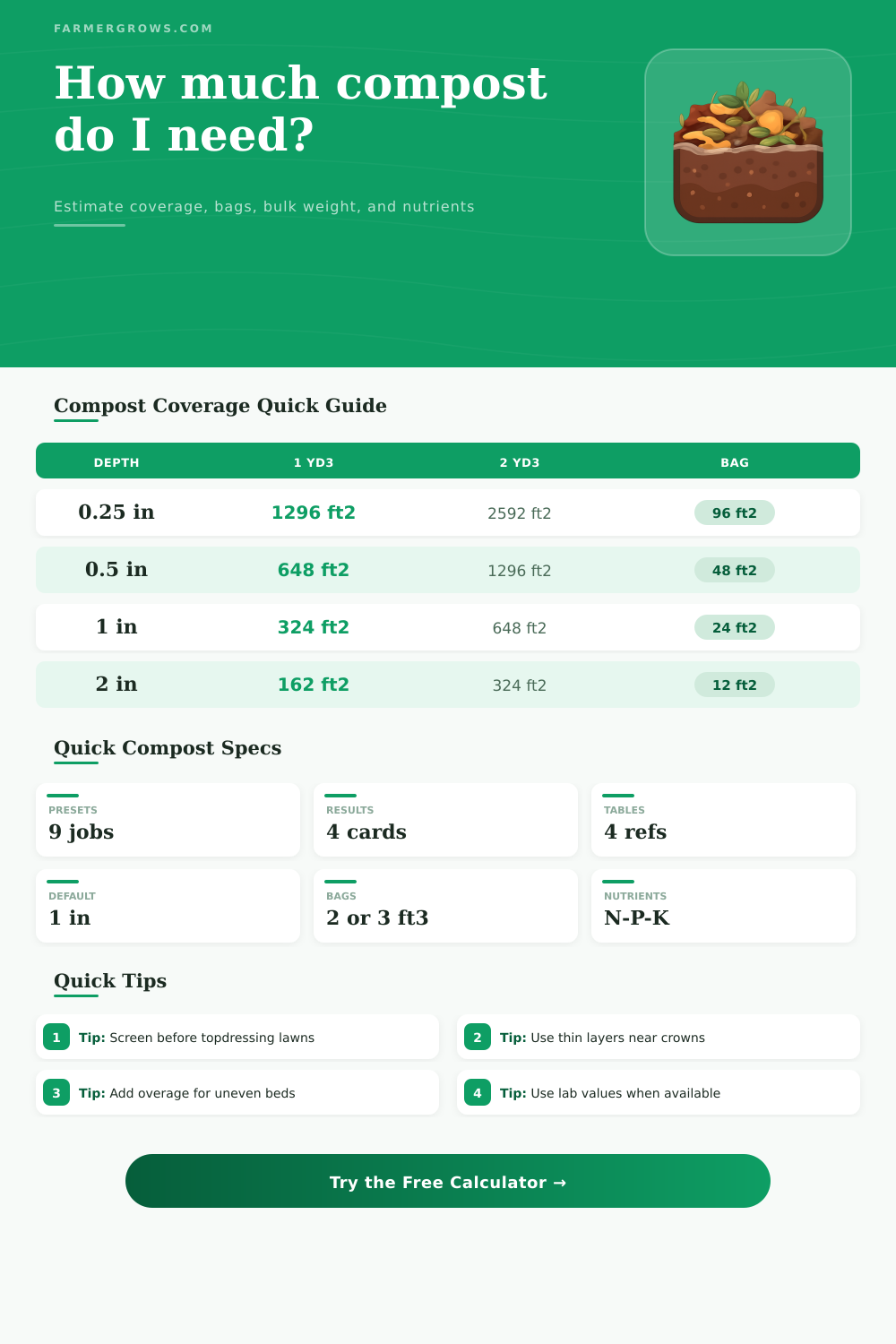
| 0.25 inch / 0.6 cm | 1,296 sq ft | 120.4 sq m | Very light lawn or pasture topdress |
| 0.5 inch / 1.3 cm | 648 sq ft | 60.2 sq m | Maintenance layer on beds or turf |
| 1 inch / 2.5 cm | 324 sq ft | 30.1 sq m | Garden bed topdress |
| 2 inches / 5.1 cm | 162 sq ft | 15.1 sq m | Annual bed refresh |
| 3 inches / 7.6 cm | 108 sq ft | 10.0 sq m | New bed incorporation |
| 4 inches / 10.2 cm | 81 sq ft | 7.5 sq m | Heavy amendment before tillage |
| Packaging | Volume | Bags per yd³ | Coverage at 1 inch | Coverage at 0.5 inch |
|---|---|---|---|---|
| 1 cu ft bag | 0.037 yd³ | 27 bags | 12 sq ft | 24 sq ft |
| 1.5 cu ft bag | 0.056 yd³ | 18 bags | 18 sq ft | 36 sq ft |
| 2 cu ft bag | 0.074 yd³ | 14 bags | 24 sq ft | 48 sq ft |
| 3 cu ft bag | 0.111 yd³ | 9 bags | 36 sq ft | 72 sq ft |
| 1 bulk yd³ | 27 cu ft | 1 bulk unit | 324 sq ft | 648 sq ft |
| Compost type | Planning N-P-K | Moisture range | Screening loss | Best coverage use |
|---|---|---|---|---|
| Screened plant compost | 1.2-0.5-0.8% | 40% to 55% | 3% to 7% | General bed topdress |
| Leaf mold compost | 0.8-0.3-0.4% | 35% to 55% | 2% to 6% | Seed beds and soil structure |
| Aged manure compost | 1.8-1.2-1.5% | 45% to 60% | 4% to 8% | Fertility boost before planting |
| Mushroom compost | 1.1-0.7-1.3% | 45% to 65% | 4% to 9% | Blended garden amendment |
| Vermicompost blend | 1.5-0.8-1.0% | 45% to 65% | 1% to 4% | Thin row bands or potting blend |
| Woody farm compost | 0.7-0.3-0.5% | 35% to 55% | 8% to 18% | Coarse beds and erosion strips |
| Project | Area | Depth | Compost before overage | 2 cu ft bags |
|---|---|---|---|---|
| 10 ft by 20 ft raised bed block | 200 sq ft | 1 inch | 0.62 yd³ | 9 bags |
| Six 6 ft tree rings | 170 sq ft | 1 inch | 0.52 yd³ | 8 bags |
| 50 ft by 50 ft lawn section | 2,500 sq ft | 0.25 inch | 1.93 yd³ | 27 bags |
| Four 30 ft greenhouse benches | 360 sq ft | 0.5 inch | 0.56 yd³ | 8 bags |
| Quarter acre field strip | 10,890 sq ft | 0.5 inch | 16.81 yd³ | 227 bags |
Lawn topdressing is usually shallow and screened fine, while incorporated vegetable beds can handle deeper compost if nutrient loading and salts are acceptable.
The nutrient card is a planning estimate from typical N-P-K values. For regulated fields, phosphorus-sensitive soils, or certified production, use lab numbers.
Compost dont always come in the measured quantity listed on the compost bag due to a range of factors. The compost can be damp or dry depending on the weather. Furthermore, compost will compact within the truck hauling the compost, and some compost will be lost during the screening process.
However, the calculator allow for the user to input compost area, depth, and compost material so the calculator can provide a more better idea of how much compost is required. First, the user must decide on the shape and size of the area that will be covered in compost. Rectangles is the most common for gardens; however, circular or triangular areas may have to be selected for areas like tree rings or vineyards.
How to Work Out How Much Compost You Need
Next, the user must also select the depth of the compost. The depth will play a significant role in determining the volume. A quarter-inch depth for lawns is different than three inches for garden beds.
Additionally, the volume will be significant when the depth increase. The volume of compost is important to determine because it will help in calculating the weight and cost of the compost. The type of compost will also play a significant role in the project.
Screened plant compost is of medium density, while leaf mold compost is of lower density. Furthermore, woody farm compost comes in chunks but loses some volume during the screening process. The compost calculator come with standard densities and loss rates.
However, users can edit the values given to account for the compost being wetter or more dry than average. The percentage of moisture impact the weight of the compost; the weight of the compost impacts compost cost between bags or bulk compost deliveries. An overage of compost must be provided to account for the fact that most individuals will not include an overage when purchasing compost.
There may be an issue of uneven ground. Furthermore, a wheelbarrow will likely spill compost when you use it to transport the compost to the garden area. Finally, there may be a need for an additional portion of compost to another garden bed.
Ten percent compost overage is the most common overage. Furthermore, ten percent overage are unlikely to be seen as wasteful when the project is complete. An overage will also account for compost being lost during the screening process.
The compost for lawns will be screened to a fine texture than raised garden beds; thus, compost lost during screening will have to be accounted for in the initial calculation of the volume of compost to be ordered. The nutrients listed on compost bags are estimates. The method in which compost is applied will impact how much nitrogen, phosphorus, and potassium are delivered to the plant roots.
If you incorporate compost into the soil rather than applied as a topdressing, more nutrients will be available to the plants. The compost calculator account for this in the calculation of available nutrients. Real-world garden projects will never be the same as the reference tables listed in the compost calculator.
Garden bed can change in width. Compost applied to tree roots must not touch the tree trunk. Finally, lawns will require a much finer texture of compost than gardens.
Although the compost calculator will provide an initial estimate of the volume of compost that will be required for the project, measuring the garden area with a tape measure will always provide a more accurate estimation of the volume of compost that should of been ordered. The purpose of the compost calculator is to avoid ordering compost based off a feeling. Based on the calculations, the user will know how much compost will be required in terms of how many yard of compost will be needed.
The calculations will aid the individual in creating a plan that matches the specific garden beds that the individual has in there area.