Cocoa Plants Per Acre Calculator
Estimate cacao tree population from field acreage, spacing, planting pattern, plantable land, access strips, gap allowance, nursery survival, and shade-tree ratio.
Choose a real cacao establishment pattern, then adjust the spacing and allowances to match the surveyed block, terraces, drains, and local shade plan.
Cocoa Planting Result
Density result will appear after calculation.
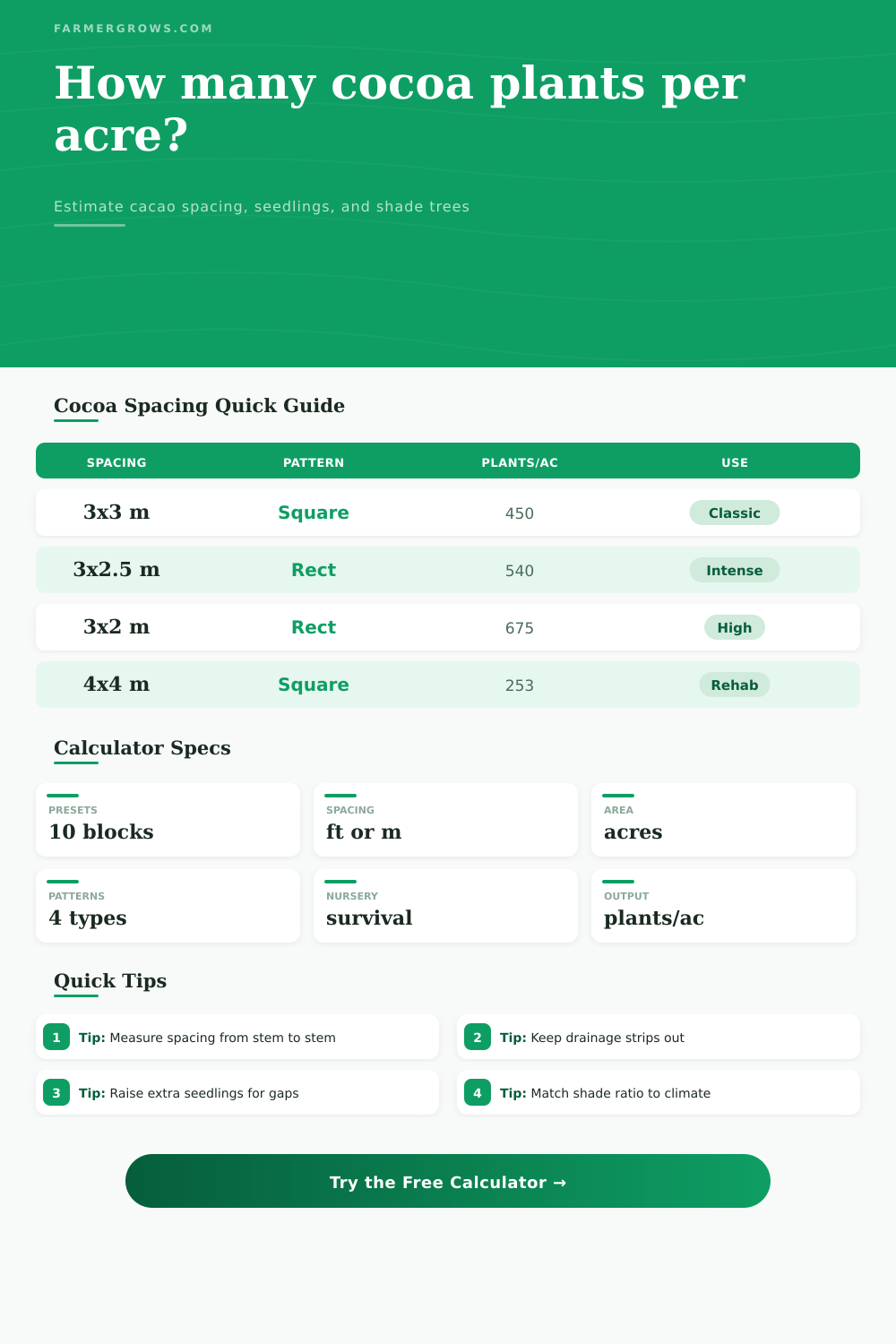
About 253 cocoa stations per acre before paths. Useful where old shade trees remain or soil moisture is limited.
About 450 stations per acre on a full acre. This is a common planning baseline for cacao farms.
About 540 stations per acre before service strips. Often used when pruning and fertility are managed well.
About 675 stations per acre. Needs disciplined pruning, light management, and timely replanting of failed trees.
| Cocoa spacing | Area per plant | Plants per acre | Plants per hectare |
|---|---|---|---|
| 4 m × 4 m | 16.00 m² | 253 | 625 |
| 3.5 m × 3.5 m | 12.25 m² | 330 | 816 |
| 3 m × 3 m | 9.00 m² | 450 | 1,111 |
| 3 m × 2.5 m | 7.50 m² | 540 | 1,333 |
| 3 m × 2 m | 6.00 m² | 675 | 1,667 |
| 2.5 m × 2.5 m | 6.25 m² | 648 | 1,600 |
| Planting pattern | Calculator factor | Density effect | Best fit |
|---|---|---|---|
| Square or rectangular grid | 1.000 | Baseline | Most flat or gently sloping cacao blocks |
| Staggered triangular grid | 0.866 | About 15.5% more stations | Uniform land where diagonal access is acceptable |
| Paired-row alleys | 1.100 | About 9% fewer stations | Blocks needing wider spray, harvest, or shade alleys |
| Contour or irregular hillside rows | 1.080 | About 7% fewer stations | Sloped farms with curves, drains, and erosion strips |
| Nursery situation | Reserve to add | Survival to use | Planning note |
|---|---|---|---|
| Strong nursery, nearby field | 5% to 8% | 92% to 95% | Good watering, short transport, fast transplanting |
| Typical smallholder nursery | 10% to 15% | 85% to 90% | Allows for weak seedlings and early blanking |
| Dry spell or remote block | 15% to 25% | 75% to 85% | Raise more spares for heat, transport, and delayed rains |
| Rehabilitation under old cocoa | 20% to 30% | 70% to 85% | Light competition and root pressure can reduce establishment |
| Shade-tree ratio | Shade trees per acre at 450 cocoa | Use case | Field caution |
|---|---|---|---|
| 1 shade per 15 cocoa | 30 | Hot, dry, exposed establishment | Thin later if canopy becomes too dark |
| 1 shade per 20 cocoa | 23 | Balanced temporary or mixed shade | Keep shade species pruned and well spaced |
| 1 shade per 25 cocoa | 18 | Moderate shade baseline | Works where cocoa canopy closes well |
| 1 shade per 40 cocoa | 12 | Humid zone with existing shade | Watch young cacao for sun scorch |
Measure usable land, not deed land. Remove drains, rocks, steep unplanted strips, farm roads, and headlands before ordering cocoa seedlings; those areas can change the real plant count more than a small spacing adjustment.
Plan blanking before the nursery closes. Cocoa farms lose plants from drought, pests, transport shock, and poor root systems. Keeping labeled spare seedlings makes first-season gap filling much easier.
Planting cocoa are less about throwing seeds at the ground and more about engineering a living system; you’re planning an orchard. You’re creating a system to live within, a living thing that needs be engineered. Every row must have enough air flow and sun reach; every tree must have room to grow without being crushed when you cross its path. A 3 x 3 meter spacing is very different from a 3 x 2 meter one. One is a number on a spreadsheet; the other is the difference between a tangle of trees strangling each other in three years or a pleasant place to walk around and take care off things.
For most farmers, it’s a question of how much land they want to begin with, and what their target output is; then it’s math to figure out how many plant per hectare. Enter your orchard block’s dimensions and planting layout, and the calculator above will do the math for you.
How to Plan Your Cocoa Farm
First: People measure the deed, not the soil. Maybe your title says you’ve got five acres, but maybe all that’s left to plant is three-and-a-half acres of the field. There are rocky outcroppings here and a drainage ditch there. A steep slope over there is too dangerous for terracing, and there is a turn-around at headland where machines park. Order seedlings for the gross acreage, and guess what? You’ll be nursing a batch of bare-root saplings in nursery as your planted area goes begging.
By forcing you to enter the percent of non-plantable land, the tool accounts for the fact that you don’t actualy have five acres of field. It makes you be honest about lay of the land before you even start digging holes. This saves you money and the aggravation of running out of usable territory and having to go back to fill in the gaps.
The calculator asks how much space I want to leave between each tree: wide (4 by 4 meters), forgiving (easier picking, less humidity-related disease, and more light); or tight (3 by 2 meters). Tight spacing lead to faster canopy closure and more yield sooner. However, it requires more challenging management, such as more discipline in fertilizing and pruning, and results in more weed competition during those first critical years. Then it will adjust the number of plants based off your chosen spacing.
For example, a staggered triangular pattern gives slightly greater density than a square grid. This means you get about fifteen percent more trees in the same amount of space without increasing distance between any single tree. That’s a little geometry tweak that shifts the intensity of the picking operation.
Nursery survival is the variable that keeps growers up at night. Despite your best efforts raising your seedlings, you’ll lose some. Ten to twenty percent? It is not unusual if they gets hit with transplant shock, have a poor root system, or are caught in a dry spell while being moved from the nursery to the field. Order exactly the quantity of trees your math tells you to, and you’ll have holes in it.
For that reason, there’s a place on the calculator for expected gaps, along with a buffer percentage of extra reserve. Raise more seedlings than necessary rather then fewer. You might get lucky and be able to plant extra ones in unexpected gaps or sell them. However, you can’t go to your neighbor and buy one to fill an empty station once the rainy season hits. Anticipating loss isn’t being pessimistic; it’s being practical.
In most climates, shade trees aren’t optional. However, they do matter for cocoa. Too much shade makes the cocoa grow slow. Not enough shade for young tree will scorch them with sun and stress them with heat. Based on a desired ratio of shade trees to cocoa and the density of cocoa you want to plant, the tool lets you calculate an estimated number of shade trees required. You’re integrating both parts of your agroforestry system, two layers into one field.
When you stand looking out at the field, you’ll be viewing something balanced, an ecosystem, not just rows of beans. The end result is one uniform stand of healthy trees. Why? Because it makes for easy harvests, prunings, sprayings, etc. And because a uniform crop generates a predictable pattern of production.
The math gives you the road map; the land is the terrain. You walk it. You study the drainage. You sense the soil. You determine what the land can truly sustain in terms of how dense you make that tree stand. And then you enter all that reality into the calculator to get your seedling count correct.
A well-spaced farm is a profitable farm. Squeeze things in too tightly and the work becomes a burden. Start with the space, respect the gaps, and the math would of shown you where to go next.