🌱 Clover Seed Calculator
Estimate clover seed by acres or square feet, species, seeding method, mix percentage, seed tag quality, inoculation status, and ordering overage.
Clover seed estimate
Seed amount adjusts for method, live seed percentage, germination, mix share, inoculation planning, and overage.
Low-growing pasture clover for grazing, lawns, orchards, and long-lived grass mixtures.
Short-lived perennial for hay, silage, frost seeding, and quick pasture improvement.
Winter annual cover crop with strong spring biomass and pollinator value.
Late-season annual clover used for winter grazing and southern forage systems.
Small-seeded annual clover for reseeding pasture and moist low-input sites.
Fast annual clover for forage, green manure, and short cover crop windows.
Self-reseeding annual for orchards, vineyards, and Mediterranean-style pasture.
Cool-season clover suited to moist soils where red clover may struggle.
Persistent pasture clover with slow establishment and strong rhizome spread.
Annual clover used in dryland forage and cover crop mixtures.
| Species | Drill rate | Broadcast rate | Frost or overseed | Common use |
|---|---|---|---|---|
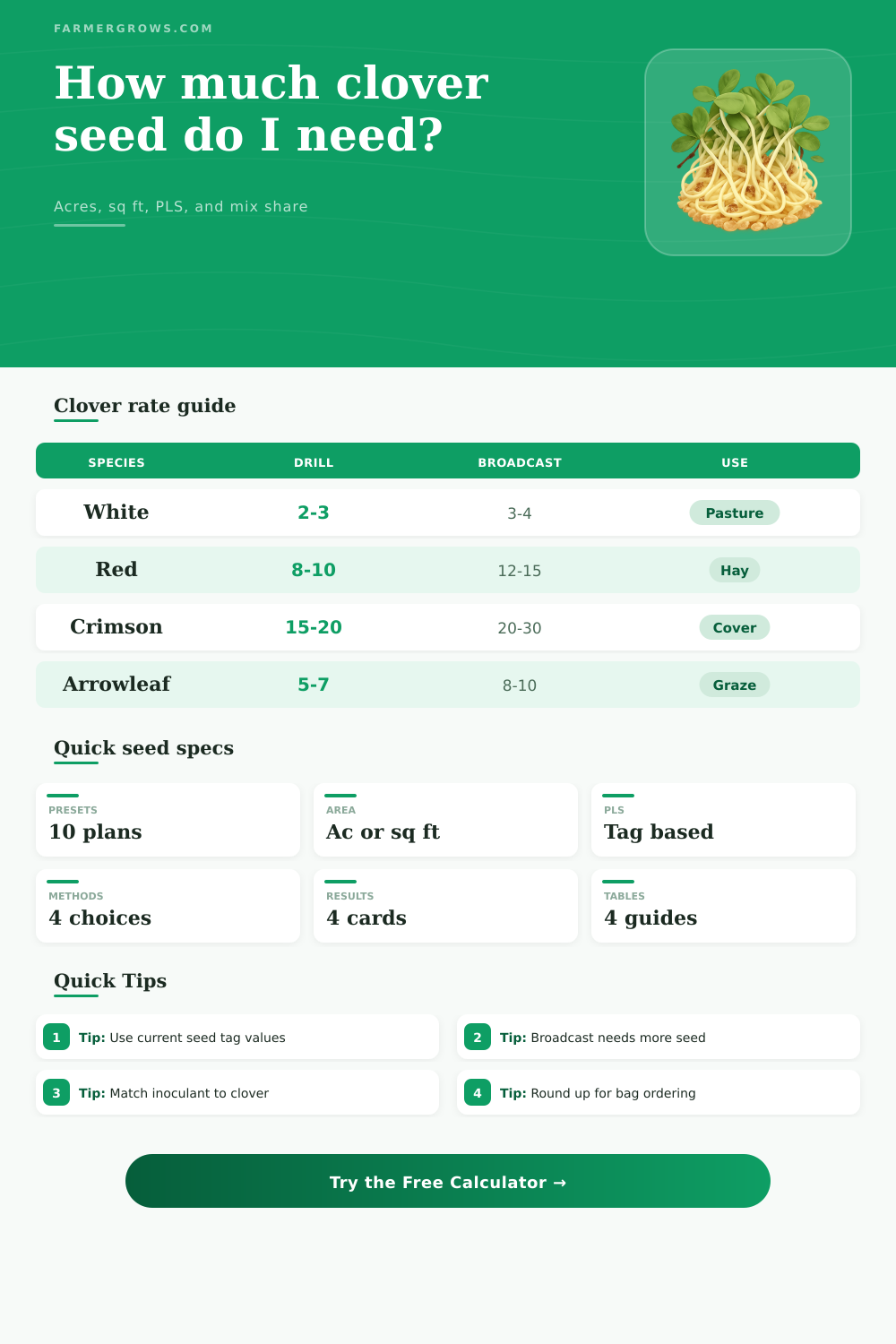
| White or ladino | 2-3 lb/ac | 3-4 lb/ac | 2-3 lb/ac | Pasture, orchard, lawn blend |
| Red clover | 8-10 lb/ac | 12-15 lb/ac | 4-8 lb/ac | Hay, pasture, frost seeding |
| Crimson clover | 15-20 lb/ac | 20-30 lb/ac | 18-25 lb/ac | Annual cover crop, pollinator |
| Arrowleaf clover | 5-7 lb/ac | 8-10 lb/ac | 7-9 lb/ac | Winter grazing, annual forage |
| Ball clover | 2-3 lb/ac | 2-3 lb/ac | 2-3 lb/ac | Self-reseeding pasture |
| Berseem clover | 10-15 lb/ac | 18-20 lb/ac | 14-18 lb/ac | Green manure, quick forage |
| Subterranean clover | 8-10 lb/ac | 10-20 lb/ac | 10-15 lb/ac | Orchards, vineyards, annual pasture |
| Alsike clover | 2-4 lb/ac | 3-5 lb/ac | 2-4 lb/ac | Moist meadow, cool pasture |
| Kura clover | 3-5 lb/ac | 4-6 lb/ac | 4-6 lb/ac | Durable perennial pasture |
| Rose clover | 15-20 lb/ac | 20-25 lb/ac | 18-22 lb/ac | Dryland annual forage |
| Planning item | Calculator action | Typical value | Field note |
|---|---|---|---|
| Drilling | Uses drill rate | Lowest rate | Best seed-soil contact |
| Broadcasting | Uses broadcast rate | Higher rate | Cover lightly after spreading |
| Frost seeding | Uses frost rate | Species specific | Works best with freeze-thaw cycles |
| Mix percentage | Multiplies base rate | 10-100% | Use clover share of total blend |
| Overage | Adds order buffer | 5-15% | Helps with calibration and edges |
| Seed tag factor | Formula use | Example | Why it matters |
|---|---|---|---|
| Pure seed or PLS tag | Entered as percent | 95% | Removes inert matter from the estimate |
| Germination | Entered as percent | 90% | Adjusts for viable seed on the lot tag |
| Effective live seed | PLS x germination | 85.5% | Bulk seed is divided by this value |
| Fresh inoculant | No seed penalty | 1.00x | Supports nodulation and nitrogen fixation |
| No inoculant | Risk cushion shown | 1.05x | Seed cannot replace nodules, but order cushion is useful |
| Pack or area | Conversion | Use in calculator | Planning note |
|---|---|---|---|
| 1 acre | 43,560 sq ft | Area conversion | Small plots can be entered directly in sq ft |
| 1 hectare | 2.471 acres | Metric area | Result still shows lb/ac and kg/ha |
| 50 lb seed bag | Standard bag | Bag rounding | Round final order up to whole bags |
| 25 lb seed bag | Small field bag | Bag rounding | Useful for high-value or small plots |
| Inoculant pack | 25-100 lb seed | Pack count | Use the label for the matching clover group |
Estimate clover seed by area, species, method, mix share, seed tag quality, inoculation, and overage. Use the result to size bags and field-ready seed orders.
Determining the amount of clover seed that are required to adequately seed an area can be a complicated process due to the various factors that can impact the total amount of clover seed that is required to be purchased for that job. Each of the variables for determining the amount of clover seed that is required for an area is accounted for in the calculator, which allows the calculator to save you the steps that would be involved in manually calculating those factors. The first variable to consider with clover seeding is the species of clover that is to be planted.
White clover and ladino clover typically grows to the ground and spread via stolons, which makes it a popular choice for areas like orchards. Red clover typically grows to taller heights than white clover, and produces more biomass during its growing season, so it is a good choice for hay fields and rotational pasture fields. Crimson clover is typically planted in the fall as an annual crop that finish growing early in the spring, and leaves nitrogen for the soil after its growing season.
How to Figure Out How Much Clover Seed You Need
Arrowleaf clover and ball clover has other niches in agriculture, such as arrowleaf being planted in late summer when grazing animals are most active in the fields, and ball clover naturally self-seeds in areas that has available moisture. Each type of clover has a suggested drill rate and a suggested broadcast rate, which are different from each other due to the different growth rates of each clover species. Choosing a clover species that does not naturaly grow in you’re region and/or in the type of field in which you plan to establish clover can result in wasted clover seed and time.
The second variable that can impact the amount of clover seed that is required is the seeding method for that clover. The seeding method is just as important as the type of clover that is to be planted. Drill methods, in which the calculator places the clover seeds into the soil at a consistent depth and distance from one another, will require less clover seed than either broadcast seeding or frost seeding methods.
Broadcast seeding methods involve dispersing the clover seed onto the soil’s surface, and requires more clover seed to account for the amount of seed that is inevitably lost during this process. Frost seeding methods utilize the freeze-thaw cycles in the soil to assist in the movement of the clover seed into the soil. Overseeding methods involve planting clover into areas that already contains sod.
More clover seed is required with overseeding methods because the young clover plants will compete with the sod plants for available soil resources. Each of these seeding methods is accounted for in the clover seed calculator, which will adjust the rate of clover seed based on the seeding method that you select. Additionally, the calculator will adjust the rate according to the percentage of clover that will be included in the total mixture of seeds.
For instance, if the clover is to be a thirty percent mixture of clover and another type of seed, the clover amount will be adjusted to reflect this percentage. The third variable is the information that is provided on the clover seed’s seed tag. The percentage of pure clover seed is listed on the tag.
This represents the percentage of the total weight of the bag of seed that consist of clover seed. The remainder of the weight of the bag is composed of inert materials. Additionally, the percentage of the clover seed that will germinate is listed on the tag.
Not all clover seeds will germinate into young clover plants. The effective live clover seed value is calculated by multiplying the percentage of pure clover seed by the percentage of clover that will germinate. Effective live clover seed values are typically between eighty and ninety percent.
Because clover seed is purchased in bulk, the amount of clover that will germinate must be purchased in addition to the amount of clover seed that the clover seed calculator calculates. The clover seed calculator accounts for this by dividing the amount of clover seed that was calculated by the effective live clover percentage. An additional factor to consider is inoculation of the clover seed.
Clover seed contains symbiotic bacteria that enables the clover to fix nitrogen in the soil. For best results, fresh inoculant should be applied to the soil when planting the clover seeds. Pre-inoculated clover seed can also be used, but only if the clover is current in age and has not been exposed to temperatures that may kill the inoculant bacteria.
If the clover seeds to be used in the calculation are missing inoculant or if the inoculant is expired, the calculation will order an additional amount of clover seed. This additional clover seed accounts for the risk of the clover root nodules not recognizing any soil nitrogen and utilizing that nitrogen in the development of the clover plants. An additional step prior to purchase is the consideration of overage.
Both five percent and ten percent overage rates are provided in the clover seed calculator. An overage amount allows for errors with seeding equipment, accounts for areas of fields that may not be seeded with the clover, and accounts for spilled clover seed during the seeding process. The percentage of overage can be adjusted according to the amount of clover seed that is to be ordered, and the amount of experience that the individual using the clover seed calculator have with seeding clover fields.
Both overage percentages are applied to the bulk weight of the clover seed by the calculator. Finally, the calculator rounds the total amount of clover seed to the nearest whole bag, which ensures that there will be enough clover seed to cover the entire area that is to be seeded. The units in which the area is measured is another of the factors that must be considered prior to calculating the amount of clover seed that is to be purchased.
The area that is to be seeded must be converted to acres before calculation, and the total amount of clover seed will be provided in both acres and hectares (metric units of area). The tables that are provided for each clover seed and seeding method indicate the rates of clover seed that is typically sold and distributed for each type of clover and seeding method. These tables are not a replacement for the recommendations of an agronomist or agricultural extension office for your region, but they do provide a starting point for purchasing clover seed for your fields.
These tables allow for comparisons between rates of drill seeding methods compared to broadcast seeding methods for the same types of clover, for instance. Additionally, the tables can account for the additional amount of clover seed that is required for each of the seeding methods to ensure that each planting area is adequately supplied with clover seed. There are a variety of methods for ensuring that the calculations are accurate.
For instance, you can calculate the amount of clover seed that is required both with and without using fresh inoculant; alternatively, you can calculate the amount of clover seed that is required for a stand of clover compared to a mixture of clover and another type of seed. Comparing these two calculations will reveal the amount of clover seed that will be saved by using a mixture of clover and another type of seed, for instance. Additionally, the differences between the amounts of clover seed required for each of these two scenarios will allow you to make an informed decision as to whether using a mixture of clover and another type of seed is worth the additional complexity in sowing the clover seeds.
Additionally, each of these calculations will allow you to determine how much the amount of clover seed that is to be purchased can change with small changes in variables for the clover stand, such as germination percentages. By calculating the amount of clover seed that is required prior to beginning to plant clover seeds into the fields, you ensure that the cost of the clover seed is a variable cost instead of a fixed cost for each acre of field. The amount of clover seed that is required can change based off the species of clover that is to be planted, the technique for planting the clover into the fields, and the quality of the clover seeds that are to be used.
Additionally, by ensuring that the amount of clover seed that the farmer orders matches the amount of clover seed that can be distributed by the seeding equipment, the time required to plant the clover fields will be reduced, and the even development of the young clover plants will be ensured. Alot of work goes into this. It’s important to do it right.