Chilli Seed Germination Time Calculator
Estimate chilli pepper emergence timing, likely sprout percentage, seedling readiness, and tray risk from chilli type, seed age, soak or pre-sprout method, soil temperature, heat mat, depth, moisture, humidity dome, medium, and days since sowing.
Use this for chilli pepper seed trays, plug flats, soil blocks, and paper-towel pre-sprouts. The estimate assumes viable seed kept warm and evenly moist; older seed, dense media, or unvented domes can shift the results.
Chilli Germination Estimate
Results combine chilli type, effective root-zone temperature, seed age, soak or pre-sprout method, medium, sowing depth, moisture, dome use, and elapsed days since sowing.
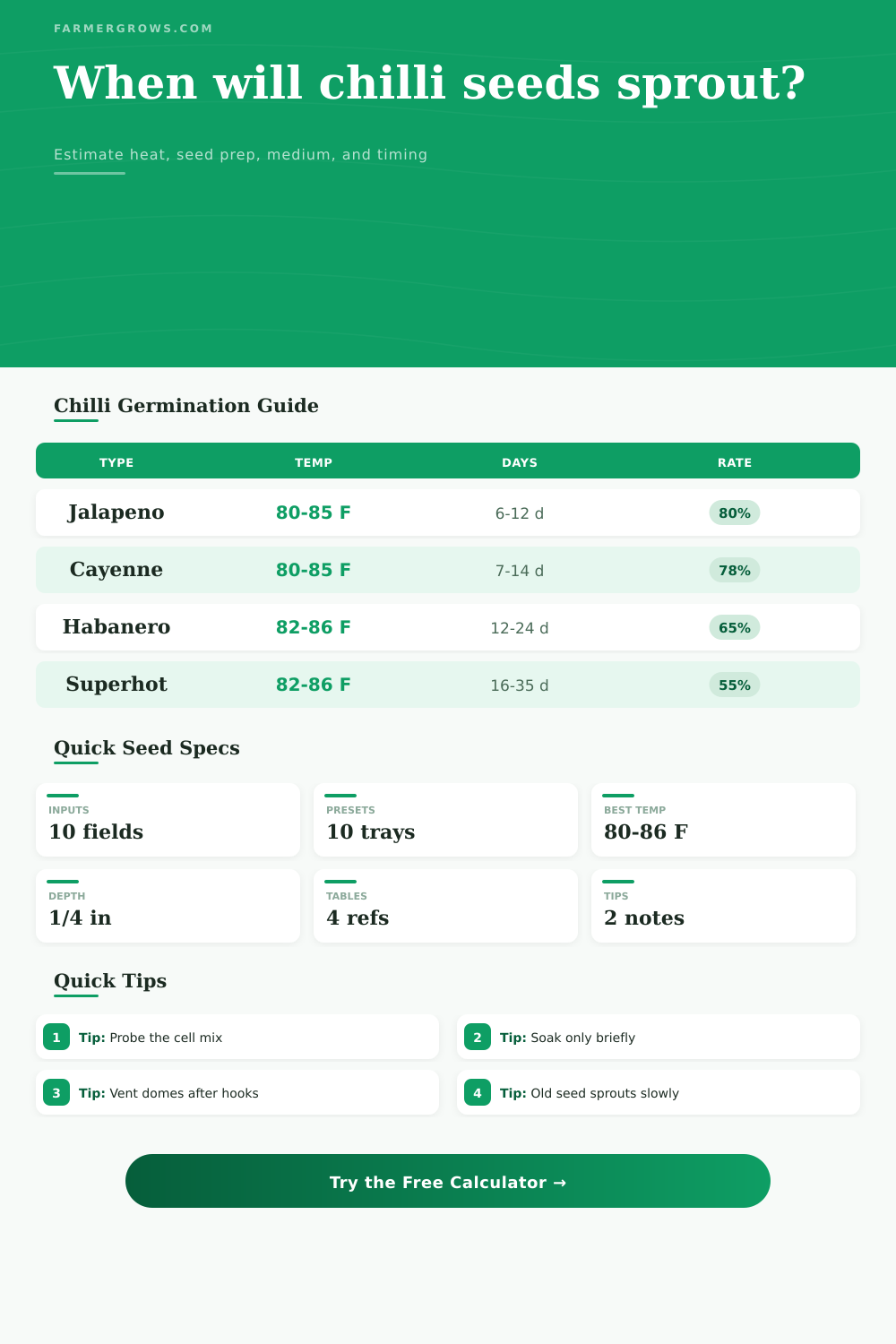
| Chilli type | Typical examples | Warm germination window | Base emergence | Nursery note |
|---|---|---|---|---|
| Jalapeno / Fresno | Jalapeno M, Fresno | 6 to 12 days at 80 to 85°F | About 82% | Fast when fresh and evenly warm |
| Cayenne / Thai | Cayenne, bird chilli, peri peri | 7 to 15 days at 80 to 85°F | About 78% | Keep shallow tray edges damp |
| Paprika / spice | Hungarian, Aleppo, drying types | 8 to 16 days at 78 to 84°F | About 75% | Uniform seed lots help block sowing |
| Aji baccatum | Lemon drop, aji amarillo | 10 to 20 days at 80 to 85°F | About 70% | Allow a longer seedling stage |
| Habanero group | Habanero, Scotch bonnet | 12 to 24 days at 82 to 86°F | About 65% | Needs steady heat and patience |
| Superhot group | Ghost, scorpion, reaper | 16 to 35 days at 82 to 86°F | About 55% | Pre-sprout old seed before trays |
| Root-zone temperature | Effect on timing | Emergence factor | Risk pattern |
|---|---|---|---|
| Below 60°F | Often stalled or very slow | Very low | Seed decay, sour mix, long wait |
| 60 to 69°F | Slow and uneven | Low to moderate | More failed cells and delayed hooks |
| 70 to 74°F | Acceptable but not ideal | Moderate | Longer window, especially for superhots |
| 75 to 79°F | Good nursery range | High | Usually reliable with fresh annuum seed |
| 80 to 86°F | Best chilli range | Highest | Fastest uniform emergence |
| 86 to 90°F | Fast but watch moisture | Moderate to high | Dry edges and sealed-dome heat stress |
| Above 90°F | Too hot for many trays | Reduced | Embryo stress and rapid drying |
| Seed age | Stored dry and cool | Expected viability | Calculator adjustment |
|---|---|---|---|
| Fresh seed | Current season or recently purchased | 85% to 95% | No delay |
| 1 year old | Good label and dry packet | 80% to 90% | Small reduction |
| 2 years old | Still useful if stored well | 65% to 80% | Add about 1 day |
| 3 years old | Test before large trays | 45% to 65% | Add about 2 days |
| 4 years old | Patchy without a pre-test | 25% to 45% | Add about 4 days |
| 5+ years or unknown | Best treated as a rescue lot | 10% to 30% | Add about 6 days |
| Seed-starting condition | Preferred setting | Why it matters | Warning sign |
|---|---|---|---|
| Planting depth | About 1/4 inch cover | Keeps chilli seed damp but lets hooks lift | Deep cells emerge late or not at all |
| Moisture level | Evenly moist, airy, never soupy | Seeds need water and oxygen together | Glossy wet mix or crusted dry top |
| Humidity dome | Vented until first hooks, then off | Reduces drying without trapping too much heat | Condensation dripping into cells |
| Pre-sprout method | Short soak or damp towel for old seed | Can confirm weak superhot lots early | Long roots tangled in paper towel |
| Seed-starting medium | Fine seed mix, coir, or peat-perlite | Balances moisture, warmth, and oxygen | Dense garden soil or sour smell |
Temperature tip: Chilli seed responds to the temperature inside the cell, not the room label. Probe the medium and keep most types between 80 and 86°F without baking tray edges.
Moisture tip: Keep the medium evenly damp and airy. Vent the humidity dome as soon as hooks appear so slow superhot cells can finish without damping-off pressure.
How do chile seeds grow? Knowing the answer lowers typical kitchen stress.
Is there something wrong with it if you’re constantly checking in on a tray under a humidity dome, every couple of hours? Do you want to poke soil surface to see if anything’s going on in there, but then risk poking those precious emerging babies? It’s not usually that they didn’t make it (the seeds aren’t dead). When you planted Carolina Reapers, say, and you’re sizing up progress against jalapeño time, thats what’s happening. Enter your variety and soil temperature into the calculator above, and let the math do the work. Now you’ll know the difference between normal delay different than true failure.
How Chili Seeds Grow
The single factor you can manage is heat, not air temperature. Because it’s the temperature of the thing around the seed coat, the chili seed respond to what happens between its skin and where it sits in the growing medium. Eighty degrees on a heat mat? The middle of the tray may be hitting eighty-four, with the ends only at about seventy-two. That difference lead to patchy germination that appears as poor seed quality but is instead poor thermal uniformity. It accounts for this in the tool, ask it not your room thermostat setting, but the measured temperature of the soil. A minor detail; but a make-or-break part of the whole calculation. Look at emergence graph (below) and see how it stalls out if there isn’t consistent warmth, and below sixty-something, it barely emerge at all.
Age of seed is also critical, particularly with the hottest. A new packet of jalapeño will be no problem, but a four-year-old packet of ghost pepper seed might not work as well. Not so much. Over time, the viability decreases and those still-viable seeds requires more time to awaken. The calculator factors in the age of your lot, and adds days to the prediction accordingly. Because older seeds don’t start metabolically as fast, it increases the time frame: perhaps from a dozen days to three weeks. This is not necessarily a sign of bad seed, but a sign that the good seed in there just going to be slower. Knowing that prevents you from discarding a perfectly functional tray of seedling. They’ll just need a bit longer then expected.
The second week is where everyone goes wrong: moisture management. Evenly damp… Not soggy, is what we’re aiming for. No oxygen in waterlogged spots mean no life for the embryo, so it will suffocate. Dry conditions stop everything. To determine risk, the calculator takes into account both your dome set-up and your soil’s moisture content. Wet soil plus a closed dome equals a damping-off scenario, which is a fungal problem that can eliminate seedlings overnight. As soon as you notice the first hooks, crack open the dome to let the surface breathe but maintain enough humidity for those slower seeds to continue their push-through.
Depth also affects timing, though not as much as you would imagine. Seeds can’t be buried a couple of inches; chili seeds aren’t powerful enough to force themselves upward from all that depth, given how little reserve they carry in their first leaves. A quarter inch is just right. Go further and the seed exhausts its reserves before ever encountering the light. The calculator takes into account your starting medium. Heavier garden soil create more resistance than a fine sterile mix. It also warns you not to dig too deep, sending an alert if you go beyond the suggested level. If your compost is dense, the seed has to overcomes more resistance to get up and going, more time, greater risk of rot.
You get back the expected emergence rate and a risk score. Low risk score? Relax. High risk score = probably a mixture of old seed and low-heat conditions. Bad mix. Emergence percentage lets you know how uniformly your tray will emerge. Uniformly high? Transplant all together. Harder to figure out what’s going on with light and space if they’re not that uniform.
IT IS A race against decay, yes, but it’s also a race of germination, and not a sprint. It is incremental: a slow crawl to the light. Patience keeps them alive; the math predicts when they’ll arrive. Stop poking at the ground. Trust the heat. Wait it out. You should of known that.