Chill Hours Calculator
Estimate fruit tree chill accumulation from hourly temperature entries or a low/high daily approximation, then compare the total against a crop and variety requirement.
Chill models are estimates, not guarantees of bloom quality. Use the variety tag, local extension guidance, and site-specific weather data when deciding whether a fruit variety fits your winter climate.
Chill Accumulation Results
Your chill estimate will appear here after calculation.
| Model | Temperature response | Warm behavior | Best use |
|---|---|---|---|
| Simple 32-45°F | Counts each hour from 32 to 45°F as 1 chill hour | Warm hours are ignored unless warm interruption is applied | Quick comparison to nursery tags listed as chill hours |
| Utah-style weighted | Gives partial credit below 45°F and full credit near 45 to 54°F | Subtracts credit above 60°F in the hourly weighting | Sites with winter warm-ups that simple hours overstate |
| Dynamic approximation | Builds chill portions from cool hours, with stronger credit near ideal chill bands | Applies a smaller warm penalty than Utah-style weighting | Warm winter fruit regions where portions are commonly discussed |
| Fruit group | Common chill range | Low-chill examples | Planning note |
|---|---|---|---|
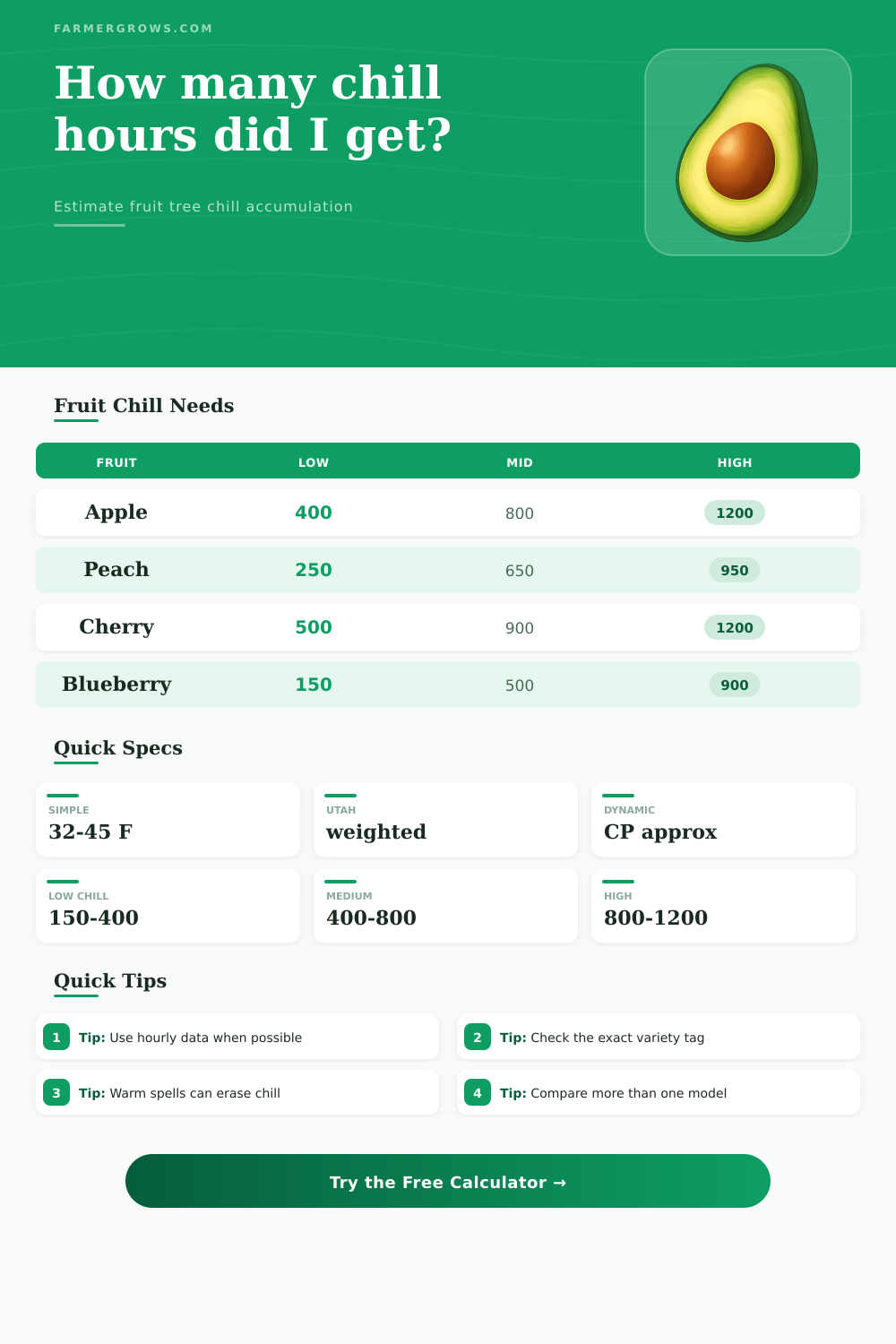
| Apple | 200 to 1200 hours | Anna, Dorsett Golden | High-chill apples may leaf and bloom unevenly in mild winters |
| Peach and nectarine | 150 to 950 hours | Flordaprince, Tropic Beauty | Match chill closely because bloom timing shifts with winter warmth |
| Sweet cherry | 700 to 1200 hours | Few true low-chill choices | Needs cold winters and good pollination timing |
| Blueberry | 150 to 900 hours | Southern highbush types | Choose type and cultivar for both chill and summer heat |
| Pear and plum | 250 to 1000 hours | Methley plum, Hood pear | Requirements vary widely across cultivars |
| Temperature band | Simple credit | Utah-style credit | Dynamic approximation credit |
|---|---|---|---|
| Below 32°F | 0 per hour | 0 per hour | 0.00 chill portions per hour |
| 32 to 36°F | 1 per hour | 0.5 per hour | 0.012 chill portions per hour |
| 37 to 45°F | 1 per hour | 0.5 to 1 per hour | 0.018 chill portions per hour |
| 46 to 54°F | 0 per hour | 1 per hour | 0.014 chill portions per hour |
| 55 to 60°F | 0 per hour | 0.5 per hour | 0.005 chill portions per hour |
| Above 60°F | 0 per hour | negative credit in warm bands | small warm reduction |
| Input method | What to enter | Calculation behavior | When to use it |
|---|---|---|---|
| Hourly entries | Weather station hourly temperatures | Scores each provided hour directly by the selected model | Best accuracy for orchards with local sensors |
| Average low/high | Average nightly low, average daytime high, and date range | Builds a 24-hour daily curve between low and high | Useful for planning before full hourly data is available |
| Warm interruption | Severity plus warm hours above 60°F per day | Subtracts a model-scaled penalty from the accumulated chill | Use when afternoons repeatedly rise above the chill range |
| Variety requirement | Catalog, nursery tag, or extension target | Compares total chill to the entered requirement | Shows surplus or deficit for a chosen fruit variety |
For variety choices: Treat the calculator as a screening tool. Final decisions should use cultivar-specific chill guidance from a local nursery or extension office.
For warm winters: Run both the simple and Utah-style models. A large difference usually means warm interruptions are important for that orchard site.
Fruit trees needs to experience a specific amount of cold temperature in order to perform correct. The specific amount of cold temperatures that the tree requires is referred to as the chill requirement of that particular tree species. The chill requirement of the fruit tree is required for the tree to break its dormancy and to flower proper.
Without receiving the chill requirement from the climate in which that tree is growing, the fruit tree may experience issues with its blooming periods, it may produce little fruit, or the tree may have long-term health problems as a result. The calculator that is presented in this article will allow you to calculate the amount of chill that your specific location receive during the previous year. You can use the data on temperature on an hourly basis or on a daily basis to determine the total chill accumulation that your area received.
How to Calculate Chill Hours for Fruit Trees
The chill accumulation that is calculated for different locations may vary due to the different models that is used to calculate the chill requirement of the area. For instance, the simple model calculate the chill accumulation for the location if the area experience temperatures within the range of 32 degrees and 45 degrees. The Utah style model provides credit for temperatures that are between 32 and 45 degrees, it does not provide credit for temperatures between 45 and 60 degrees, and it provides negative credit for temperatures that is above 60 degrees.
The dynamic approximation model uses portions of the chill accumulation to calculate the chill that is present based off the amount of hour that experience cool temperatures during a period of time. You can select each of these models using the calculator to determine the chill accumulation of your area. Warm weather can often interrupt the chill accumulation of the fruit trees.
Warm weather can lead to a reduction in the amount of chill that the fruit tree receive during its growing period. In these cases, you can enter warm weather into the calculator to adjust the chill accumulation according to the amount of warm weather that was experienced during that portion of the year. The settings for warm weather can be light, moderate, or strong warm seasons, and the user can also enter the length of the portion of the year that the area experience temperatures above 60 degrees.
The model determines the portion of the chill accumulation that is lost due to warm weather according to the model that was used to calculate chill accumulation for the area. In order to use the calculator to determine the chill accumulation of your area, you must know the chill requirement of the specific type of fruit trees that you desire to grow. The chill requirements for these varieties are often provided on the tags of the plants in nurseries, or provided in agricultural extension publications.
These values are provided as ranges of chill hour because different locations experience different amounts of warm weather throughout the year. For instance, a fruit tree variety that requires 600 chill hours in one location may require 700 chill hours in another location due to the warm weather in that other location. The chill hour requirement can be entered into the calculator to compare the chill accumulation to that requirement for the area.
Temperature data can be provided on an hourly basis for the most accurate measurement of chill accumulation. However, most people will not have access to this data. An alternative is to use the average low and high temperature for each day.
This mode uses these two temperatures to create a daily curve that display temperatures throughout the day. While this is an approximation of the chill accumulation, it is often sufficient for determining whether the chill accumulation for your area is sufficient for the type of fruit trees that you would like to grow in that area. The time period that is used for measuring the chill accumulation is important.
If you start too early, you may include periods of warm weather that does not contribute to chill accumulation. If you end too late, you may include hours of chill accumulation of a time period when the tree had begun to bloom. Most growers start in the late fall and end in the late winter when the temperatures begin to rise during that portion of the year.
The users of the calculator can alter these dates. If the chill accumulation that is calculated for the area that you intend to grow your fruit trees is only marginal, then the fruit trees will experience issues with even blooming. These plants may bloom at different times, and the frosts that may occur after blooming may destroy the blossoms that bloom later.
While fruit trees with low chill requirements are more likely to experience even blooming, there is still a minimum amount of chill that is required for the trees to break dormancy and begin to bloom. You can calculate chill accumulation using the different models to determine whether the chill that was experienced during that year was marginal or insufficient for the area and the type of fruit trees. Different types of fruit have different requirements for chill accumulation, and most of those requirement are different in different climate zones.
Apples can grow in a variety of different climates. For instance, some varieties of apples can grow best in climates with mild winters, while other varieties require the chill of continental climates. Other fruits, like cherries and peaches, have more exacting requirements of chill accumulation.
Other fruits, like blueberries have lower requirements for chill accumulation than fruits like plums. By using the chill accumulation calculator, you can compare the results of the different models. For instance, calculate the chill accumulation using the simple model for chill accumulation, and then calculate again using the Utah style model.
The difference in the two calculation will indicate whether warm weather impacted the chill accumulation of the area. In cases with a great deal of warm weather, the dynamic approximation model will provide a third calculation of chill accumulation. Chill accumulation calculated using the three models will allow you to determine if the chill accumulation for the area was sufficient to support the type of fruit trees that you would like to cultivate in your orchard.
One indication of the chill accumulation in your area is the percentage of the chill requirement that was provided. For instance, reaching 95% of the required chill accumulation for the specific type of fruit tree that you are cultivating indicates that you may have a slight problem of insufficient chill accumulation for that type of fruit tree. Conversely, reaching 70% of the chill requirement for that type of fruit tree may indicate that the fruit tree will struggle to bloom and produce fruit most year in your area.
This percentage is provided for the benefit of the growers to understand the chill accumulation without having to perform the calculations themselves. Eventually, you will become aware of which weather patterns have the most impact upon the chill accumulation of your area. For instance, a warm week in January will have a greater impact upon chill accumulation than many cool nights.
Cool nights between 30 and 40 degrees will allow for rapid chill accumulation. By making records of the chill accumulation for several growing seasons, you can form an understanding of your area’s climate. The main goal for using the chill accumulation calculator will be to understand whether the climate of your area is adequate for the types of trees that you wish to grow.
The calculation can act as a filter for your decision, but you should make the decision itself according to your experiences with farming in the area, and based upon the information that a local nursery or extension agent provides to you.