Chicken Manure Per Acre Calculator
Estimate poultry litter or chicken manure tons per acre from acreage, broiler or layer source, litter analysis, moisture, bedding fraction, target N or P, first-year availability, timing, burn cap, and spread uniformity.
Pick a named poultry manure situation, then adjust the actual lab analysis, moisture, bedding fraction, target nutrient, mineralization, incorporation timing, and spreader uniformity for your field.
Chicken Manure Application Estimate
Rate estimate based on the selected poultry manure type and target nutrient.
Fast nutrient release when incorporated, but moisture, cake, and bedding can make the spread pattern variable.
Often less bedding than broiler litter, with meaningful phosphate and calcium carryover for soil-test planning.
More stable and easier on seedlings, but first-year nitrogen availability is usually lower than fresh litter.
Dry pellets spread more evenly and handle well, though the actual product label should drive analysis entries.
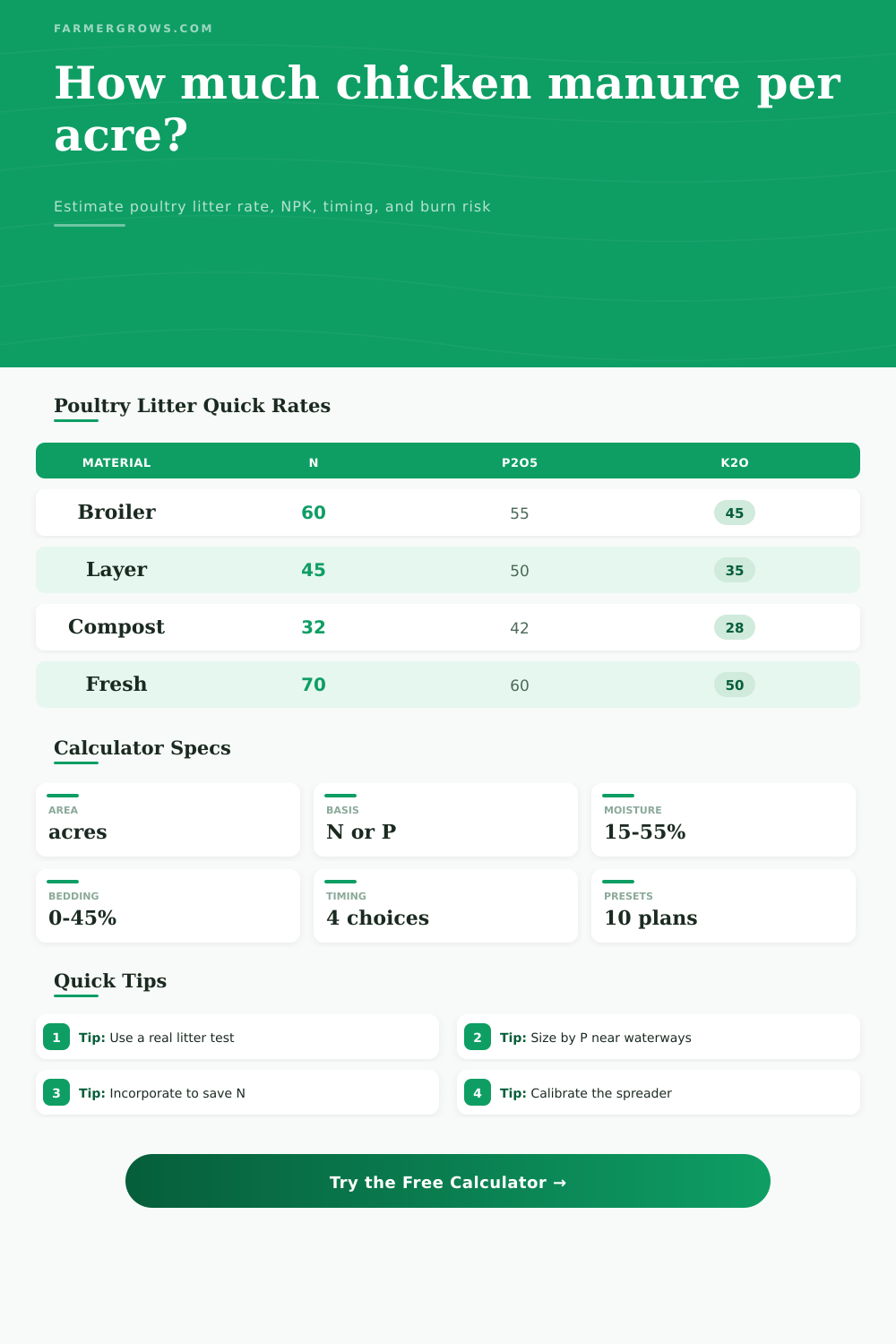
| Poultry material | Total N lb/ton | P2O5 lb/ton | K2O lb/ton | Common moisture |
|---|---|---|---|---|
| Fresh broiler litter with shavings | 55 to 75 | 45 to 70 | 35 to 55 | 22% to 35% |
| Stacked broiler litter | 45 to 65 | 45 to 65 | 35 to 50 | 25% to 40% |
| Layer manure, scraped house | 35 to 55 | 40 to 65 | 25 to 45 | 30% to 50% |
| Belt-dried layer manure | 60 to 90 | 70 to 110 | 45 to 70 | 8% to 18% |
| Composted poultry litter | 25 to 45 | 35 to 60 | 20 to 40 | 25% to 45% |
| Pelletized chicken manure | 50 to 90 | 40 to 80 | 25 to 55 | 5% to 15% |
| Application timing | N timing factor | Best fit | Loss risk | Calculator effect |
|---|---|---|---|---|
| Incorporated within 24 hours | 1.00 | Preplant fields and tilled beds | Lowest volatilization risk | Counts full entered N availability. |
| Incorporated within 3 days | 0.88 | Farms waiting on tillage or rain | Moderate surface loss | Reduces available N by 12%. |
| Surface applied before rain | 0.74 | Pasture, hay, and cover crops | Rainfall timing decides N saved | Reduces available N by 26%. |
| Warm surface delay | 0.58 | Emergency spreading windows | Highest ammonium loss and odor | Reduces available N by 42%. |
| Target basis | Example target | Example litter | Availability used | Approx rate |
|---|---|---|---|---|
| N based vegetable preplant | 70 lb available N/ac | 60 lb total N/ton | 55% N | 2.1 tons/ac |
| N based pasture boost | 50 lb available N/ac | 55 lb total N/ton | 45% N | 2.0 tons/ac |
| P based runoff-sensitive field | 35 lb P2O5/ac | 55 lb P2O5/ton | 80% P2O5 | 0.8 ton/ac |
| Compost organic matter pass | 25 lb available N/ac | 32 lb total N/ton | 30% N | 2.6 tons/ac |
| Field condition | Suggested uniformity | Burn-risk cap | What to watch | Practical response |
|---|---|---|---|---|
| Calibrated litter spreader, dry material | 90% to 95% | 3 to 4 tons/ac | Even swath edges | Check pan pattern and overlap width. |
| Variable cake and bedding chunks | 75% to 85% | 2 to 3 tons/ac | Clumps and streaking | Screen, remix, or slow the ground speed. |
| Fresh litter before direct seeding | 70% to 85% | 1 to 2 tons/ac | Salt and ammonium injury | Apply early and keep manure off seed rows. |
| Composted poultry manure | 80% to 90% | 3 to 5 tons/ac | Lower first-year N | Base crop N on lab mineralization estimates. |
Let the lab test lead the rate. Poultry litter can vary a lot by bird type, feed, bedding, house cleanout, cake fraction, storage time, and moisture. Enter current as-spread values whenever possible.
Respect phosphorus and salt limits. Chicken manure can meet nitrogen needs while over-supplying P2O5, salts, or ammonium near seedlings. Use the lower-of-N-and-P option for sensitive fields.
Chicken litter is a black box to you, but there’s more going on than that. It contains nitrogen, phosphorus, potassium, salts and bedding material. Pile it onto your field, let the rain work with it, and pray for corn. Get your rate wrong, though, and you’ll either singe your seedlings or have your soil test off the charts for years.
Plug in your manure analysis and field size into the calculator above, and it will do the math for you, sparing you the guesswork of moisture adjustments and availability factors. Broiler litter and composted layer manure aren’t like-for-like substitutes. You should of know that right off.
How to Use Chicken Litter Safely
Fresh broiler litter contains a lot of ammonium nitrogen that is readily available, but it is volatile unless covered up. Composted material is relatively stable and will release its nitrogen throughout the season. With fresh litter, timing’s the key. Tilling in within 24 hours captures the nitrogen. But a week-long wait in warm conditions? Well, you might as well be fertilizing the air different than the ground.
The tool takes that timing variable into account. It calculates precisely how many pounds of available nitrogen you’re losing each day you put off tilling.
The silent budget buster in applying poultry manure is phosphorus. Poultry manure are frequently high in phosphorus…sometimes too high. And many of our fields reaches their nitrogen needs before they reach their phosphorus capacity. That’s the problem.
What do you do? Do you apply so much that you meet your crop needs but risk losing phosphorus through runoff and breaking regulations? Or you could apply less, which spares water quality but fails to provide enough nitrogen for the crop.
The calculator lets you size by either phosphorus or nitrogen. It is a little change, but it completely transforms the approach. It makes you face the fact that with manure, you’re not just applying a nitrogen source. You’re delivering a complete package of nutrients… And all those nutrients has to be balanced.
Another trip-up factor is moisture content. A ton of dry pellets have more nutrients than a ton of wet litter. That’s why the calculator changes your lab results to an as-spread basis so it can account for this variable. When your lab reports come back with nutrients expressed on a dry matter basis, you need only enter proper moisture percentage so that you don’t over-apply or under-apply.
And remember, your spreader itself will be affected by high moisture. Dry pellets fly; wet cake clumps. You want uniformity. Spreading three tons in one place and none in another creates areas of salt injury; and missed spots. By setting a reasonable uniformity percentage in the tool, you’re able to protect yourself from such unevenness.
Bedding like straw, sawdust, or rice hulls adds bulk without adding nutrients. Adding more bulk dilutes the concentration even further. For example, applying a litter containing 40% bedding will require more tons than clean manure to provide the same amount of nitrogen.
Enter the burn risk cap. Even if the lower nutrient concentration can be made up by applying more tons, you don’t want to apply infinitely many to compensate. Why? This is because seedlings can also handle ammonium and salts. Applying beyond that cap will cause root burn. Regardless of how much nitrogen may be technicaly available. The tool imposes this limit to protect your crop from well-meaning over-application.
But ultimately it’s up to your local conditions (see the range of typical values on the reference tables on that page). And there’s no substitute for a lab test. Litter chemistry change with feed changes, house management, and storage time. What worked for your neighbor may not work for you.
Model various scenarios using the calculator. What happens if you compost the litter first? How does delaying incorporation impact your nitrogen budget? It makes a complex set of chemical equations manageable as a field plan.
It is not about dumping manure; it is about applying nutrients exactly where they are needed, where plants can use them and the environment can handle them. Get the rate right, and turn waste into wealth, not a liability.