🐔 Chicken Feed Calculator
Plan feed for chicks, pullets, layers, broilers, bantams, roosters, and mixed pens from bird count, age class, feed type, daily ounces, waste, days, protein target, treats, and bag size.
Choose a flock preset to seed the fields, then adjust the ounces per bird, waste allowance, protein target, treat share, and bag size to match your feeders and local feed bags.
Feed Plan Results
Your feed estimate will appear here after calculation.
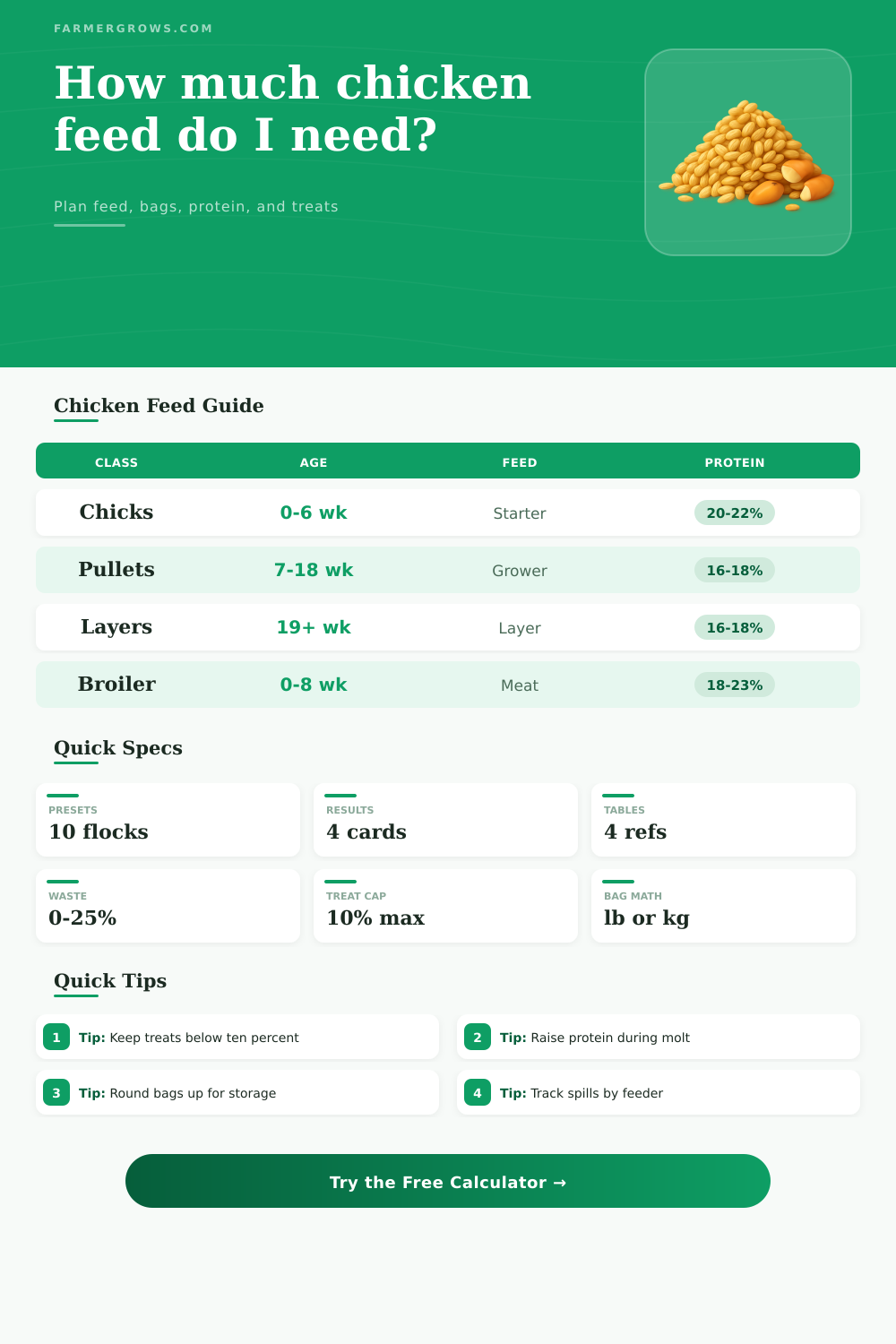
| Age or class | Typical age | Daily feed per bird | Protein guide |
|---|---|---|---|
| Starter chicks | 0 to 6 weeks | 1.0 to 2.2 oz | 20 to 22 percent |
| Grower pullets | 7 to 18 weeks | 2.4 to 3.4 oz | 16 to 18 percent |
| Laying hens | 19 weeks and older | 3.5 to 4.5 oz | 16 to 18 percent |
| Broiler growout | 0 to 8 weeks | 2.0 to 8.0 oz | 18 to 23 percent |
| Bantams | Adult small breeds | 1.5 to 2.4 oz | 15 to 17 percent |
| Roosters | Adult maintenance | 3.5 to 5.5 oz | 14 to 16 percent |
| Feed type | Typical protein | Best fit | Planning note |
|---|---|---|---|
| Chick starter crumble | 20 to 22 percent | Brooder chicks | Use until birds transition to grower feed. |
| Grower feed | 16 to 18 percent | Pullets | Lower calcium than layer feed. |
| Layer pellet or crumble | 16 to 18 percent | Laying hens | Includes calcium for shells. |
| All-flock feed | 18 to 20 percent | Mixed pens | Offer oyster shell separately for layers. |
| Meat bird ration | 18 to 23 percent | Broilers | Match phase to growth rate. |
| Scratch grain blend | 8 to 10 percent | Treat only | Use as a limited supplement. |
| Bag size | Weight | Layer-days at 4 oz | Good use |
|---|---|---|---|
| 25 lb bag | 11.3 kg | 100 bird-days | Small flock, fresh rotation |
| 40 lb bag | 18.1 kg | 160 bird-days | Backyard coop |
| 50 lb bag | 22.7 kg | 200 bird-days | Common feed-store size |
| 55 lb bag | 24.9 kg | 220 bird-days | Metric-style sacks |
| 80 lb purchase | 36.3 kg | 320 bird-days | Two 40 lb bags |
| 100 lb purchase | 45.4 kg | 400 bird-days | Two 50 lb bags |
| Treat share | Ration effect | Protein risk | Use case |
|---|---|---|---|
| 0 percent | Complete feed only | Lowest dilution | Chicks, broilers, recovery birds |
| 5 percent | Small supplement | Usually manageable | Training, winter scratch, garden greens |
| 10 percent | Upper routine limit | Watch protein and shells | Adult backyard birds only |
| 15 percent | Strong dilution | Likely too much | Short-term use with caution |
| 20 percent or more | Ration imbalance | High risk | Reformulate or reduce treats |
If feed piles up as dust or birds bill it onto the floor, raise feeder height, narrow the lip, or add a spill tray before increasing the waste percentage.
Chicks, fast broilers, molt recovery, and breeder pens often need more protein than maintenance birds, while scratch grain usually pulls the average down.
This calculator is a planning tool for feed ordering and ration review. Follow feed labels, local extension advice, and veterinary guidance for medicated feed, withdrawal periods, deficiencies, or disease concerns.
Feeding chickens require an understanding of how the nutritional need of chickens change with the age and environment of those chickens. As chickens ages, their needs for certain nutrients changes. For instance, chicks requires a high level of protein in their feed in order to grow there feather and bones.
After the chicks have matured into adult chickens, however, their needs for protein decreases, as do their needs for calcium in order to produce egg. If you dont provide the correct amount of nutrition to the chickens, the chickens will produce fewer eggs, and the eggs will have more weaker shells. Furthermore, the weather or the chickens’ natural molting process may change the amount of feed that must be provided to the chickens.
How to Calculate Chicken Feed Needs
A calculator can help to determine the amount of feed that should be purchased for the chickens by converting each of these variable to the total count of bags of feed that are necessary to feed the flock. The calculator allow for the input of the number of chickens, the number of ounces of feed that each chicken eats per day, and the number of treats that is provided to the chickens each day. Treats often contain a lower percentage of protein then the feed that is provided to the chickens.
If the percentage of protein in the feed is too low due to the inclusion of many treats, the chickens may lay fewer egg with weaker shells. Waste that occurs from the chickens or rodents in the barn can also impact the amount of feed that is necessary for the chickens. Chickens often kick feed onto the ground, rodents often consume the feed, and the chickens often eat only part of their provided feed.
Therefore, the calculator can adjust the percentage of feed waste in accordance with the feeding setup of the chickens. For instance, if the feed is placed in a covered feeder, there will be less waste than if the feed was provided in an open trough. Furthermore, if there is alot of feed on the ground, the allowance for waste in the calculator should be adjusted.
Many treats can be provided to chickens as a means of providing the chickens with some enjoyable activity. However, if too many treats are provided, the chickens may eat fewer complete feed bags of feed. Therefore, treats should be provided to the chickens in amounts no greater than 10% of the total feed intake of the flock.
If treats are provided in amounts exceeding 10% of the total feed intake of the chickens, the chickens will eat the treats rather than the complete feed, thus reducing the protein levels within the chickens body. Furthermore, the calculator allow for the determination of the weighted protein levels of the feed after the treats are included into the feed schedule. Thus, the calculator can be used to determine if the protein levels is sufficient for the chickens’ diets.
Beyond the determination of the amount of feed that is required for the chickens, other factor must be considered when purchasing that feed. Such factors include the size of the bags of feed, and in what location the bags of feed will be stored. The amount of feed that is calculated as being necessary may not be the amount that should be purchased.
For instance, if storm are common in the area, it is likely that the chickens will not always have access to the feed store. The same can be said for holidays at the feed store. Therefore, it is a suggestion to round up to the next whole bag of feed.
This extra bag of feed will provide extra feed for the chickens during the winter month (when the chickens require eating more for warmth), as well as in case more chickens are added to the flock. Changes in the weather can impact the eating habit of the chickens. For instance, when it is hot outside, the chickens may eat less feed, but when it is cold outside, the chickens will eat more feed.
Additionally, during the chickens’ molting process, the chickens require more protein. These type of changes are common and can be compensated for through the use of the calculator. Furthermore, if additional feed is purchased, the calculator can help to determine if the type of feed should be changed.
For instance, if the protein levels are too low for the chickens, a different type of feed may be purchased. However, if the protein levels are within the necessary range for the chickens, then the type of feed dont need to be changed. Thus, through the calculator, the protein levels of the feed can be determined.
Furthermore, if any changes in eating habit are noticed in the chickens, the feed schedule can be compared with the baseline schedule to determine if such changes is normal for that flock. By monitoring the feeder and the chickens eggs, the owner can ensure that there is a steady rhythm of nutrition provided to each chicken in the flock.