Cherry Tree Time to Bear Fruit Calculator
Estimate when a sweet or sour cherry tree should bloom, set its first usable crop, and reach a stronger harvest based on age, rootstock, pollination, chill, frost, and care.
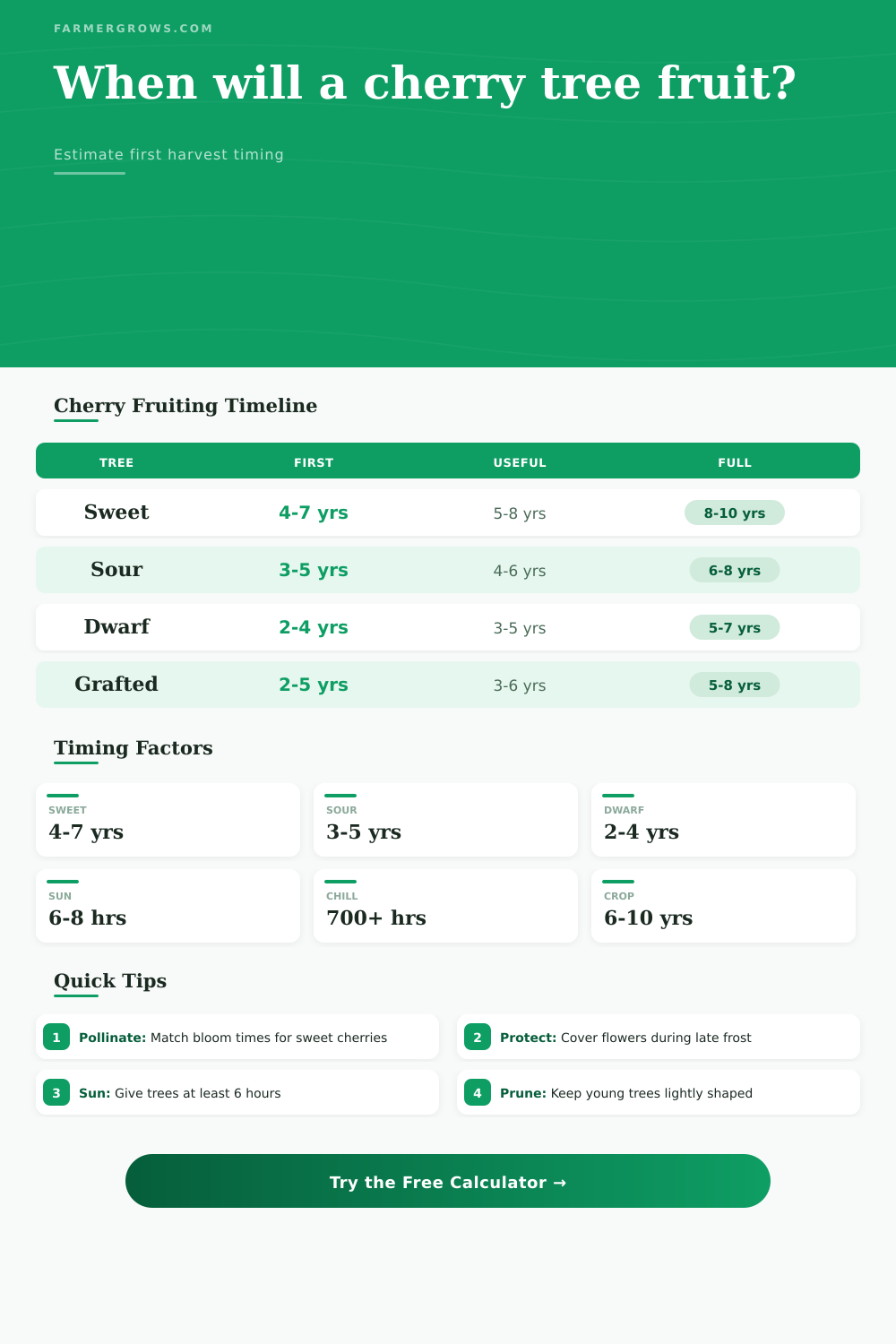
| Cherry type | First light crop | Useful crop | Full production |
|---|---|---|---|
| Sweet cherry | 4 to 7 years | 5 to 8 years | 8 to 10 years |
| Sour cherry | 3 to 5 years | 4 to 6 years | 6 to 8 years |
| Duke or hybrid cherry | 3 to 6 years | 4 to 7 years | 7 to 9 years |
| Seedling cherry | 6 to 10 years | 7 to 12 years | 10 or more years |
| Rootstock | Vigor | Fruiting effect | Common use |
|---|---|---|---|
| Dwarf | Small tree | Often fruits earlier | Patios and tight gardens |
| Semi-dwarf | Moderate tree | Balanced start and yield | Home orchards |
| Standard | Large tree | Usually slower to bear | Large yards and farms |
| Unknown | Variable | Use semi-dwarf estimate | Older unlabeled trees |
| Bloom season | Typical bloom | Harvest timing | Frost exposure |
|---|---|---|---|
| Early | Early to mid spring | Late spring to early summer | Higher |
| Midseason | Mid spring | Early to midsummer | Moderate |
| Late | Mid to late spring | Midsummer | Lower |
| Cold climate | After dormancy breaks | Shorter summer window | Site dependent |
| Limiting factor | Delay risk | What it affects | Best correction |
|---|---|---|---|
| No pollinator | High | Fruit set after bloom | Add compatible cultivar |
| Late frost | High | Flowers and young fruit | Protect bloom nights |
| Low sun | Moderate | Flower bud formation | Open canopy or relocate |
| Wet soil | Moderate | Root growth and vigor | Improve drainage |
If this is your first year of blooms on a cherry tree, you figure it’s all over now. Flowers open. Pollination happens. Then you just sit back and await the fruit. But what? Nothing happen, or else the flowers falls off without setting.
Unless there’s been some human error, that’s typically not you… It’s usually biology. Your trees has their own inner clock. It is set to winter chill hours (the amount of cold weather required), to pollination partners, and even to rootstock vigor. If the tree hasn’t made up its mind to do the deed yet, there’s no hurrying it along.
Why Your Cherry Tree Has No Fruit
There’s a tool to take the guesswork out of when, though: a calculator that factors in your specific site conditions against average orchard information. It is also important to know which kind of cherry you planted. Generally speaking, sour cherries gets up and going much faster (some as soon as three years); sweet ones take longer (five or more). A dwarf tree on your patio will yield faster, but again, keep in mind that smaller trees has less stored energy. Those starting points are factored into the calculator.
Was it a fast or slow starter you got? Or is it a neglected fast one now? Then there’s the matter of what tree you want: how big or small? That’s what rootstock is about. With standard rootstock, you get a large tree. Lots of wood production for many years and then eventually some fruit.
With a dwarf rootstock, the tree simply can’t gets so big, so it goes right into reproductive mode sooner. If you don’t know what rootstock the nursery used, the tool defaults to semi-dwarf. This provides a balance between giving too much hope and causing unnecessary disappointment.
Many gardeners trip up on pollination. Most sweet cherries is self-sterile, relying on another compatible variety to bloom simultaneously in order to set fruit. Even if you have one of these trees and it flowers well and appears healthy, it won’t produce fruit without a partner; it will just drop its blossoms instead. The tool queries how you’ll be pollinating. Without a partner, not only will you wait longer for fruit, but you won’t get any for that year at all.
Sour cherries is mostly self-fertile, which makes them easier for single plant.
The site factors are quieter, but also important. To reset its dormancy cycle, cherry trees requires a deep winter chill. In mild climates where winter temps seldom gets low enough, it may never break bud correctly. Because flower buds develop on last year’s wood, the tool takes into account sun exposure. Flower buds on these trees is weaker without good light. The tool also considers chill match. Wet soil weakens that wood as well. This results in few flowers and poor fruit set later.
Cherry crops are vulnerable to spring frosts. If there’s a late freeze, early-blooming cherries are more likely than later ones to have their blossoms destroyed in a single night. The calculator takes into account frost pressure to show you the odds you’re working with. When do you think your crop will bloom, given your local frost dates?
Be patient with your young trees. In their first season or two of production, many will set a light crop and drop most of it, to save themselves from working too hard. Early thinning of fruit can help the tree get stronger for larger crops down the road. Better to have one good crop then five bad ones that weaken the tree.
The bottom line: A cherry tree is an investment, and a long term one. Planting for future summers, not the weekend’s snack. Knowing how the biology of your tree works are key to caring for it well and managing your expectations. Then when that moment arrives, you’ll be prepared to protect those beloved blooms so that they pay off (eventually) with what Mother Nature will provide.
You should of known this earlier. Actualy, it is more complicated than it looks. The moddern gardener must be carefuly aware of the site conditions based off soil types.