Chain Link Fence Calculator
Estimate chain link fence fabric, line posts, terminal posts, gate openings, top rail, tension wire, bands, bars, concrete, privacy slats, and waste for farm, garden, yard, and access projects.
Enter the total path length including gate openings. The calculator subtracts gate widths from the fabric run, lays out line posts by straight segments, then rounds hardware and concrete to practical whole pieces.
Chain link material estimate
Rounded material quantities based on your fence path, gate openings, terrain, and waste allowance.
| Fence condition | Typical spacing | When to reduce spacing | Layout note |
|---|---|---|---|
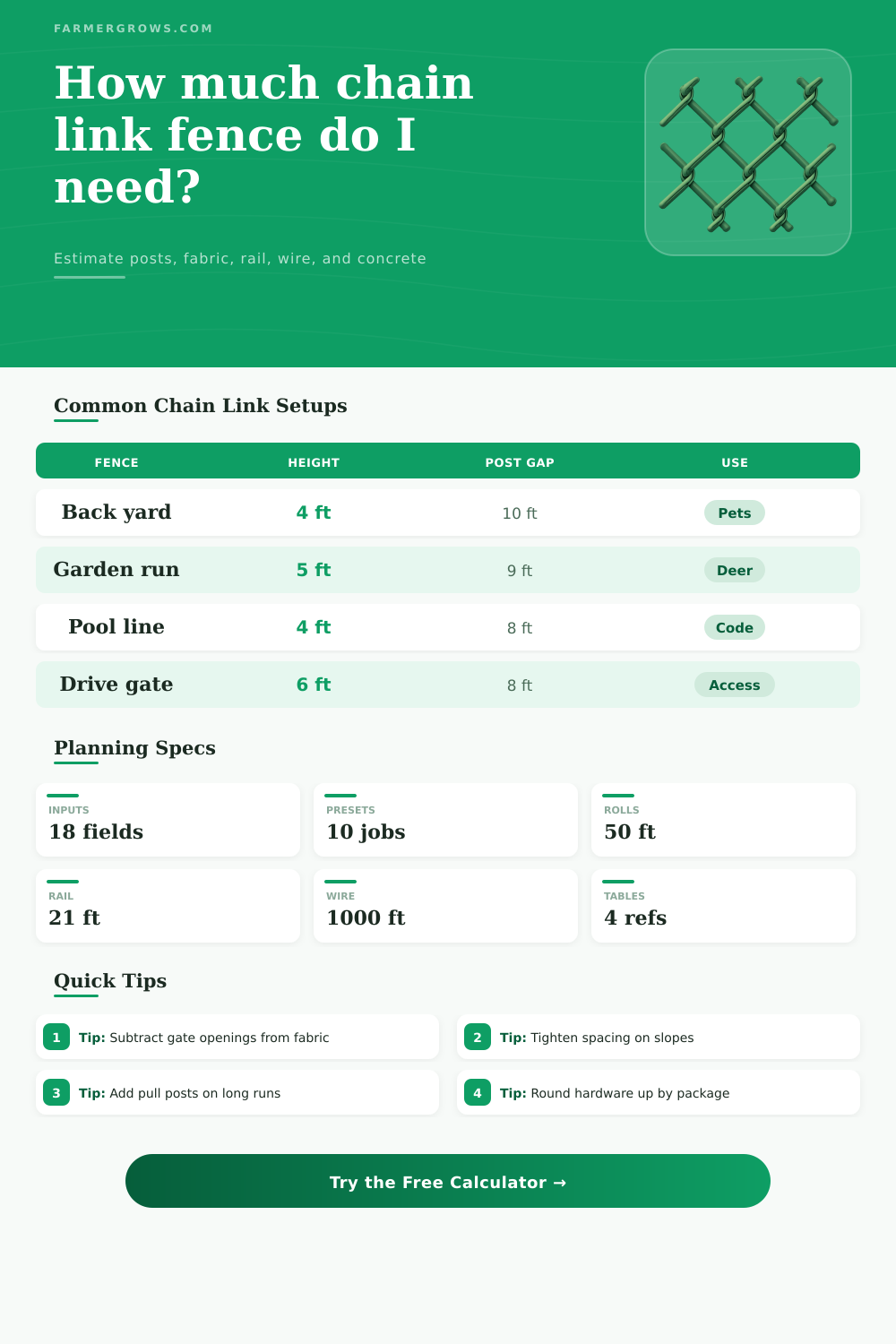
| 4 ft residential fence | 9 to 10 ft | Pets push fence or soil is soft | Common for straight, flat yard runs. |
| 5 to 6 ft garden or pasture edge | 8 to 10 ft | Rolling grade or long exposed lines | Add pull posts at corners and slope changes. |
| 6 ft security fence | 8 ft | Privacy slats, wind, or heavy fabric | Terminal posts and bracing become more important. |
| 8 ft tall enclosure | 6 to 8 ft | Open wind or top extensions | Check local engineering and post embedment. |
| Steep or terraced ground | 6 to 8 ft | Racked fabric or stepped panels | Shorter spans keep the fabric line cleaner. |
| Fabric roll | Best use | Coverage before waste | Planning note |
|---|---|---|---|
| 25 ft repair roll | Short patches and small runs | 25 linear ft | Useful when a gate or corner leaves a short remainder. |
| 50 ft residential roll | Most yard and garden fences | 50 linear ft | Easy to handle and common at retail suppliers. |
| 100 ft bulk roll | Long straight runs | 100 linear ft | Reduces seams but is heavier to stretch. |
| 150 ft contractor roll | Field, farm, and security projects | 150 linear ft | Best with proper stretch bars and extra help. |
| Slatted fabric run | Privacy or screening | Use net fabric length | Gate openings still do not receive fence fabric. |
| Ready-mix bag | Approx yield | Useful for | Calculator use |
|---|---|---|---|
| 40 lb bag | 0.30 cu ft | Small repairs | Divide total concrete by 0.30 and round up. |
| 50 lb bag | 0.375 cu ft | Light post jobs | Good for small batches and tight access. |
| 60 lb bag | 0.45 cu ft | Common fence work | Main result card uses this size. |
| 80 lb bag | 0.60 cu ft | Larger terminal holes | Fewer bags, but heavier to lift and mix. |
| Bulk concrete | 27 cu ft per yard | Large commercial runs | Convert total cubic feet to cubic yards. |
| Hardware item | Quick rule | Where it is used | Why it matters |
|---|---|---|---|
| Tension bands | Height divided by spacing | Terminal and gate posts | Hold the tension bar and fabric edge to the post. |
| Tension bars | One per stretched fabric edge | Ends, corners, pull posts, and gates | Spread pull force along the full fabric height. |
| Brace bands | Two per terminal is common | Top rail ends and bottom wire | Connect rail ends, truss rods, or wire fittings. |
| Rail sleeves | One fewer than rail pieces per run | Top rail joints | Join swedged or plain rail sections between terminals. |
| Tie wires | Post ties plus rail ties | Line posts and top rail | Fasten fabric while allowing the system to flex. |
Measure the fence line as installed. Gate openings, corner pull posts, and slope changes all affect fabric cuts, rail splices, and terminal hardware. Mark those points before ordering rolls.
Round posts and hardware up. Chain link parts are sold as whole pieces, and having a few extra ties, bands, sleeves, and rings keeps the installation from stalling mid-stretch.
Building a chain link fence requires that you calculate the materials you will need to complete the fence. Before beginning to build the fence, you can measure the length of your property line with a tape measure. However, building a fence is more than measuring the property line, as the fence must also include the installation of gate, fence posts, concrete, and fabric panels.
The terrain on which the fence will be built also plays a role in the materials necessary for constructing the fence; the type of terrain will change the amount of fence materials that is required for construction. The calculator that is provided can calculate these materials for the fence; it performs the calculations necessary to determine the length of the fence path, the height of the fence, the number of gate openings, and the type of terrain in which the fence will be constructed. The length of the fence path is one of the primary measurements that must be made prior to calculating the materials for the fence.
How to Calculate Materials for a Chain Link Fence
The length of the fence path will also have to account for the measurements of the gate openings for the fence. The sections of the fence that contain gates will not contain fence fabric panels, so you will have to subtract the gate openings from the total length of fabric that will be required for the fence. The calculator will automatically subtract the length of the gate openings from the total length of fabric that is calculated for the fence.
However, the length of the fence path will also include terminal posts at every corner of the fence. Each of these terminal fence posts will require a larger hole in the ground than the line posts, and will, therefore, require more concrete for installation. The number of these angles in the fence will impact the amount of concrete for the fence posts and the number of terminal fence posts that will be required for construction.
The spacing at which you will install the fence posts is another critical measurement for constructing the fence. The spacing between fence posts will impact the number of line fence posts that will be required for installation between the terminal fence posts. The terrain in which the fence will be constructed can determine the spacing between fence posts.
For flat terrain, wide spacing between the fence posts can be used. However, if the fence is to include privacy slats or if the terrain is sloped, the fence posts must be installed at closer distances to each other. The type of terrain that you select with the calculator will adjust the spacing between the fence posts to ensure that the fence lines will not pull away from the fence posts.
Additionally, if the terrain is rolling or steep, more fabric and fence posts will be required. An allowance for waste in the calculation of fabric rolls is made for these types of terrain to account for the additional fabric that may be required to ensure that the fence remains standing straight and stabile. The amount of concrete that will be required is another calculation that those that are building a fence often perform incorrectly.
The amount of concrete for the fence will require the calculation of the amount of concrete for both the line fence posts and the terminal fence posts. The line fence posts will require one size of hole in the ground for installation of the fence post, whereas the terminal fence posts will require a larger diameter hole in the ground. The calculator will determine the amount of concrete for each of these different fence posts types, and will round each measurement up to the nearest whole bag of concrete that is required.
The same calculations are made for the amount of tension wire, fence rail sections, and privacy fence slat packs. These calculations can be viewed on the output cards for the fence building project. Gates will impact the amount of materials that is required to build the fence.
Each gate will require two terminal fence posts for construction, extra bands for the fence panels to allow for the gate to open and close, and will require additional amounts of concrete for the foundation of the posts as they will have to be constructed to support the weight of the gate. If a wide, double gate is selected, there are advantages for using such a gate for the fence, however, the construction of such a gate will require more fence posts and bracing than a single walk gate for the fence. Using the fence material calculator allows individuals to understand these types of changes to the fence materials before they order the fence materials.
Privacy fence slats will add to the wind load of the fence, and the wind load will change the requirements for the fence posts. When privacy fence slats are added to a fence, the fence will catch the wind. Additionally, the calculator will provide a warning for those individuals that may wish to build tall fences with privacy slats; the fence posts and the spacing between the fence posts for a plain mesh fence may not be able to withstand the amount of wind load that will be placed onto the fence with the addition of the privacy slats.
Therefore, each individual must make sure that their fence posts will be the correct size, and that the distance between the fence posts will be close enough to the required distance to withstand the wind load. The reference tables provide information that is in addition to the calculations of the fence materials that are provided by the calculator. One reference table indicates the various spacings between fence posts based off the height of the fence that will be constructed.
Another table indicates how the length of the fabric rolls will affect the cost of the fence. Additionally, a fence material yield table is provided; this table will assist in ensuring that individuals dont purchase the wrong size bag of concrete for the fence holes. These tables will allow individuals to compare the quantities of materials that are calculated for their fence plan to common fence construction plans.
The numbers that the fence material calculator provides will tell individuals if their plan for their fence is feasible. After reviewing the final calculations for the fence materials, individuals should walk the fence line one more time to make sure that the plan for the fence appears to be accurate. If the calculations for the materials indicate that an amount of fabric, for instance, is high in comparison to other fences, it is likely due to the terrain on which the fence will be constructed; high terrain will require more fence pull posts to be installed at various points along the fence line.
By reviewing these calculations before individuals order the fence materials, they can ensure that the fence will stand straight and stable for a long time.