Cereal Rye Seed Per Acre Calculator
Estimate cereal rye seed for cover crop biomass, fall or spring grazing, grain production, erosion protection, or late-season residue using acres, target lb/ac, seed size, germination, field emergence, planting method, date, row spacing, and residue goal.
Choose a realistic cereal rye planting plan, then adjust the acreage, purpose, seed lot, planting date, row spacing, and residue goal for your field.
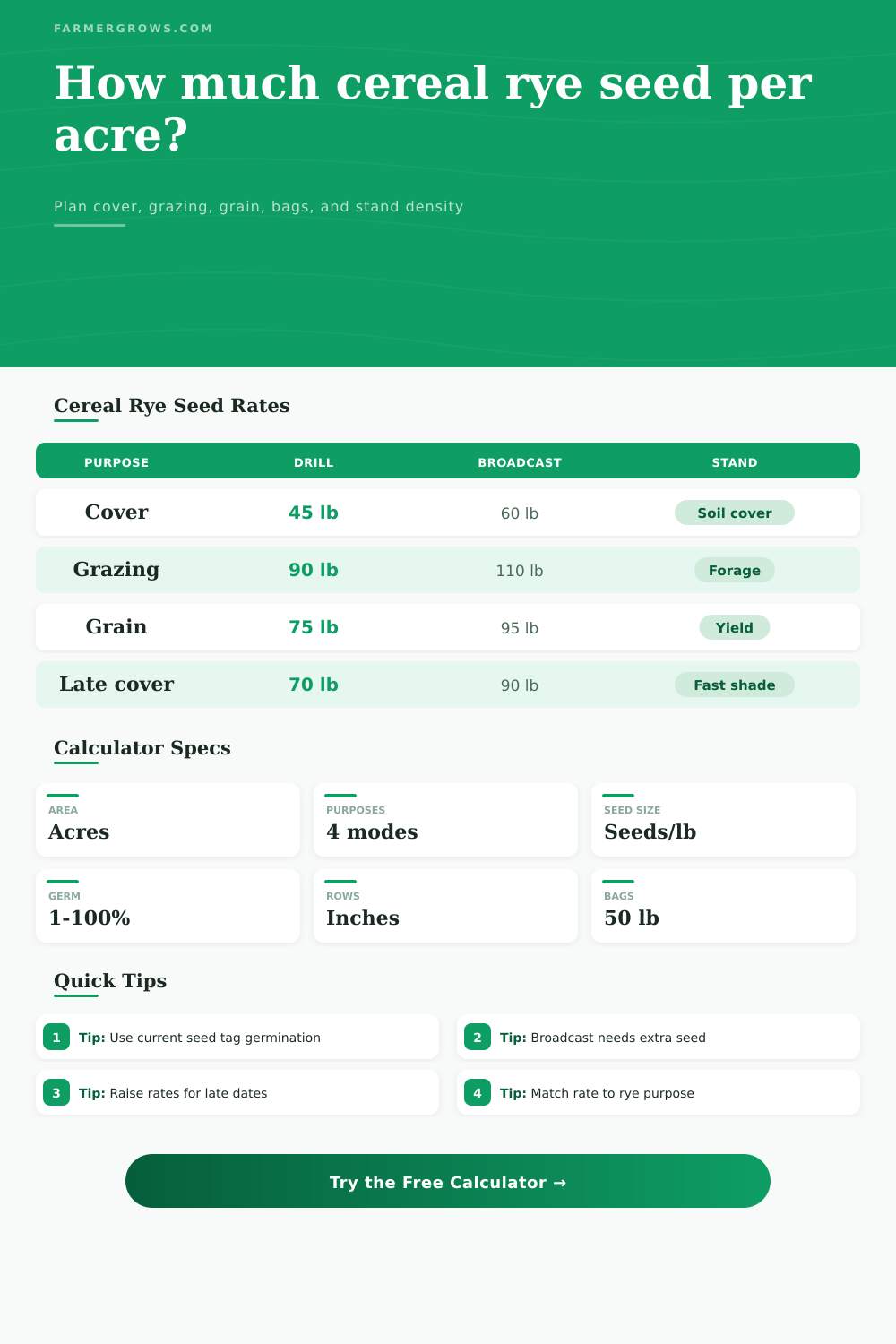
Cover crop plans usually balance soil armor, root growth, termination timing, and seed cost by using moderate drilled rates and higher broadcast rates.
Grazing stands use higher rates because the goal is dense forage, faster canopy closure, and recovery after livestock traffic.
Grain production focuses on uniform heads and lodging control, so the calculator keeps a steady stand without chasing maximum biomass.
High-residue systems push the rate upward when heavy cover is needed for weed suppression, moisture protection, or roller-crimp timing.
Cereal Rye Seeding Results
Results update from purpose, acres, seed lot quality, planting method, date, row spacing, and residue goal.
| Planting purpose | Drilled starting rate | Broadcast starting rate | Best fit |
|---|---|---|---|
| Basic cover crop | 45 to 60 lb/ac | 60 to 80 lb/ac | Soil cover, erosion control, nutrient capture, and overwinter root growth. |
| Late cover crop | 65 to 90 lb/ac | 80 to 110 lb/ac | Short fall growth windows where faster canopy closure is needed. |
| Grazing forage | 90 to 120 lb/ac | 100 to 140 lb/ac | Fall grazing, spring grazing, or haylage where density and regrowth matter. |
| Grain production | 60 to 90 lb/ac | 80 to 100 lb/ac | Uniform head population without pushing lodging risk too far. |
| High residue rye | 70 to 100 lb/ac | 90 to 120 lb/ac | Weed suppression, roller-crimp systems, and heavy spring biomass goals. |
| Situation | Calculator factor | Use when | Why it changes seed |
|---|---|---|---|
| Early fall planting | 0.95 to 1.00 | Planted before or near the local ideal window. | Rye has more fall tillering time, so the target can be met with less seed pressure. |
| Normal fall planting | 1.00 | Planted during the main cereal rye window. | Baseline establishment and biomass expectations. |
| Late fall planting | 1.12 to 1.25 | Planting slips into a short, cold establishment period. | Higher density helps compensate for reduced tillering and slower canopy closure. |
| Broadcast placement | 1.15 to 1.35 | Seed is spread, aerial applied, or left near the surface. | Less consistent soil contact and moisture raise the bulk seed requirement. |
| Row spacing | Seed placement signal | Stand effect | Calculator use |
|---|---|---|---|
| 6 inch rows | Fast canopy | More uniform ground cover and fewer open strips. | Useful for cover crop residue and weed suppression goals. |
| 7.5 inch rows | Common drill | Good balance of drill setup, canopy, and seed spacing. | Default row spacing for seed per row-foot checks. |
| 10 inch rows | Wider drill | Each row carries more seed, with slower row closure. | Check seeds per row foot so the drill is not bridging or dumping. |
| 15 inch rows | Wide spacing | Greater between-row exposure, especially for light cover rates. | May fit interseeding or specialty grain plans, but residue closure is slower. |
| Plan | Acres | Bulk rate | Total seed | 50 lb bags |
|---|---|---|---|---|
| Drilled cover crop | 20 ac | 60 lb/ac | 1200 lb | 24 bags |
| Late broadcast cover | 12 ac | 100 lb/ac | 1200 lb | 24 bags |
| Fall grazing rye | 35 ac | 115 lb/ac | 4025 lb | 81 bags |
| Grain production | 40 ac | 85 lb/ac | 3400 lb | 68 bags |
One acre is 43560 ft². One lb/ac equals 1.12085 kg/ha. Seeds per row foot = lb/ac x seeds/lb x row inches / 522720.
Use germination and emergence separately. The seed tag tells how much seed can germinate; the emergence input estimates how much survives field placement, moisture, residue, and weather.
Match purpose to the first target. A light cover crop, dense grazing stand, grain field, and roller-crimp residue crop do not need the same rye population.
The amount of cereal rye seed you plant depend on when you plant it, what kind of seed you use, and what you want the plant to do.
Some farmers will plant 45 pounds an acre as a matter of course and that’ll be fine for some things but not others. Rye’s behavior can vary depending on why you’re growing it (for example: a fast-growing cover crop in the spring versus something that’ll make a nice grazing crop). Is it going to be cut to feed livestock? Will it be harvested for grain? Will it be used to stop soil from washing away?
How to Choose the Right Amount of Rye Seed
The first step is defining what you are trying to achieve. For example: Do you just want some root structure out there (erosion control, soil armor), or do you need a very dense stand (e.g., for grazing livestock)? The latter require a much higher seeding rate, as animals will tear up the plants and consume them quick; you’ll need plenty of plant to replenish.
There’s a tool that figures all that out for you, no need to guess between “I should bump up my rate by X percent for forage density,” vs. Oh but I only really need the plant cover, not much extra forage.” Because if you underseed a grazed area, the pasture will degrade rapid, whereas over-seeding a cover crop will cost more than much more biomass.
Another variable that people ignore until it is too late are seed quality. Your seed tag will tell you what its germination percentage is (how many seeds out of a hundred are alive). Fresh seed typicaly has a 90-plus percent germination rate. Seed carried over year to year may be far less, as can seed bought in bulk and labeled “bin-run” or “rye. To compensate for dead seeds, you must up the bulk weight you apply to the drill. Otherwise, you will get a ghost stand.
That’s where the tool comes into play, because it allow you to specify actual germination and anticipated field emergence; splitting the lab test from real world of moisture and soil contact.
The numbers are also influenced by when you plant and how you do it. Rye that’s planted later in the fall have fewer days to tiller up before going dormant for the winter. So, it takes more seed in the ground at planting to get equivalent canopy cover different than an earlier-planted crop.
Drilling seed with press wheels is far more effective than broadcasting (on top of soil) or aerially applying (from above). Why? Because those surface-seeds don’t have good contact with the soil or moisture, and some percentage won’t ever germinate. Broadcast applications thus take much greater rates. Like those shown in the table below, to match stand densities achieve by drilling.
And then there’s the practical side of ordering. You can easily visualize buying your seed by the pound. However, you’re going to have to round up when buying by the fifty-pound bag or bulk tote. This could of been expensive if you run out on the final acreage because some of your fields didn’t go as expected. The calculator also helps you know what size bags to order. It bases this off how much seed needs to go in the ground, while accounting for a little extra for edge-of-field and calibration errors. Better to have excess in the truck bed than unplanted acreage at the end of headland.
When you realize how your seed quality, your planting method and your intended use works together, figuring the correct rate takes less guesswork and more planning. What changes is how you view rye… From an all-purpose commodity to a specific tool for use on the particular piece of ground you’re working. This mindset change makes a bag of seed become a smart choice instead of just a buy, with rewards in terms of increased stand strength and soil health.