Centrifugal Pump Affinity Laws Calculator
Estimate a centrifugal pump's new flow, head, shaft power, impeller trim effect, fluid specific gravity adjustment, efficiency change, and duty point fit from speed and diameter ratios.
Use this calculator for first-pass pump changes in irrigation, transfer, fertigation, greenhouse circulation, and farm utility systems. Affinity laws are most reliable near the same pump curve shape and should be checked against the manufacturer curve before changing a motor, VFD setting, or impeller trim.
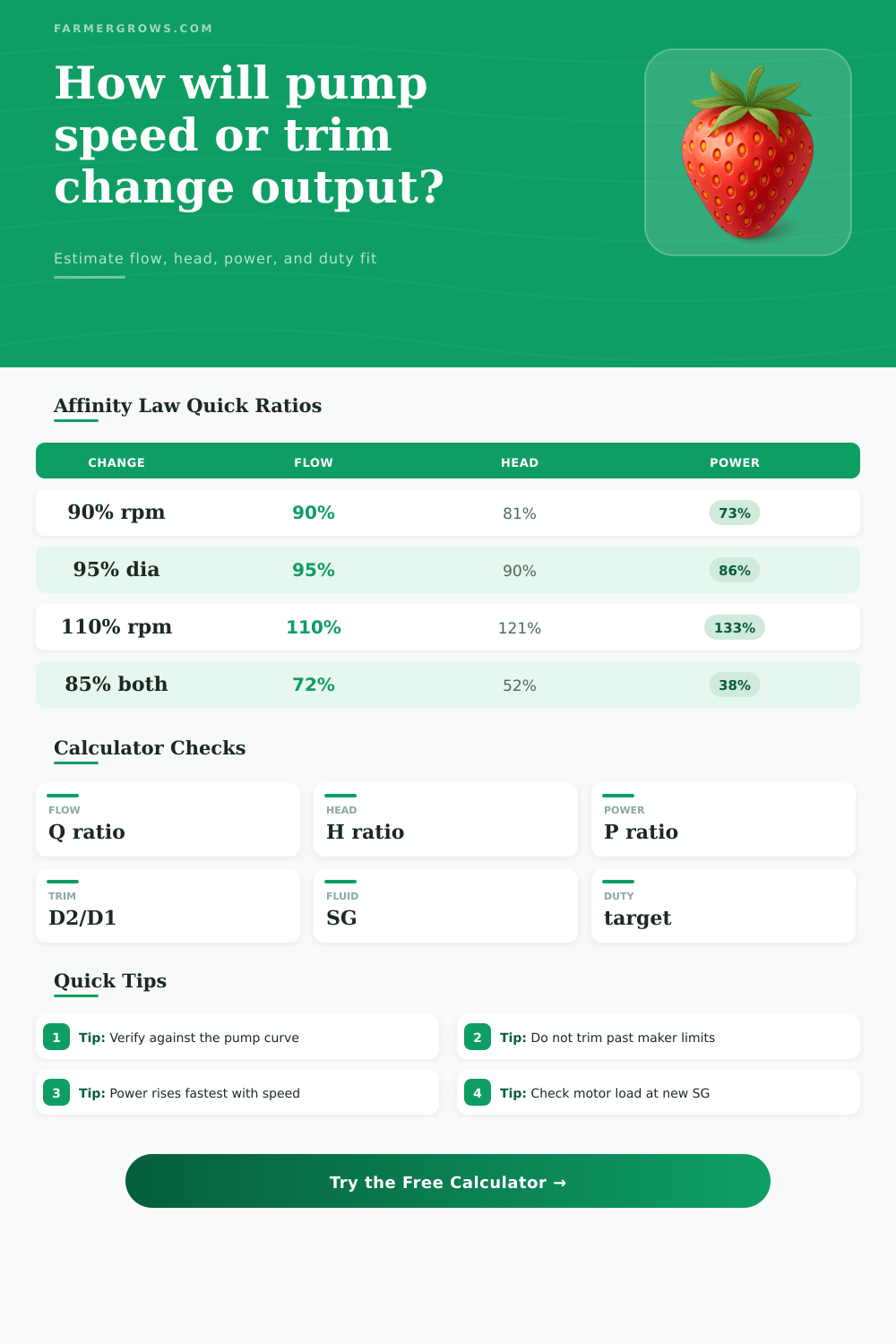
These quick ratios show why power changes faster than flow. The calculator below applies the same ratio logic to your actual pump values.
Affinity Law Results
Results use Q2 = Q1 x (N2/N1) x (D2/D1), H2 = H1 x (N2/N1)2 x (D2/D1)2, and P2 = P1 x (N2/N1)3 x (D2/D1)3, then adjust power for fluid SG and efficiency.
| Variable changed | Flow Q | Head H | Power P | Best use |
|---|---|---|---|---|
| Speed only | Q2 = Q1 x N ratio | H2 = H1 x N ratio2 | P2 = P1 x N ratio3 | VFD tuning, motor speed changes |
| Diameter only | Q2 = Q1 x D ratio | H2 = H1 x D ratio2 | P2 = P1 x D ratio3 | Impeller trim estimates |
| Speed and diameter | Q2 = Q1 x N ratio x D ratio | H2 = H1 x N ratio2 x D ratio2 | P2 = P1 x N ratio3 x D ratio3 | Combined VFD and trim checks |
| Fluid SG and efficiency | Does not set flow directly | Head in feet is nearly unchanged | Power adjusted by SG x old eff / new eff | Motor load and dense fluid checks |
| Speed setting | RPM | Flow | Head | Power before SG/eff |
|---|
| Diameter setting | Diameter | Flow | Head | Power before SG/eff |
|---|
| Speed ratio | D 90% | D 95% | D 100% | D 105% |
|---|
| Check | What it means | Watch range | Action |
|---|---|---|---|
| Flow short | New Q is below duty flow | More than 5% low | Increase speed, reduce trim, or reduce zone demand |
| Head short | New H is below required TDH | More than 5% low | Check friction, elevation, filter loss, and curve margin |
| Power high | Motor may be overloaded | Near nameplate HP | Check service factor, SG, and VFD amps |
| Large trim | Efficiency and curve shape may shift | Over 10% trim | Confirm with manufacturer trim curve |
Curve check: affinity laws move a known operating point, but the system curve still decides the real intersection. Treat the result as a planning estimate until it is checked against the pump curve.
Motor check: power changes with the cube of speed and diameter ratio. Dense fluid or lower efficiency can push amps up even when flow looks reasonable.
The affinity laws relate the change to the rotational speed or impeller diameters of a centrifugal pump to the changes to the flow, head, and power of that pump. Each of these variables dont change in a linear fashion with the change to the pump speed; instead, each of these variables changes in accordance with the affinity laws. Thus, you can use the affinity laws to calculate the new flows, head, and power variables of the pump prior to altering the pump speed or trimming the impeller of a centrifugal pump.
The affinity laws exist due to the way that centrifugal pumps moves liquids through the use of rotating impellers. When the rotational speed of those impellers change, the speed of every particle of the liquid within the centrifugal pump change as well. The flow of the liquid is directly related to the speed of the impeller; the faster the impeller travels, the more liquid it can move in a given unit of time.
How Changing Pump Speed or Impeller Size Affects Flow, Head and Power
The head of the centrifugal pump is related to the square of the speed of the impeller (since head is related to the velocity of the liquid multiplyed by itself). Finally, the power of the centrifugal pump is related to the cube of the speed of the impeller (since power is related to the rate at which the fluid is moved multiplyed by the head of the fluid). Due to the fact that real pumps are not always as accurate as the mathematical models of the affinity laws, there are some exceptions to these laws.
For instance, if the speed at which the centrifugal pump is operated is significantly reduced, the recirculation of liquids within the pump may reduce the efficiency of the pump. Additionally, if the pump manufacturer trims the impeller beyond the specifications of the pump, the angle at which the vanes of the impeller exit the impeller will change; therefore, the curves that is published for that pump will no longer be applicable to the pump with an trimmed impeller. A calculator can be used to compare the calculated duty point for a pump to the requirement for flow and head for that pump to determine if the calculated point is workable.
The specific gravity of the liquids that the pump moves are another important factor in the application of the affinity laws. Because some liquids have higher specific gravities than water, the pump will require more torque to move those liquids. Thus, the power requirement of the centrifugal pump will increase with the increase in the specific gravity of the liquids that the pump is to move.
Therefore, the motor that was working well for pumping water may require more current to operate when moving liquids with a more higher specific gravity. Power is the most sensitive of the variables described by the affinity laws. For instance, if the speed of a centrifugal pump is reduced 10%, the flow will reduce 10%, the head will reduce 19%, but the power will only reduce 27%.
If the speed of a centrifugal pump is increased 10%, the power will increase 33%. Thus, it is possible that increasing the speed of a pump will render the pump motor without extra capacity to provide the power necessary to the pump at the increased speed. In addition to the variables that changes to speed and impeller diameter affect, it is also necessary to consider the possible change in the efficiency of the centrifugal pump.
Efficiency will likely decline if the pump is operated away from its best efficiency point; therefore, it is necessary to consider the efficiency of the pump prior to changing the speed of the pump or trimming the impeller. The efficiency will affect the brake horsepower that is required for the pump to function at the new speed or trim. The duty point comparison will allow the ratios of the affinity laws to be turned into a decision regarding the operation of the pump.
By entering the flow and head that are required of the pump, the output will indicate whether or not the centrifugal pump will be able to meet the requirements of the system. If the centrifugal pump will deliver more flow than the system requires, this is usually an acceptable result. However, if the flow that the pump will deliver is less than that which is required of the system, then the speed of the pump can be increased, the impeller can be changed, or the friction within the system can be reduced.
Field conditions can affect centrifugal pumps in ways that are outside of the parameter of the affinity laws. For instance, suction conditions, air entrainment, wear ring clearance, and vibration within the piping system can all impact the efficiency of the centrifugal pump. Thus, while the affinity laws can provide a planning number for irrigation or liquid transfer work, it is still necessary to check the manufacturers specifications for the pump once any physical changes are made to the pump.
Additionally, using the affinity laws allow for pumps to be tested in various scenarios prior to making physical changes to the pump.