Cedar Mulch Lifespan Calculator
Estimate how long cedar mulch will keep useful depth, when to refresh it, and how much top-up material your bed, path, tree ring, or landscape strip needs.
Start with a realistic cedar mulch situation, then adjust site exposure, current depth, age, maintenance, and the depth you consider ready for refresh.
Cedar Mulch Lifespan Results
Your cedar mulch life estimate will appear here after calculation.
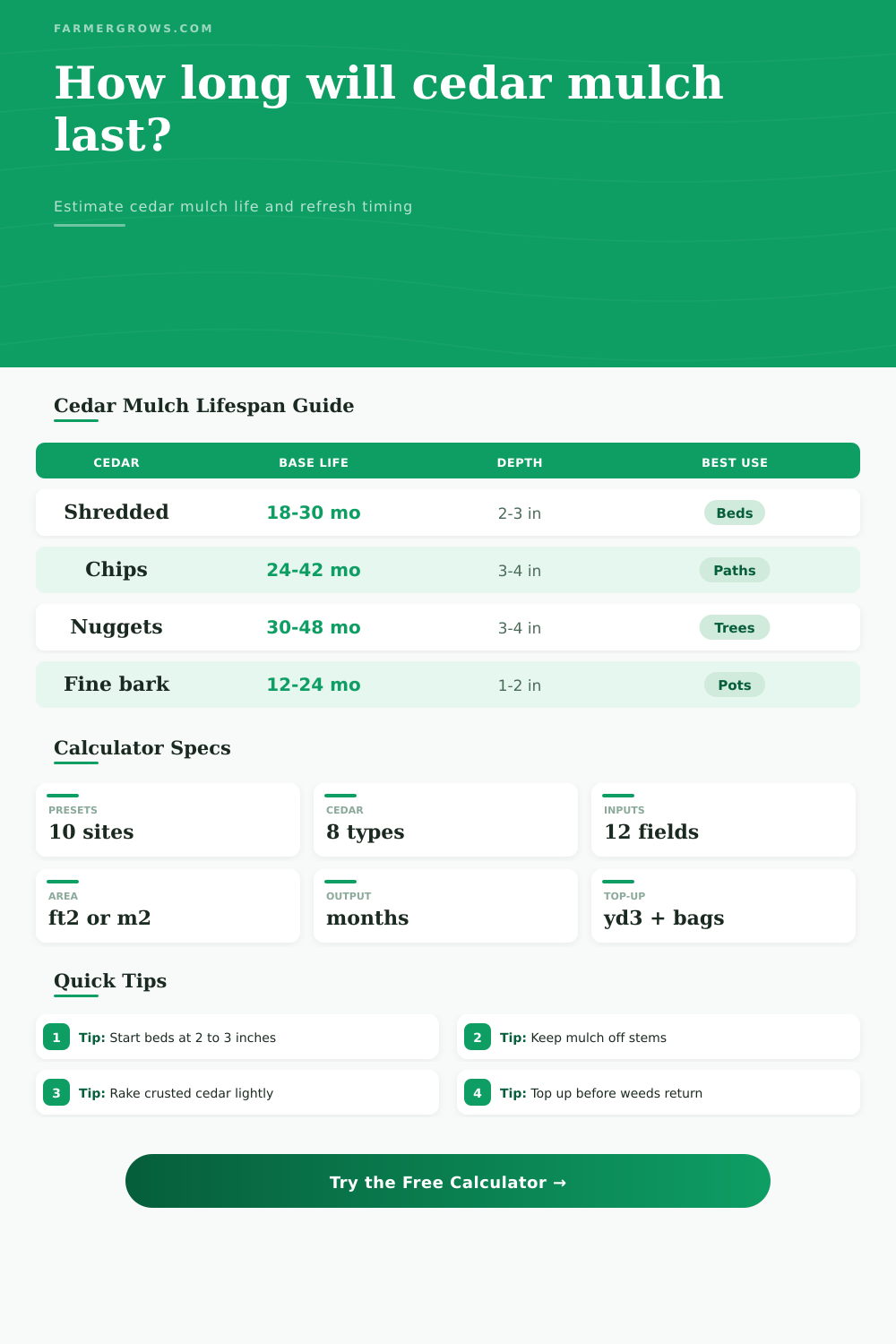
Different cedar products age differently. Finer pieces look tidy sooner but settle and decompose faster; larger chips and nuggets usually keep measurable depth longer.
Knits together well around shrubs and perennials, with a useful life often around two seasons in average beds.
Chunkier texture resists quick matting and can keep depth longer where light foot traffic is expected.
Large pieces fade but remain visible, making them useful for tree rings and broad ornamental islands.
Looks polished in containers and front beds, but it settles quickly and needs thinner, more frequent topping.
| Cedar mulch form | Typical useful life | Depth loss tendency | Best fit |
|---|---|---|---|
| Triple-shredded fine cedar | 12 to 24 months | Settles fast, smooth surface | Containers, small front beds, short-cycle displays |
| Double-shredded cedar | 18 to 30 months | Moderate settling, good coverage | Foundation beds, vegetable edges, perennial borders |
| Cedar chips | 24 to 42 months | Slower breakdown, can scatter | Garden paths, berry rows, rural beds with edging |
| Cedar bark nuggets | 30 to 48 months | Slow breakdown, open texture | Tree rings, shrub islands, low-traffic ornamental areas |
| Cedar hardwood blend | 16 to 28 months | Depends on blend and fines | General landscape beds where color is less critical |
| Dyed cedar-color blend | 14 to 26 months | Color may outlast or fade before depth | Decorative beds judged mostly by appearance |
| Installed depth | Common role | Refresh threshold | Coverage from 1 yd³ |
|---|---|---|---|
| 1 inch | Cosmetic top-dress | 0.5 to 0.75 inch | About 324 sq ft |
| 2 inches | Light weed control | 1 inch | About 162 sq ft |
| 3 inches | Standard bed mulch | 1.5 to 2 inches | About 108 sq ft |
| 4 inches | Path or tree ring | 2 to 2.5 inches | About 81 sq ft |
| 6 inches | Deep path layer | 3 inches or more | About 54 sq ft |
| Site condition | Lifespan effect | Why it matters | Adjustment to try |
|---|---|---|---|
| Mostly shaded bed | Extends life | Less heat, UV, and drying stress | Refresh by depth rather than color alone |
| Hot wall or driveway edge | Shortens life | Reflected heat fades and dries cedar faster | Use chips or maintain a slightly deeper layer |
| Frequent sprinklers | Shortens life | Wet-dry cycles speed settling and decomposition | Switch to drip or reduce overspray |
| Open slope or runoff | Shortens life | Mulch moves downhill or collects soil | Add edging, terraces, or larger chips |
| Leaf litter mixed in | Shortens visible life | Fine organic matter mats the cedar layer | Lift leaves before they break apart |
| Project profile | Area example | Starting cedar depth | Typical refresh rhythm |
|---|---|---|---|
| Front foundation bed | 120 sq ft | 3 inches | Light top-up every 12 to 18 months |
| Tree ring | 50 sq ft | 3 to 4 inches | Check annually; top up every 2 to 3 years |
| Garden path | 180 sq ft | 4 inches | Top up ruts yearly, full refresh later |
| Raised bed top layer | 32 sq ft | 1 to 2 inches | Refresh each season if mixed into soil |
| Berry row | 160 sq ft | 3 inches | Maintain around 2 inches for weed pressure |
Measure before buying: Pull mulch aside in several places and average the loose depth. A bed can look thin at the edge while still holding enough depth near plant crowns.
Top up, do not bury stems: Restore the layer gradually and keep cedar pulled back from trunks, crowns, and vegetable stems so the mulch does not trap moisture against plant tissue.
If your mulch is cedar, by mid-summers end you’ll find the stuff to be ash-gray. It is not exactly a landscaping element, but more like a piece of driftwood washed up on shore. Remember how it looked reddish-brown a couple of months back? Or remember how it sounded when you walked on it? It was crunchy. Now all that’s left are bleached-out chips… And you’re thinking: Do I have to rip out and replace this whole bed?
Most people changes their cedar mulch far too early. That isn’t to say it fails functionally; it just fades visually. Even though the wood lacks its original hue, it continues to do its work. That means you need to know when to top up the mulch.
How to Know When to Add More Mulch
The mulch calculator will tell you. It turns your exact circumstances into an honest time frame. It is more precise then generic tips offered here or on other blogs. It factors the available physical depth of mulch into the equation and also considers what kind it’s made from.
“Cedar” comes in odd-shaped bark pieces that resist decomposition and last a long time. It also comes as shredded stuff that breaks down relatively quickly and becomes sort of like soil. That difference makes all the difference, so does knowing how much of each you have. The calculation reveals what form holds up longest in your microclimate.
Another big variable is whether it is sunny and gets hot. People imagine that mulch has an equal lifespan throughout property. Nope. That’s the mulched bed along a light-colored brick wall. It gets reflective heat. That speeds up UV breakdown and drying. The calculator takes heat levels into account.
That shaded north-facing border holds its shape and moisture better than does a south-facing one. It is baked by the afternoon sun. You need a coarser chip or a thicker layer. If there’s a hot wall nearby, you know to invest more wisely, not in repeated top-ups.
Another hint: Save money (don’t buy what you don’t need). The moisture also shortens the life of the mulch. Cedar that resists rot may still decay, but repeated wetting and drying spells aren’t good for it. Drip irrigation will last longer then overhead sprinkler systems; the material compacts more quickly when sitting under water.
That’s where the mechanics come into play. Traffic is another factor. Mulch that sits undisturbed (such as a decorative bed) lasts longer than mulch on a heavily trafficked path (as in one where kids are running through). Kids’ footsteps compact the air spaces, making loose mulch go solid. It becomes a hard crust. Not many weeds is blocked by the crust.
When most people think they are done with the mulch, they’re looking up. Missing what’s going on underneath. The calculator estimates the total service life from installation to the point where the loose layer drops below your chosen refresh threshold. That’s measured as the time from when it was installed until the loose mulch falls beneath your specified threshold.
What is this threshold? You can choose it. For example, a thin one-inch layer of loose mulch might be enough to keep weeds under control. Maybe you want a deeper mulch (two inches?) to hold onto moisture. Set that level, and the tool will tell you how many months remain before you hit that line.
Time to stop replacing things just because the season changes; and move toward maintenance based off facts. Don’t strip down A BED to raw earth every other year. That tears up the soil structure, killing all those good things that live right under the surface. A shallow topping up will make it look nice again, and provide a physical barrier against weeds. It is not as much work as replacing everything.
How does each form of cedar age? How long does what last? The nugget fades but stays put. Shred breaks down but covers well. Depends which is most important to you, looks or duration?
So knowing what to measure (the main thing)…. Then the rest of it comes into play: “How long will that last?” “How much more should I add?” and “how many bags do I need?” And now there’s no guessing about your supply run. Math = number of bags. Buy four when math says four. It is a small change, but it makes a difference.
Because now you’re thinking of mulch not as a disposable cosmetic, but as a soil additive. Top it off and it gets better over time.
Begin by running the calculator on the basic preset. Now adjust it for your yard’s conditions. See the contrast? One is a sun-drenched slope and the other is a shady hosta bed. Watch the numbers change. Chances are good you still have several months worth of use in the mulch you already spread.
Don’t worry about what color yours is. Maintain the depth. Consistent surroundings is better for the plants, and longer time means a break on your wallet. The gray isn’t a color at all, but the patina of a job well done.