Cauliflower Plants Per Square Foot Calculator
Plan cauliflower spacing from bed shape, row layout, plant spacing, usable growing area, transplant survival, harvestable heads, and expected head size.
Choose a real cauliflower planting pattern, then adjust dimensions, spacing, and survival for your own bed, block, or field row.
Cauliflower Planting Results
Use these numbers to order transplants, set row markers, and compare intensive beds with wider field-style spacing.
Best for raised beds where every square foot is planting area and hand access is from the side.
Leaves room for hoeing, side-dressing, scouting caterpillars, and harvesting heads without crowding.
Two lines on one bed can raise density while keeping a center gap for leaf spread and airflow.
Staggered plants use space efficiently, but avoid pushing cauliflower too tight in humid sites.
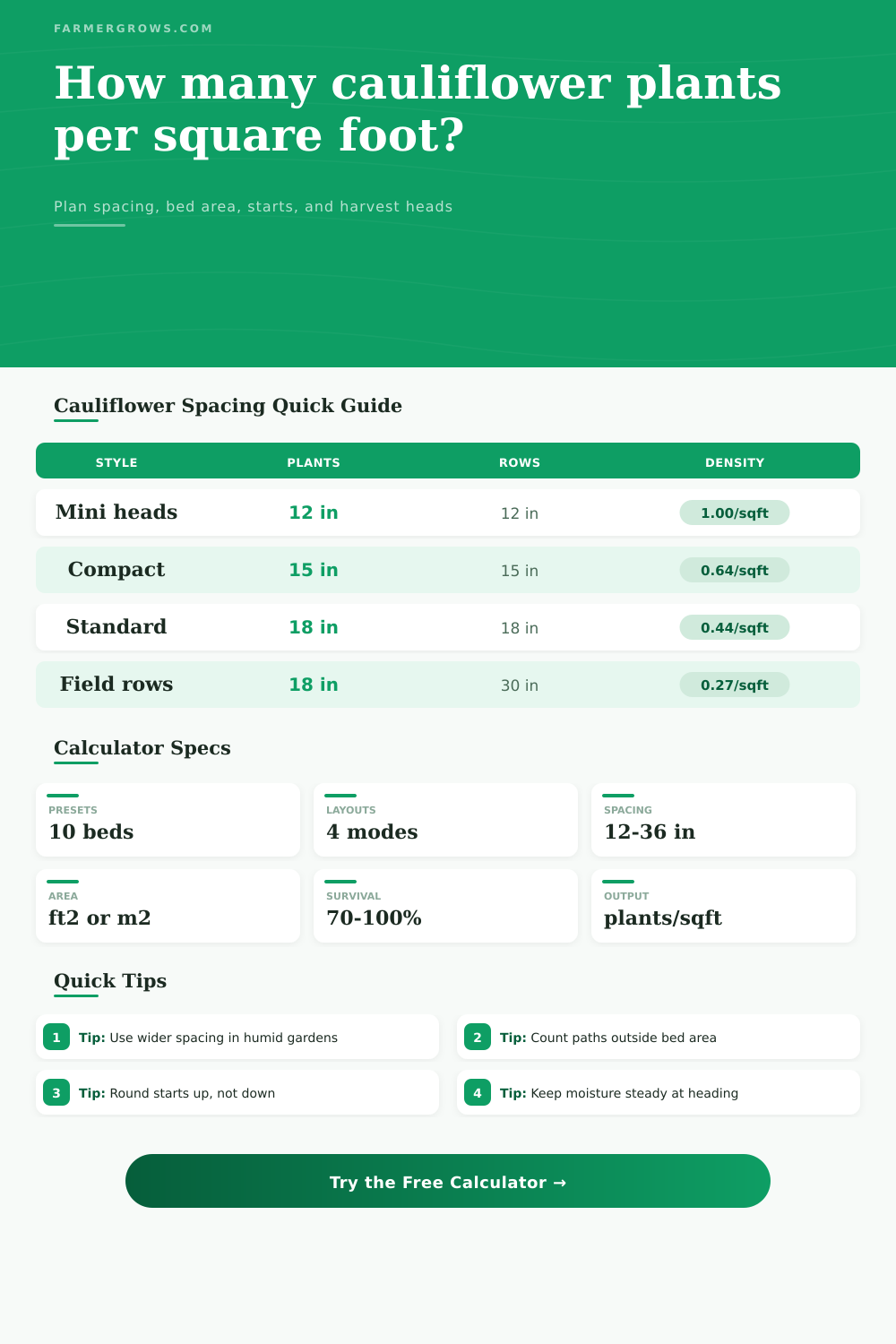
| Planting style | Plant spacing | Row spacing | Plants per sq ft | Best fit |
|---|---|---|---|---|
| Mini head intensive | 12 in | 12 in | 1.00 | Small heads, rich soil, close hand care |
| Compact raised bed | 15 in | 15 in | 0.64 | Compact varieties and cool, dry weather |
| Standard raised bed | 18 in | 18 in | 0.44 | Common home-garden cauliflower spacing |
| Large head block | 24 in | 24 in | 0.25 | Big frames, fertile beds, heavier heads |
| Garden rows | 18 in | 30 in | 0.27 | Hand cultivation and good airflow |
| Wide field rows | 24 in | 36 in | 0.17 | Large equipment paths or disease pressure |
| Bed area | 12 in grid | 15 in grid | 18 in grid | 18 in x 30 in rows |
|---|---|---|---|---|
| 16 sq ft | 16 plants | 10 plants | 7 plants | 4 plants |
| 32 sq ft | 32 plants | 20 plants | 14 plants | 9 plants |
| 50 sq ft | 50 plants | 32 plants | 22 plants | 13 plants |
| 100 sq ft | 100 plants | 64 plants | 44 plants | 27 plants |
| 250 sq ft | 250 plants | 160 plants | 111 plants | 67 plants |
| Head class | Typical spacing | Planning weight | Harvest risk | Use in calculator |
|---|---|---|---|---|
| Mini or baby heads | 12 to 15 in | 0.75 to 1.25 lb | Needs steady fertility | Use high density, lower weight |
| Medium fresh heads | 15 to 18 in | 1.5 to 2.0 lb | Most flexible spacing | Use standard preset |
| Large heads | 18 to 24 in | 2.25 to 3.0 lb | Crowding lowers size | Use wider spacing |
| Fall dense heads | 18 to 24 in | 1.75 to 2.75 lb | Weather can tighten timing | Add extra starts |
| Bed or row | Planting area | Suggested spacing | Plant positions | Starts with 10% extra |
|---|---|---|---|---|
| 4 ft x 4 ft square | 16 sq ft | 18 in grid | 7 plants | 8 starts |
| 4 ft x 8 ft raised bed | 32 sq ft | 18 in grid | 14 plants | 16 starts |
| 30 in x 20 ft bed | 50 sq ft | 15 in twin rows | 32 plants | 36 starts |
| 3 ft x 30 ft bed | 90 sq ft | 18 in grid | 40 plants | 44 starts |
| 100 ft field row | 250 sq ft at 30 in row | 18 in in-row | 67 plants | 74 starts |
Protect airflow: Cauliflower leaves get broad before heads size up. If your garden is humid or brassica disease has been a problem, compare the 18 inch grid against 24 inch spacing before ordering starts.
Measure only plantable bed: Exclude permanent paths, trellis alleys, and wheel tracks before using square-foot density. The usable area input is for small losses such as bed shoulders and irrigation gaps.
It’s easy to panic: There are three dozen tiny cauliflower starts in a tray, and then you think about it, where on earth am I going to put these? You’ve got a bed. And some plants. And you’re hungry for dinner. What you probably don’t have is perspective.
With radishes, you can sprinkle them around like confetti and pray. Not cauliflower. Cauliflower has an ego. And that ego must be given physical expression. It doesn’t shrink when things gets crowded; it will only starve its neighbors to death. Slow down. Cauliflower is finicky. Cauliflower takes time.
How to Space Cauliflower Plants
The calculator up top does all the conversion-and-coefficient math for you if you input your bed dimensions, so there’s no guessing game. It translates a fuzzy feeling of “I have enough space” into firm number of transplants you need to order. It is not helpful to order just a little less than you need and leave big gaps, or to order far too much and waste both soil and money.
SEE ALSO: How many plants will fit?
The problem: When people try to space out their cauliflower, they don’t really understand how big the leaf canopy will be, they’re thinking about the size of the finished head, not the spread of the plant. A finished head may measure just eight inches across, but at harvest time those leaves has stretched out almost two feet in width. That’s why the traditional eighteen inch grid for normal-sized heads make sense. It is not too tight (to allow some air circulation to avoid mildew problems) yet is still compact enough to compete with weeds.
In a humid environment, though, err on the side of the generous twenty four-inch spacing. Moisture is the bane of any brassica, and closer planting will hold moisture between the leaves. It is just a slight compromise, but it is worth it to save the crop.
You’ll be able to tweak it to match. The tool has various spacing presets; if you set one for bigger plants, you can see where you can squeeze just a few more in with less space, if you like.
Strategy is based off shape as well. With a square grid (what’s ideal for raised beds), where you can be on all four sides, you get maximum use of every inch of soil. If you’re growing in conventional rows, however, you must leave room for walking, because you won’t step foot inside the cauliflower patch. Leave enough room to check the leaves for cabbage loopers and to add fertilizer or hoe around the plants. The row layout choice in the calculator allows for that, making the distance between lines wider than it appears at first glance. At first glance, it seems wasteful…but wait until you aren’t crawling around on slimy foliage to get back into the middle of the bed.
There’s one other factor that surprises gardeners: survival rate. Maybe you planned on 40 plants. And guess what? In the real world you never get exactly 40. Not all of your starts survives transplant shock. Maybe something unknown gobbled them up. Maybe you simply got unlucky. The calculator lets you enter how many extra starts you want as a buffer, plus your percentage of survival. I am not being pessimistic. I’m being pragmatic. It feels far better to have three extra starts languishing in the nursery tray than three vacant holes in my bed when summer heats up.)
The result shows you not only raw number of plants per square foot, but also turns that number into a pounds-per-square-foot estimate of your expected harvest, so you can picture what you’re getting, in terms of weight instead of sheer abstraction.
This means that how much space you give your cauliflowers ultimately depends on how comfortabley they are; how dense do you dare get? That’s why the page has a reference table that lets you compare spacings at a glance, but the best part is playing around with the figures until they work for your conditions. Local weather patterns matter (as does light; longer days might mean you need to space things a little farther apart). You can space plants a bit closer in fertile soil than in poor soil, because plants in poor soil has to reach further for nutrients.
There is no one right way in everybody’s garden. The idea is to set up a system so that plants won’t be contending for resources but doing what they came there to do. The cauliflower repays your efforts with tight heads of creamy-white curds, as if plucked from a moddern magazine layout; the right spacing delivers what you envisioned getting when you ordered the starts. You should of no second-guessing required.
It is a little thing, but it is important.