🐄 Cattle Square Calculator
Calculate the square footage & space requirements for your cattle pen, barn, feedlot, or pasture
Open Lot
Free Stall
Feedlot
Individual Pen
Group Pen
Group Housing
Open Lot
Confinement
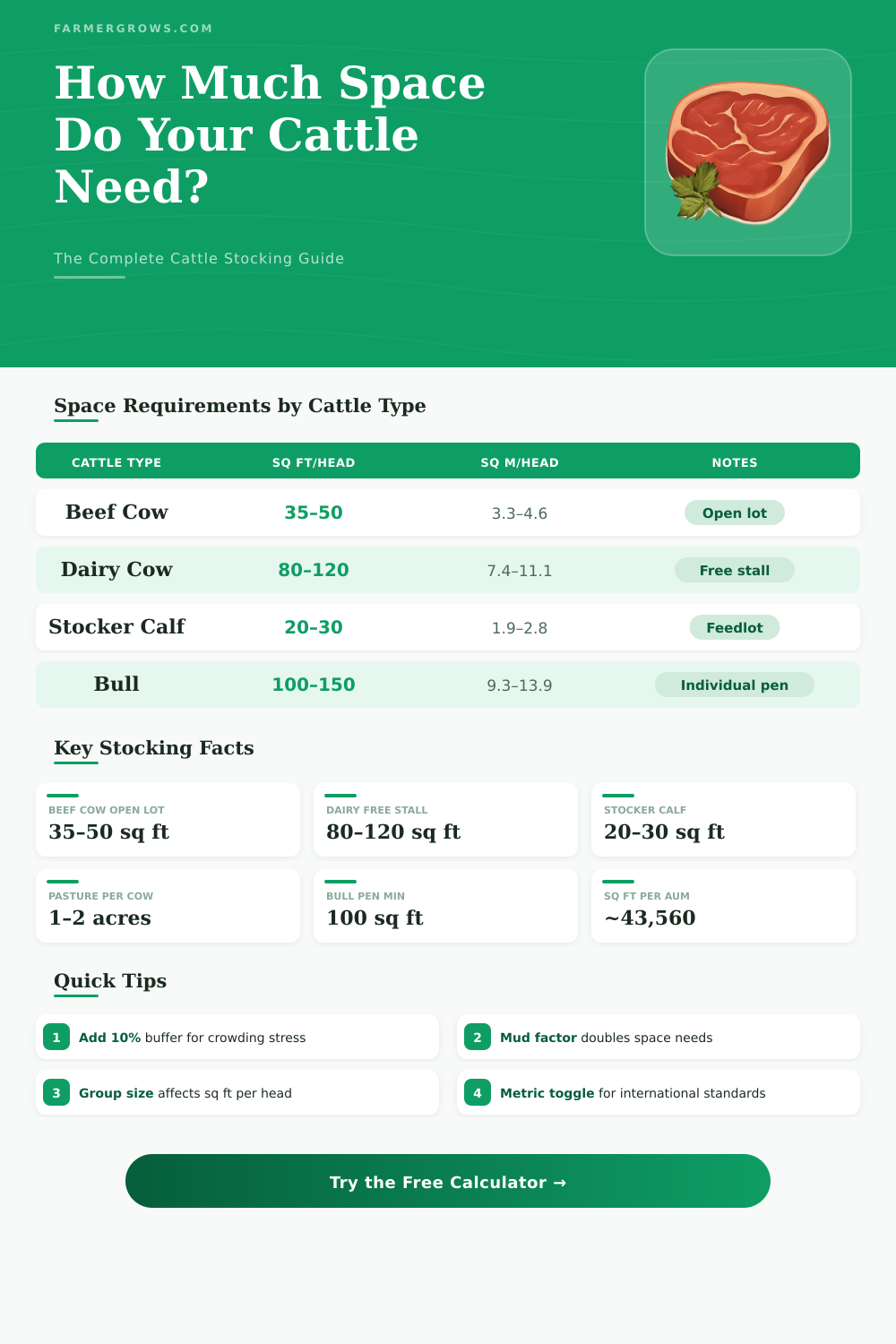
| Cattle Type | Min sq ft/head | Rec sq ft/head | Min sq m/head | Rec sq m/head |
|---|---|---|---|---|
| Beef Cow – Open Lot | 35 | 50 | 3.3 | 4.6 |
| Dairy Cow – Free Stall | 80 | 120 | 7.4 | 11.1 |
| Stocker / Yearling | 20 | 30 | 1.9 | 2.8 |
| Weaned Calf | 15 | 20 | 1.4 | 1.9 |
| Bull – Individual Pen | 100 | 150 | 9.3 | 13.9 |
| Veal Calf | 25 | 35 | 2.3 | 3.3 |
| Cow-Calf Pair | 60 | 80 | 5.6 | 7.4 |
| Feedlot Steer | 25 | 40 | 2.3 | 3.7 |
| Pen Dimensions | Sq Ft | Sq M | Head at 35 sq ft | Head at 50 sq ft |
|---|---|---|---|---|
| 20 x 20 ft | 400 | 37.2 | 11 | 8 |
| 30 x 40 ft | 1,200 | 111.5 | 34 | 24 |
| 40 x 60 ft | 2,400 | 223.0 | 68 | 48 |
| 50 x 100 ft | 5,000 | 464.5 | 142 | 100 |
| 100 x 200 ft | 20,000 | 1,858 | 571 | 400 |
| 200 x 400 ft | 80,000 | 7,432 | 2,285 | 1,600 |
| Pasture Type | Acres per Cow | Sq Ft per Cow | Sq M per Cow |
|---|---|---|---|
| High-quality improved pasture | 1.0–1.5 | 43,560–65,340 | 4,047–6,070 |
| Native/mixed grass pasture | 2–3 | 87,120–130,680 | 8,094–12,140 |
| Dry or degraded land | 4–8 | 174,240–348,480 | 16,187–32,374 |
| Rotational grazing system | 0.75–1.0 | 32,670–43,560 | 3,035–4,047 |
Cattle square bales are common for feed beef cattle and knowing how they work help save time and money on the farm. Small squares weigh around 45 to 75 pounds depending on the kind of hay, the baler and the person putting them up. Because of that weight, you easily move them by hand.
Big squares on the other hand reach 800 to 1,800 pounds. They come in sizes as 4x4x8, 3x4x8 or 3x3x8 feet. They are not really square, and small squares are not really square.
Square Hay Bales: Sizes, Care, and Feeding
Small squares stack best, so they most easily last. Even so you must put square bales in a barn so they do not get wet. Big squares were made to maximize transport with less waste.
Outside you cover them with a tarp or shed above the top bales. Round bales resist moisture better than square, when you keep them outside.
Cow eats around 3 percent of her body weight daily. For 1,000-pound cow that is about 30 pounds of dry matter a day. Square bale of Massey baler suffice for a cow for a week or half a week depending on the age.
250-pound feeder calf require around 7 pounds of hay a day, so a square bale will not last long in that rthyhm.
Feed small squares to livestock commonly only require to throw hay on the ground, though that causes a bit of waste. Even so eating off the soil reduce the waste. One way is put big square in the bed of the truck, drive forward and scatter the hay on the ground, so that all cows can eat.
If you leave a three day or longer supply for the livestock to eat, you can expect 40 percent or more feeding loss. Daily fed, the loss declines to around 12 percent. Advantage of spread or process bales are, that you can move feeding areas around the pasture and distribute manure and nourishments equally.
Square bale feeders help cut waste. Tarter’s Large Square Bale Hay Feeder is made from 2-inch steel tubing for durability and strength. The V-bar structure gives to livestock easy and safe access to the hay.
Hi-Hog’s square bale feeders are built to minimize waste and last heavy ranch use, ideal for cattle, bison and horses. Some feeders work for square and round bales, with a V-shaped bottom for good flow of feed.
West livestock systems, that require precise rationing, favor small squares or big square bales, that more easily part and stack. Round bales more answer for folks with big sets of livestock. Square bales, especially for horses, usually are prime alfalfa cuts and last better.
Somefeeders work for square and round bales.