📏 Cattle Frame Score Calculator
BIF-standard frame scoring by hip height and age for beef and dairy cattle
Quick Presets:
📊 Frame Score Results
Frame Score Scale
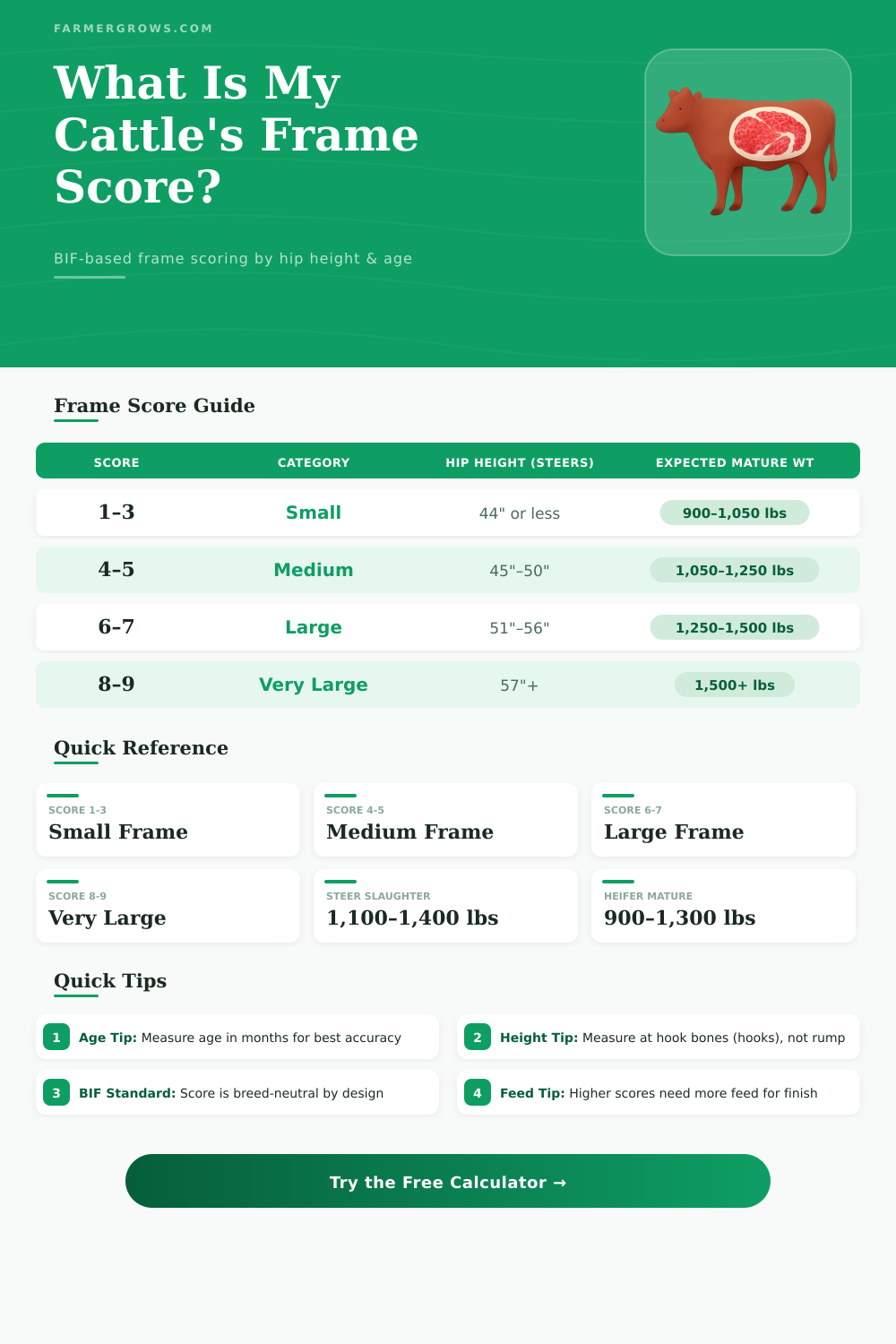
Frame Score Guide
| Score | Category | Hip Ht Range (Steers @12mo) | Expected Mature Wt |
|---|---|---|---|
| 1 | Small | under 40" | 850–950 lbs |
| 2 | Small | 40"–42" | 950–1,000 lbs |
| 3 | Small | 42"–44" | 1,000–1,050 lbs |
| 4 | Medium | 44"–46" | 1,050–1,150 lbs |
| 5 | Medium | 46"–48" | 1,150–1,250 lbs |
| 6 | Large | 48"–50" | 1,250–1,350 lbs |
| 7 | Large | 50"–52" | 1,350–1,500 lbs |
| 8 | Very Large | 52"–54" | 1,500–1,700 lbs |
| 9 | Very Large | 54"+ | 1,700+ lbs |
Hip Height by Age (Frame Score 4–7 Targets)
| Age (months) | Score 4–5 Target (in) | Score 5–6 Target (in) | Score 6–7 Target (in) |
|---|---|---|---|
| 6 | 38"–41" | 41"–43" | 43"–45" |
| 9 | 40"–43" | 43"–46" | 46"–48" |
| 12 | 43"–46" | 46"–48" | 48"–51" |
| 15 | 44"–47" | 47"–50" | 50"–52" |
| 18 | 45"–48" | 48"–51" | 51"–54" |
| 24 | 47"–50" | 50"–53" | 53"–56" |
Expected Weights by Frame Score
| Frame Score | Mature Cow Wt (lbs) | Mature Bull Wt (lbs) | Slaughter Wt Steer (lbs) |
|---|---|---|---|
| 1–2 | 850–950 | 1,400–1,600 | 950–1,050 |
| 3–4 | 950–1,100 | 1,600–1,900 | 1,050–1,150 |
| 4–5 | 1,050–1,200 | 1,800–2,100 | 1,100–1,250 |
| 5–6 | 1,150–1,300 | 2,000–2,300 | 1,200–1,350 |
| 6–7 | 1,250–1,400 | 2,200–2,500 | 1,300–1,450 |
| 7–8 | 1,350–1,550 | 2,400–2,700 | 1,400–1,600 |
| 8–9 | 1,500–1,700+ | 2,600–3,000+ | 1,500–1,750 |
Cattle frame score is a practical way to estimate the size of its skeleton. It delivers objective numerical indication about the skeletal size of the animal, which shows its growth pattern and possible mature weight. Most animals preserve the same frame score through the whole life although their actual height grows with age.
Like this you can use one value for any animal, since the moment of the rating
What is cattle frame score
You count frame score from the hip height and age of the animal. The points usually range between 2 and 9 and you commonly add them as extra info. The frame score from hip height is a line measure and helps producers of livestock estimate the potential ratio of lean to fat at a particular animal in a program.
Big advantage of frame score is that it gives a notion about the growth curve of the animal. You can use it to project the expected finishing weight for slaughter cattle or the mature weight for breeding cattle. It also helps breeders estimate how big a replacement heifer will become as an adult, or what harvest weight will have feeder steers and heifers.
Even so today’s livestock are different from those of the 1970s that served to set the standards of frame score.
Also the management affects the frame score. Whether you care for commercial herds or grassfed cattle for direct sale, it matters to think about the size you intend to reach. Even in the same breed happens a big diffrence between individuals.
Some meet demands better than others. Frame score helps to simplify the choice.
Many discuss what frame score is the best. Too big animals eat much more, which reduces efficiency. Lowering the frame score can be a way for increase the efficiency of feed.
A score around 6 answers for average cows, and 7 also works, although in breeds as Angus or Hereford it occasionally hardly appears.
Some think that livestock became too small in frame during the years. Since the 1980s and at the beginning of the 1990s they looked entirely different than now. Then some yearling cattle reached a frame score even of 11.
Body condition scoring is something other than frame score. It goes from 1 for a very slim animal until 9 for a very fat one. Animals with a score 6 or 7 have a smooth look, healthy fat amount and good reproduction results.
Frame score estimates the skeleton size, while body condition score shows the thicknes of the cover.