Cattle Feed Mix Calculator
Build a cattle batch sheet from dry-matter targets, ingredient nutrient values, inclusion limits, mineral percentage, and shrink so the loader weights match the ration math.
Use tested forage and by-product analyses whenever possible. This calculator estimates crude protein and TDN for planning, then converts the dry-matter mix into as-fed ingredient weights with shrink added.
Cattle Feed Mix Results
Dry-matter blend and as-fed ingredient loadout.
| Ingredient | Dry matter | Crude protein | TDN | Common use |
|---|---|---|---|---|
| Corn grain | 88% | 9% | 88% | Energy base for gain and finishing diets |
| Soybean meal | 89% | 48% | 84% | High protein correction feed |
| DDGS | 90% | 30% | 88% | Protein and energy by-product |
| Grass hay | 90% | 12% | 58% | Effective fiber and roughage |
| Corn silage | 35% | 8% | 70% | Wet forage energy base |
| Mineral premix | 96% | 0% | 0% | Mineral and vitamin carrier |
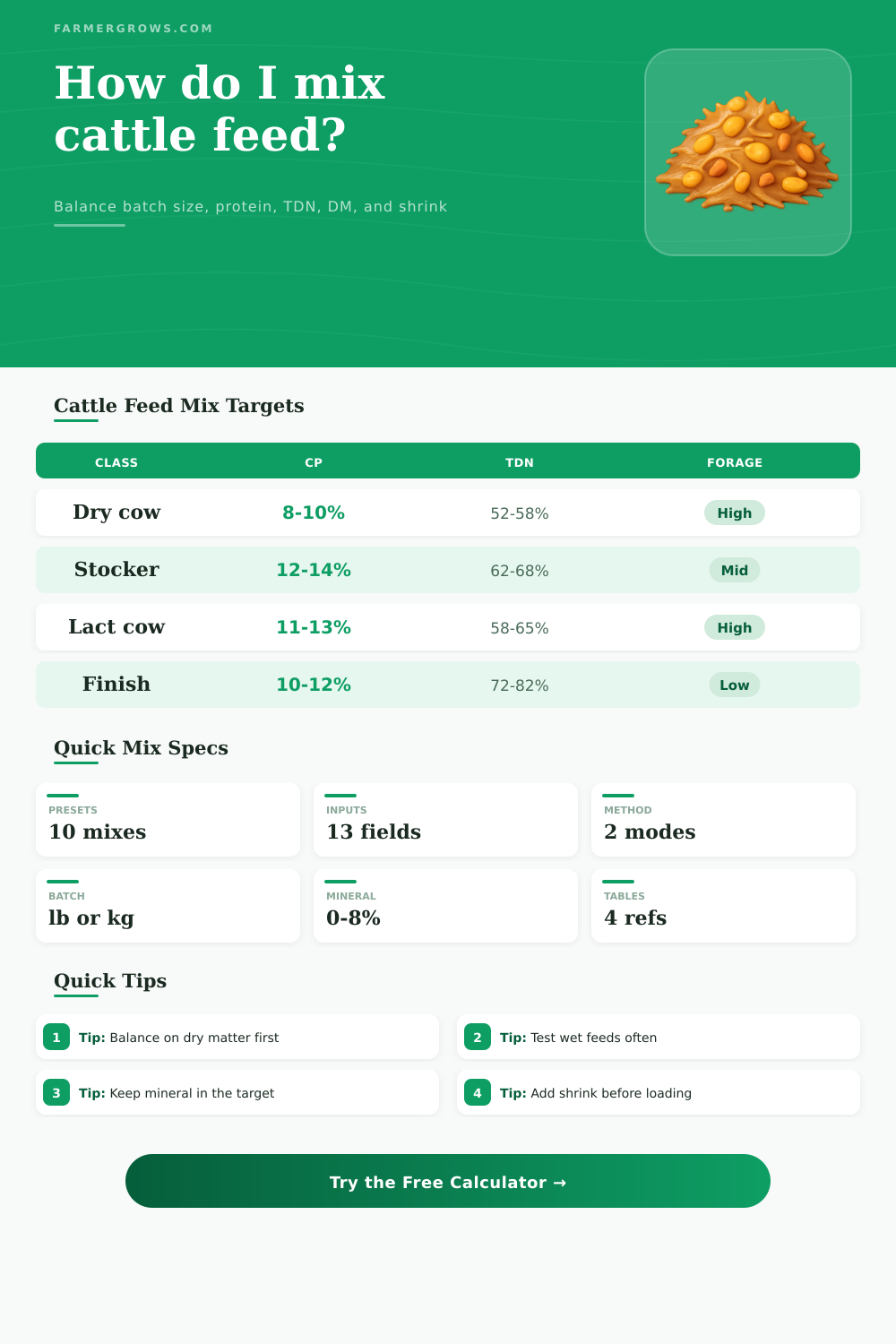
| Cattle class | Typical CP target | Typical TDN target | Forage emphasis | Use note |
|---|---|---|---|---|
| Dry beef cow | 8% to 10% | 52% to 58% | High | Match stage of gestation and hay test |
| Lactating beef cow | 11% to 13% | 58% to 65% | High | Protein and energy needs rise after calving |
| Stocker / backgrounder | 12% to 14% | 62% to 68% | Moderate | Balanced gain with forage or silage base |
| Growing calf | 14% to 16% | 66% to 72% | Moderate | Protein density matters more for lighter calves |
| Dairy heifer | 13% to 15% | 60% to 66% | Moderate | Avoid overconditioning while maintaining growth |
| Finishing cattle | 10% to 12% | 72% to 82% | Low | Step cattle up and monitor bunks closely |
| Ingredient | Conservative DM range | Watch point | Calculator flag |
|---|---|---|---|
| Corn grain | 0% to 75% | Starch load and step-up | Flags over class limit |
| Soybean meal | 0% to 18% | Protein density and palatability | Flags over class limit |
| DDGS | 0% to 30% | Fat, sulfur, phosphorus | Flags over class limit |
| Grass hay | 5% to 80% | Fiber quality and sorting | Flags low forage where risky |
| Corn silage | 0% to 65% | Dry matter variation | Flags over class limit |
| Mineral premix | 0.5% to 4% | Label directions | Flags above 8% |
| Preset mix | Method | Target CP | Target TDN | Best use |
|---|---|---|---|---|
| Dry cow winter hay mix | Weighted | 9% | 56% | Low energy cow maintenance batch |
| Lactating cow silage blend | Weighted | 12% | 62% | Post-calving cows with silage base |
| Stocker moderate gain | Weighted | 13% | 66% | Growing cattle on mixed forage and grain |
| Backgrounder DDGS mix | Weighted | 14% | 68% | Higher protein gain ration |
| Finishing step-up feed | Weighted | 11% | 76% | Controlled move toward finish ration |
| Pearson corn soy balancer | Pearson | 14% | 70% | Fast protein balance around fixed forage |
Use dry matter first: Enter ingredient shares on a dry-matter basis, then use the calculator to convert silage, hay, grain, and mineral back to as-fed loader weights.
Recheck wet feeds: Corn silage and wet by-products can shift several points of dry matter. Update the value after rain, harvest changes, or face heating.
To create a cattle ration, you must calculate the specific nutrient levels because a cattle ration must have the correct amount of proteins and energy for the cattle. If the ration dont contain the correct amount of protein and energy for the cattle, the cattle will not gain adequate weight or produce the amount of milk needed. You must ensure that the ration meets the specific needs of the cattle.
Additionally, you must ensure that the ration stay within the limits of the forages and by-products available. Because the cattle ration determines the health and productivity of the cattle, you must make sure that the calculations are precise to avoid errors in the feeding of the cattle. All cattle ration calculations should be performed on a dry matter basis to remove the variable of water content in the feed.
How to Use a Cattle Ration Calculator
Because hay, silage, and wet by-products all contain different amounts of water, calculating the cattle ration on a dry-matter basis will ensure that the calculations is accurate and consistent throughout the ration. Once you calculate the dry-matter shares of each ingredient, the loader weight of each ingredient can be calculated. The calculator tool will automatically calculate the loader weights based on the dry-matter percentages of each ingredient and the batch size to be run.
The calculator also accounts for shrink; accounting for shrink will ensure that the amount of each ingredient loaded into the mixer will account for the weight of the feed that will be lost to shrink between the mixer and the feeding area. The class of cattle to be fed will impact the protein and energy that is required in the ration. For instance, dry cows require less protein than stockers or lactating cows.
Thus, the ration fed to dry cows will contain less protein than the ration fed to stockers or lactating cows. The calculator tool allows a person to select the class of cattle to be fed. By selecting the class of cattle, you can adjust the goals for the crude protein and TDN for the ration.
The calculator will also apply upper limits to ingredients like corn, soybean meal, and distillers grains to ensure that the ration will not have too much starch or secondary nutrient that could upset the cattle. Each ingredient for the cattle ration will have specific characteristics that must be considered when formulating the ration. For instance, corn will increase the energy value of the ration but can upset the rumen of the cattle when present in high amounts in ration with insufficient fiber.
Distillers grains will increase the protein and energy value of the ration but can become a problem when used in high amounts because of the fat and sulfur content of the by-product. Hay will provide the fiber necessary to perform normal rumen function but has a lower energy value than grain by-products. A person can review these specific characteristics of each ingredient in the reference tables included in the calculator to allow a person to compare the nutrient content of each ingredient to the targets set for the ration.
Minerals should always be included in the cattle ration calculation to ensure the cattle receives the correct amount of minerals. The calculator will use a fixed percentage of minerals so that the rest of the ration adjusts around this percentage. If the minerals are not calculated as a fixed percentage of the total ration, it is possible that the minerals will become diluted by increasing the amount of any other ingredient.
Thus, including the minerals to the calculation will ensure they stay within the recommended range for the ration. If the minerals are within the recommended range, the cattle will not receive too much or too little supplement. In addition to the ingredients for the ration, shrink should also be accounted for in the calculation of the ration.
The shrink in the ration is the weight of the feed that is lost between the mixer and the feeding area. Many people do not account for this loss in feed when formulating rations. If you account for the shrink percentage when formulating the ration, the calculator will produce a higher load of feed for the mixer so that the cattle receive the amount of feed calculated in the ration after some of it is lost to shrink.
Finally, the calculations will help to determine which ingredient will have the largest loader weight. Knowing the ingredient that has the largest loader weight will help a person decide what adjustments to make to the ration if the person is short on a specific type of feed. Additionally, using the calculator will allow a person to determine whether the protein and energy levels of the ration are close to the targets that are required of the cattle.
If the protein and energy levels are not close to the target levels, a person can decide to swap one ingredient for another to even out the protein and energy levels, or a person may decide to accept the difference from the target levels. Cattle require consistency in the ration that is fed to them. If a ration has any differences in the percentages of ingredients or the levels of nutrients from day to day, the cattle will waste more time sorting through the feed to obtain the nutrients that they require.
Using the cattle ration calculator will ensure that no guesses are made in the feeding of cattle. By avoiding making guesses at the ingredients needed in the ration, the cattle will receive a consistent and calculated amount of nutrients.