🐄 Cattle Feed Calculator
Estimate daily & monthly feed requirements for your herd by weight, breed, and feed type
| Feed Type | Dry Matter % | As-Fed lbs per lb DM | Typical Use |
|---|---|---|---|
| Grass Hay | 88% | 1.14 | Maintenance, cow-calf |
| Legume Hay (Alfalfa) | 86% | 1.16 | High-producing cows, calves |
| Corn Silage | 35% | 2.86 | Backgrounding, finishing |
| Total Mixed Ration | 50% | 2.00 | Dairy, feedlot |
| Pasture / Fresh Forage | 20% | 5.00 | Grazing, cow-calf |
| Grain (Corn) | 88% | 1.14 | Finishing, energy supplement |
| Wet Distillers Grains | 32% | 3.13 | By-product feeding |
| Whole Cottonseed | 92% | 1.09 | Energy/protein supplement |
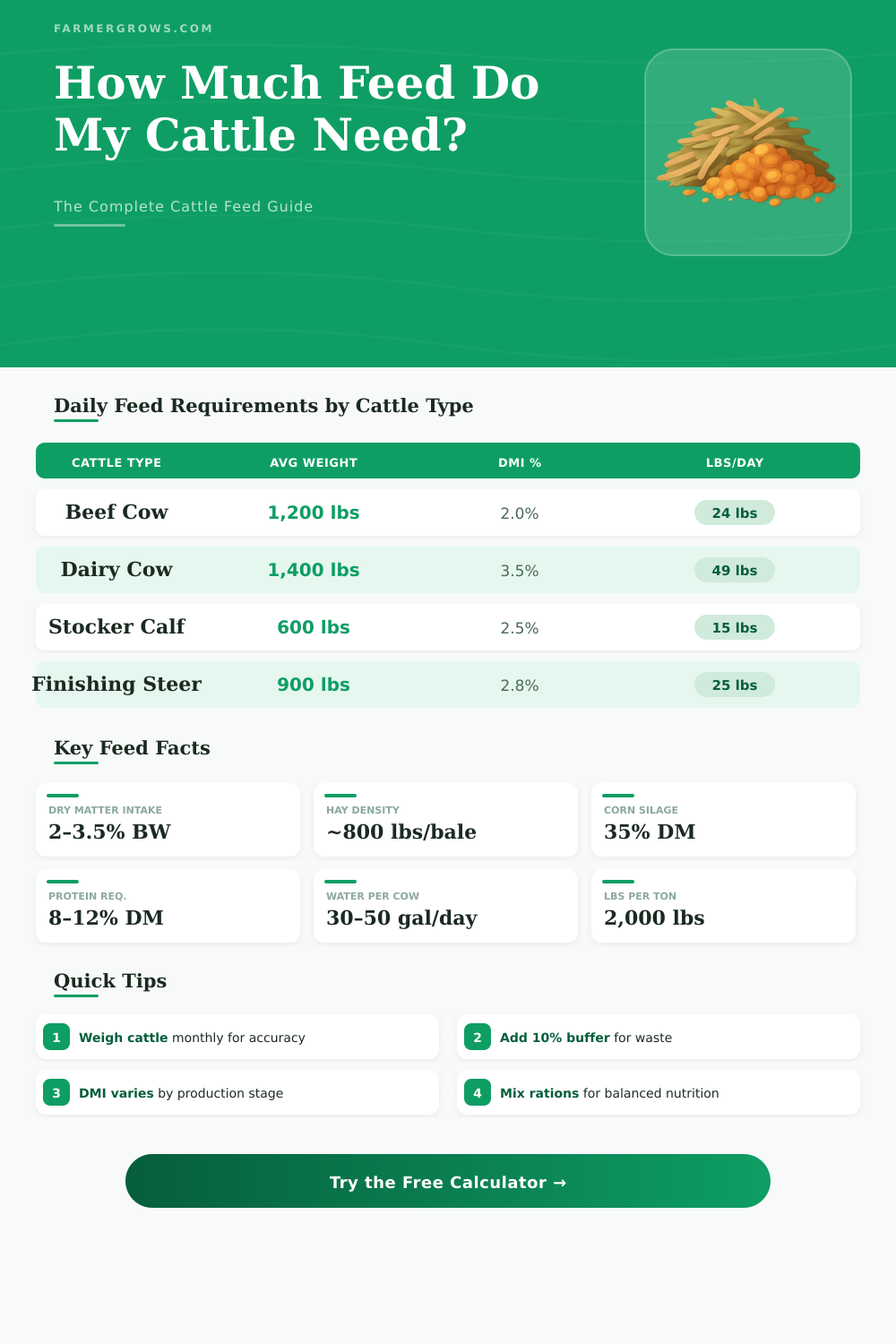
| Cattle Type | Avg Weight (lbs) | DMI % BW | DMI lbs/day | DMI kg/day |
|---|---|---|---|---|
| Beef Cow (Maintenance) | 1,200 | 2.0% | 24 | 10.9 |
| Beef Cow (Late Gestation) | 1,200 | 2.1% | 25 | 11.4 |
| Dairy Cow (Lactating) | 1,400 | 3.5% | 49 | 22.2 |
| Stocker Calf | 550 | 2.5% | 13.8 | 6.2 |
| Finishing Steer | 900 | 2.8% | 25.2 | 11.4 |
| Yearling | 700 | 2.6% | 18.2 | 8.3 |
| Breeding Bull | 1,800 | 1.8% | 32.4 | 14.7 |
| Bale Type | Avg Weight (lbs) | Avg Weight (kg) | Approx. DM lbs |
|---|---|---|---|
| Small Square Bale | 50–70 | 23–32 | 44–62 |
| Large Square Bale (3x3x8) | 800–1,000 | 363–454 | 700–880 |
| Round Bale (4x5 ft) | 800–1,000 | 363–454 | 700–880 |
| Round Bale (5x5 ft) | 1,000–1,200 | 454–544 | 880–1,056 |
| Round Bale (5x6 ft) | 1,200–1,500 | 544–680 | 1,056–1,320 |
| Scenario | Head | Duration | Total DM (lbs) | Total As-Fed (lbs) |
|---|---|---|---|---|
| Small Beef Herd – Winter | 10 | 180 days | 43,200 | 49,090 |
| Cow-Calf Operation | 25 | 30 days | 18,750 | 21,307 |
| Feedlot Finishing | 100 | 150 days | 378,000 | 429,545 |
| Dairy Herd | 50 | 30 days | 73,500 | 147,000 |
| Stocker Calves – Summer | 75 | 90 days | 93,375 | 466,875 |
Good cattle feed matters for keeping the herd healthy and productive. It is made to help the health and success of the livestock. Feed with good nutrition cares about good growth, milk and general welfare of the creatures.
For livestock in various stages you require food that answers to their needs according to age. Cows during breeding either growing youth require more food and proteins from special mixes for healthy growth. For creatures that do not work or produce, maintenance feed gives the right amount of nutrition to keep weight and health.
Good Cattle Feed: Types and Feeding Tips
The best food depends on the age of the creature and its purpose. Usually you choose prime forage as grass or hay from pastures, together with grains and protein supplements because of its balanced nutrition
There are many kinds of cattle nourishment, but the most common are hay, silage and grains. Each has its advantages and gaps, so it matters to choose the right one. Pastured creatures usually eat grass, that forms the bulk of their diet.
That grassy nutrition is known because of meat with rich tastes. In feedlots you give hay with grains, soy products and other ingredients to increase energy.
Livestock are ruminants. They do not actually require grain in their nutrition. A bit of it does not hurt, but it is not required for normal growth.
You give them grain to fatten them up, not to improve health. Most grass-free cattle feed is made up of corn with additives. Some carry minerals or vitamin supplements.
In Canada you feed livestock mostly with barley, in United States with corn, New Zealand beef cattle eat fresh grass, and Japanese livestock can receive scraps of cookies, bread or rice. Some foods require additives as micronutrients or salt. Commonly used ingredients in cattle feed are cereals as sorghum, millet and foxtail millet, together with legumes as horse gram, cowpea and black gram hulls.
In cattle nutrition programs you mind total digestible nutrients, crude protein, fat, fiber and minerals, for example the ratio of calcium to phosphorus. Fat ideally does not go over six percent of the whole diet for adult creatures or four percent for growing.
A store like Tractor Supply is the costliest place to buy cattle feed. Better find a feed store and buy in bulk to save money. If enough pasture is available, you do not even require supplements.
Give grain each seventh day upsets there stomach commonly. Better feed them a bit daily. Close management of feed bunks improve efficiency and reduce acid in creatures on grain-rich diets.