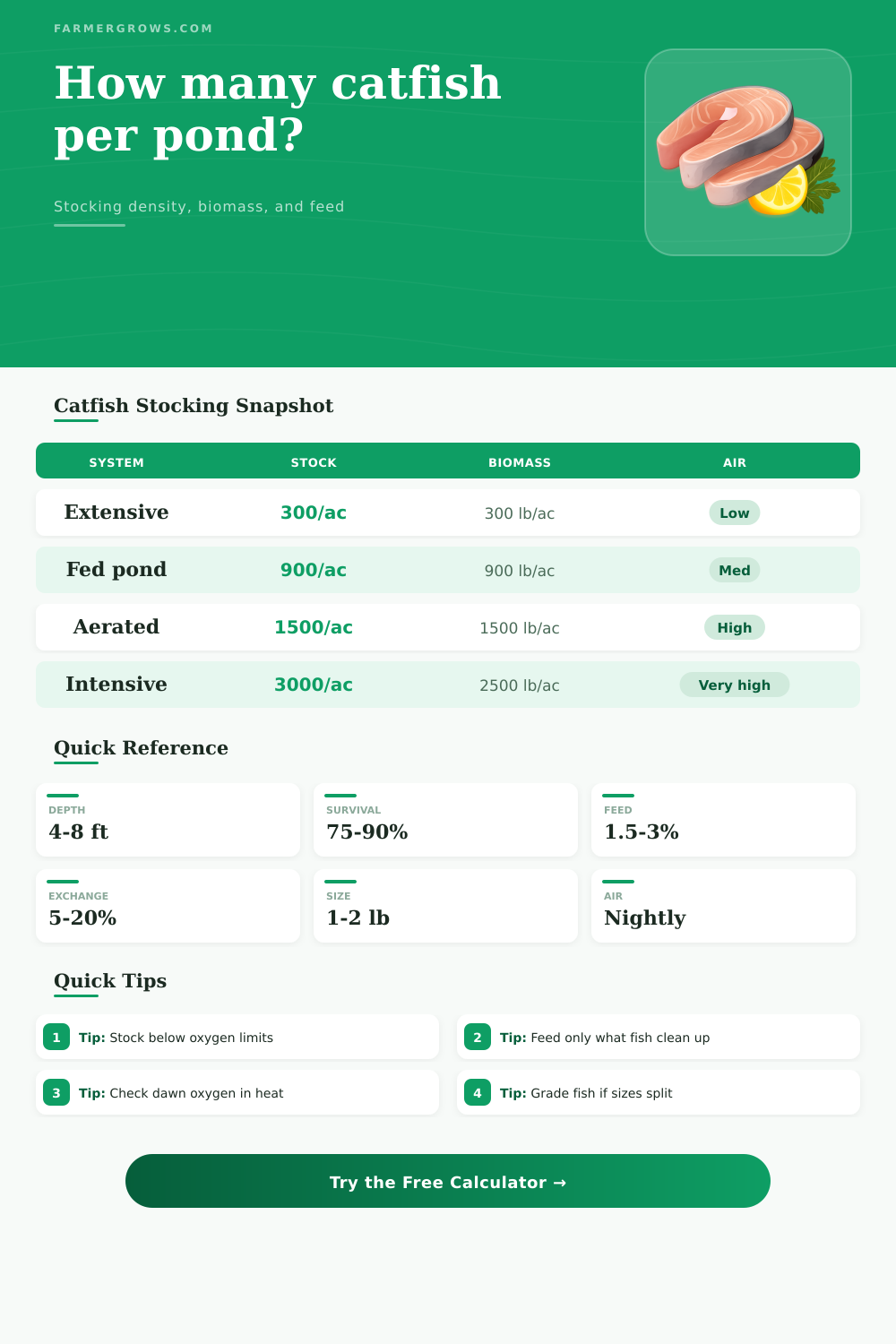
Catfish Stocking Density Calculator
Estimate catfish fingerlings, fish per acre, harvest biomass, daily feed, water exchange volume, and density risk from pond size, depth, aeration, survival, feed rate, and management level.
Use this planner for channel catfish, blue catfish, or mixed food-fish ponds. It estimates a stocking density from carrying capacity, then adjusts the count for survival to harvest size.
Uses natural food and light feeding. Stocking stays conservative because oxygen and growth are less controlled.
Regular feed and harvest records support moderate density when water depth and plankton stay stable.
Diffused or surface aeration raises safe biomass, but feed cleanup and dawn oxygen still set the limit.
High feed, water exchange, and active aeration can support heavier biomass with close daily management.
Catfish Stocking Density Results
The calculator rounds fingerlings up because survival losses occur before harvest. Treat the density as a planning ceiling unless water quality is monitored closely.
| System type | Typical fingerlings | Harvest biomass | Best fit | Watch point |
|---|---|---|---|---|
| Extensive farm pond | 250 to 500 per acre | 200 to 400 lb/acre | Light home harvest | Slow growth without feed |
| Semi-intensive pond | 500 to 1,000 per acre | 500 to 900 lb/acre | Regular feeding and harvest | Summer oxygen swings |
| Fed growout pond | 900 to 1,500 per acre | 900 to 1,400 lb/acre | Family or farm sales harvest | Feed cleanup and ammonia |
| Aerated production pond | 1,500 to 2,500 per acre | 1,400 to 2,200 lb/acre | Managed pond production | Aeration reliability |
| Intensive managed system | 2,500 to 4,000 per acre | 2,200 to 3,500 lb/acre | High feed and water control | Daily oxygen records |
| Aeration level | Calculator factor | Feed load fit | Typical use | Caution |
|---|---|---|---|---|
| None or emergency only | 0.75x | Low feed | Pasture or recreational ponds | Keep density conservative |
| Light surface aeration | 1.00x | Moderate feed | Small fed ponds | Check dawn oxygen in heat |
| Diffused nightly aeration | 1.22x | Regular growout feed | Farm pond catfish systems | Backup power is useful |
| Paddlewheel surface aeration | 1.45x | Higher feed | Production ponds | Do not var feed settle |
| Intensive production aeration | 1.75x | High feed | Closely managed systems | Monitor oxygen every day |
| Weekly exchange | Water factor | Management level | Stocking meaning | Caution |
|---|---|---|---|---|
| 0% | 0.90x | Extensive | Lower carrying capacity | Waste accumulates faster |
| 1% to 5% | 1.00x | Semi-intensive | Normal farm pond planning | Still test ammonia |
| 6% to 15% | 1.10x | Fed growout | Supports heavier feed load | Match water temperature |
| 16% to 30% | 1.20x | Aerated production | Useful for higher biomass | Avoid sudden chemistry shifts |
| Over 30% | 1.25x cap | Intensive | No unlimited density bonus | Oxygen still controls risk |
| Pond example | Area and depth | Management | Planning density | Harvest note |
|---|---|---|---|---|
| Backyard food pond | 0.20 acre, 4 ft | Semi-intensive | 500 to 700 fish/acre | Harvest in small batches |
| Half-acre fed pond | 0.50 acre, 5 ft | Fed growout | 900 to 1,300 fish/acre | Feed response drives growth |
| One-acre farm pond | 1.00 acre, 6 ft | Fed and aerated | 1,200 to 1,800 fish/acre | Track feed conversion |
| Production pond | 3.00 acres, 5.5 ft | Aerated intensive | 2,000 to 3,500 fish/acre | Requires daily water checks |
Density tip: If the calculator shows a high fish-per-acre number, confirm dawn dissolved oxygen before stocking. Catfish tolerate warm water, but high biomass still needs oxygen margin.
Feed tip: Raise feed gradually and stop when fish leave pellets. Uneaten feed turns into ammonia load and can erase the benefit of extra aeration.
Stocking density is a calculation that will help you to determine how many catfish you can put into your catfish pond. Many different factors will influence the stocking density that your pond can take. These factors includes the size of your pond, the depth of your pond, the weight of the catfish that you would like to harvest from your pond, the rate at which you will feed the catfish in your pond, and the aeration levels of the water within the pond.
If you ignore any of these factors, the catfish may grows slowly within your pond or the oxygen levels in the water may become too low for the catfish to adequately consume the food and grow. The stocking density calculator will allow you to determine the stocking density of your pond by processing these different variables. The calculator will reduce the guesswork that you would of had to use in order to determine the stocking density of your pond.
What Affects Stocking Density in a Catfish Pond
One of the first concepts that you should understand about stocking densities is the concept of the biomass limit of your pond. The biomass limit is not based upon the number of catfish that can fit into the pond, but is based upon the amount of oxygen that the catfish can consume. Catfish require oxygen in order to eat and grow, and they consume the oxygen from the water within the pond as they eat and grow.
Therefore, ponds that contain aeration or perform water exchanges will be able to support more biomass in the pond than ponds that do not contains those aeration or exchange processes. Thus, these variables help to indicate the amount of feed that can be added to the pond before the oxygen levels in the pond become too low. Another variable that will impact your stocking density is the feed rate for the pond.
The feed rate will impact the oxygen and ammonia levels in the pond. If the feed rate is increased, the catfish will grow at a fast rate. However, there will also be an increased amount of ammonia in the pond.
Because ammonia requires oxygen in order to break down, increasing the amount of ammonia will increase the demand for oxygen in the pond. Thus, stocking density calculators will adjust the stocking density for the pond according to the feed rate that is selected, but only within the limits allowed by the stocking densities allowed by the aeration rate in the pond. Therefore, if an individual selects a high feed rate but the aeration level is too low for the amount of catfish in the pond, the catfish will not be able to sustain that high feed rate after they have matured to a larger size.
Survival percentage is another variable in stocking density calculations. The survival percentage will impact the total number of fingerlings that have to be purchased for the pond. Commonly, an individual will select a survival percentage of 80% or 85% for the catfish.
However, the number of catfish that die during transport of the fingerlings to the pond, and how many of the catfish die from predators or disease within the pond, actualy influences the survival percentage. If an individual selects a lower survival percentage on the stocking density calculator, more fingerlings will have to be purchased in order to provide for the harvest of the catfish that are targeted by the pond owner. Thus, buying more fingerlings will ensure that the owner is able to harvest the amount of catfish that they desire, but will also increase the biomass of the catfish in the pond, leading to increased requirements of oxygen for the pond.
The depth of the pond is another physical variable that will impact stocking densities. Catfish ponds with shallow depths will heat and cool more fast than ponds with deeper depths of water. Because stocking density calculators reduce the stocking densities for ponds with depths less than four feet, many stocking density calculator owners will find that increasing the depth of the pond has a greater impact on stocking densities than increasing the aeration levels in the pond.
Water exchange is another parameter that can impact stocking densities. If you periodically exchange water in the pond, the amount of ammonia within the pond will decrease, and the pH of the water will be stabilized. These changes in the chemistry of the pond will allow for increased feed rates for the pond.
Thus, stocking density calculators will increase the stocking densities as the rate of water exchange is increased. However, stocking densities do not increase at significant rates beyond a certain rate of water exchange (fifteen percent exchanged per week). Water exchange will help to control the chemistry of the pond, but cannot take the place of aeration processes within the pond.
The stocking density calculator will also consider the level of management that will be applied to the pond. An intensive management level will require the pond to be managed daily, but will allow for higher stocking densities within the pond than extensive management levels. Thus, stocking densities will be increased as the level of management shifts from extensive to intensive management.
This stocking density increase with intensive management is due to the fact that you can identify and correct problems in the pond during intensive management, which prevents the catfish from perishing within the pond. Finally, stocking densities may have to be changed according to the conditions within the pond. For instance, crashes of the algae within the pond can reduce the amount of oxygen that is present in the pond.
Similarly, other conditions in the pond, such as cloud cover or power outages, can also reduce the amount of oxygen in the pond. Because stocking densities are based upon these conditions in the pond, stocking densities should be considered a maximum stocking density for the pond. Many pond owners may choose to only stock ten or fifteen percent of the stocking density that is calculated in the stocking density calculator.
The stocking density calculator will ask for a percentage of reserve quantity that will be stocked, which would allow these individual owners to provide a safety cushion for the stocking densities. Stocking density is not a single number. However, the interaction between the pond itself, the feed for the pond, the aeration for the pond, and the management of the pond determines stocking density.
Each of these factors will impact stocking densities, and stocking density calculators will allow pond owners or pond managers to consider each of these factors. Thus, stocking density calculators will allow owners or managers to decide whether they would like to manage stocking densities at high levels or at low levels.