Cashew Trees Per Acre Calculator
Estimate cashew trees per acre, total grafts or seedlings to order, row count, canopy clearance, productive stand, harvest labor, and dry nut yield from spacing and block shape.
Choose a cashew planting pattern, then tune the block area, spacing, alley deduction, stand survival, reserve plants, canopy diameter, and expected nut yield.
Cashew Orchard Estimate
Results update automatically as you adjust the calculator.
| Spacing system | Center spacing | Trees per acre | Trees per hectare |
|---|---|---|---|
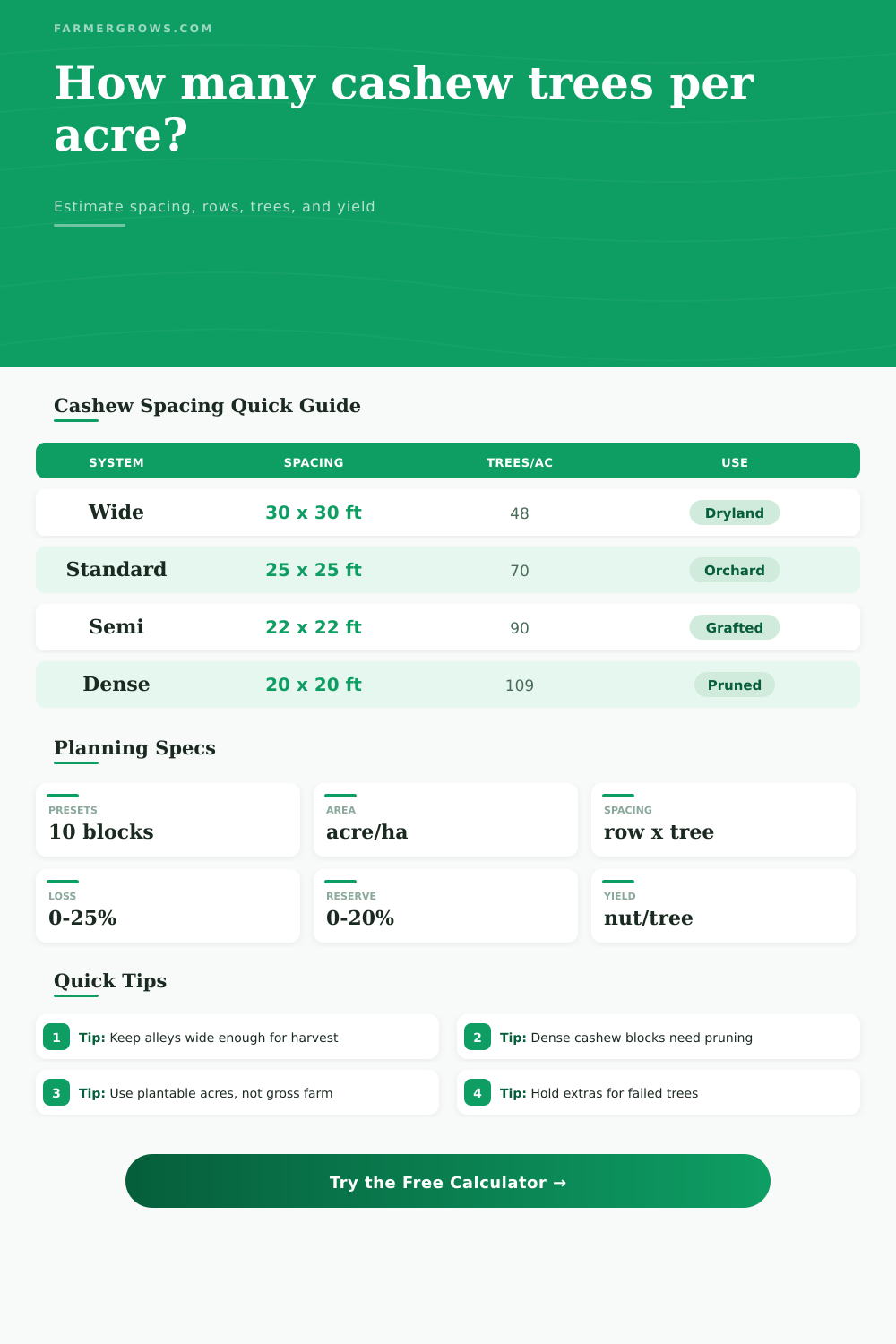
| Dryland wide grid | 30 x 30 ft / 9.1 x 9.1 m | 48 trees/ac | 120 trees/ha |
| Traditional square grid | 25 x 25 ft / 7.6 x 7.6 m | 70 trees/ac | 172 trees/ha |
| Grafted semi-dense grid | 22 x 22 ft / 6.7 x 6.7 m | 90 trees/ac | 223 trees/ha |
| Managed dense grid | 20 x 20 ft / 6.1 x 6.1 m | 109 trees/ac | 269 trees/ha |
| Triangular 24 ft grid | 24 ft centers / 7.3 m | 87 trees/ac | 216 trees/ha |
| Hedgerow trial | 18 ft trees, 14 + 26 ft pairs | 121 trees/ac | 299 trees/ha |
| Planting stock | Typical spacing | Stand allowance | Yield note |
|---|---|---|---|
| Grafted improved cashew | 22 to 25 ft | 8% to 12% reserve | Earlier uniform bearing when nursery quality is strong |
| Seedling cashew | 25 to 30 ft | 10% to 15% reserve | More variation in canopy size and nut yield |
| Compact grafted selection | 18 to 22 ft | 10% to 15% reserve | Needs planned pruning to keep rows open |
| Rehabilitation gap filling | Match existing rows | 15% to 20% reserve | Account for old-tree shade and patchy survival |
| Block example | Spacing basis | Planting positions | Order with reserve |
|---|---|---|---|
| 1 acre smallholder block | 25 x 25 ft, 8% loss | 64 trees | 71 grafts at 10% |
| 5 acre grafted orchard | 22 x 22 ft, 8% loss | 414 trees | 456 grafts at 10% |
| 10 acre dryland block | 30 x 30 ft, 5% loss | 460 trees | 529 seedlings at 15% |
| 20 acre dense block | 20 x 20 ft, 10% loss | 1,960 trees | 2,156 grafts at 10% |
| Orchard condition | Dry nut per tree | Best use in calculator | Planning caution |
|---|---|---|---|
| Young bearing block | 6 to 12 lb/tree | Early crop estimate | Do not size harvest labor from young trees only |
| Average grafted block | 15 to 25 lb/tree | Normal production plan | Use local variety performance if known |
| Strong mature orchard | 25 to 40 lb/tree | Upper planning range | Requires good stand, canopy light, and nutrition |
| Old patchy orchard | 5 to 18 lb/tree | Rehabilitation estimate | Gap count and canopy competition matter most |
Separate gross and plantable acres. Remove roads, drains, rocky strips, firebreaks, and headlands before using the final tree count for a nursery order.
Check the mature canopy. Cashew trees spread wide in good conditions. Dense layouts can work, but only when pruning, harvest access, and light penetration are managed.
Most cashew growers start with a simple question about how many trees fit in an acre, but that question is actualy a trap. But it’s a trap question.
We really want to know not just how many trees there are, but how many live long enough to bear nuts and if we can get them before fruit falls off.
More Than Just a Number
Enter the calculator (above). It takes care of the geometry and counts exactly how many you’ll have in each block at any spacing. It also allows for whatever reserves you require. It removes the guesswork, freeing you to concentrate on the nuts-and-bolts stuff; the logistics and the biology; that truly drive profits.
What’s the trick? The trick is knowing what’s really being counted. In truth, this isn’t a math-only decision. It’s a balance of light, work and future tree health.
Thirty feet apart sounds like plenty, thirty feet by thirty feet. But then there’ll be only about forty-eight trees per acre. They are easy to pick and easier on the soil since they aren’t competing as much for nutrients. This is good if your land has poor soil or is dry, when water is your limitation.
But in a twenty-by-twenty-foot dense grid, you’ll cram close to one-hundred-and-ten trees onto that same plot. That looks good on paper… And if you’re willing to keep pruning aggressively, it could pan out. If not, the middle tree will shade each other out and their innermost branches will die back. All you’ll have is a wall of foliage…and no way for your nut-harvest crew to reach what’s behind it.
Because of that messy establishment reality, you have to factor it into the calculator. Most of us don’t plant precisely what we think will survive in place. A certain portion won’t make it: Seedlings perish. Some grafts fail. The calculator gives you a way to enter an allowance, typically 10 to 15 percent (for your original order). It’s not padding. It’s insurance.
Fail to include that, and when your stand shrinks by 10 percent, you’re losing money during your wait for fill-ins (two years if you planted early). The reference table at the bottom of the page explains that in detail, including survival assumption rates for various stock types. For example, grafted trees bear sooner, are more uniform, but is also more vulnerable to transplant shock than hardy seedlings.
There’s another expense, though, that most people don’t recognize: The land that will never grow trees. These include firebreaks, roads, and drainage ditches. A ten-acre property contains only eight acres of tree-planting space if you must devote a percentage of your land to safety and access. The tool calculates this margin for you, because many people makes the error of purchasing plants based off gross acreage (their total property), not net planting area.
When nurseries charge top dollar, every bit counts. Don’t imagine yourself at some future date holding a thousand surplus saplings you can’t plant.
That’s when fantasy collides with reality: yield estimation. Twenty-five pounds of dry nut weight per tree sounds great, but that’s on a mature, well-maintained grafted tree. Stressed and/or young trees will sets down a fraction of that. To account for this, the calculator includes an adjustment for productive stand percentage, recognizing that not all surviving trees will be top performers.
It also accounts for harvest labor; how many worker-days will it take to clean the block? If your spacing is too tight, then the harvest rate declines as workers spend more time moving around under the trees than picking up nuts. That labor bottleneck can eliminates the benefits of increased tree density. The objective isn’t maximal density; it’s maximum efficiency.
You want enough trees to fill out the soil and soak up the sunshine, but also enough space that they’re easy to care for, without costing you money or busting your back. Whatever size orchard you plant, whether it’s a large commercial orchard or just a block on a smallholding, the design you lay out now will be the work you perform over the next two decades.
Let the math provide the structure, certainly; but let reality of your land and labor inform the ultimate decision. You should of checked this twice.