Carrot Seed Viability Calculator
Estimate usable carrot seed from germination tests, seed age, storage, pelleted or raw seed form, direct-seed density, thinning target, row length, and soil crust risk.
📋Carrot sowing presets
Choose a realistic starting point for raw seed, pelleted seed, stale packets, dense baby carrots, overwintered beds, and soil crust risk.
🥕Seed lot and germination test
Carrot seed often declines faster than larger vegetable seed. A simple towel or tray test gives a better sowing rate than guessing from packet age alone.
🌱Direct-seeded row plan
Enter the planned carrot rows and final spacing after thinning. The calculator estimates plants wanted, seeds to sow, seed spacing, and seed weight.
⛅Field emergence risks
Fine carrot seed is vulnerable to dry surface soil and crusting. These inputs adjust lab germination to a more realistic field emergence estimate.
Carrot seed viability results
Calculated from your seed lot, germination test, row length, seed form, thinning target, and field emergence risk.
Calculation breakdown
📊Stand and seed lot summary
📘Carrot seed reference tables
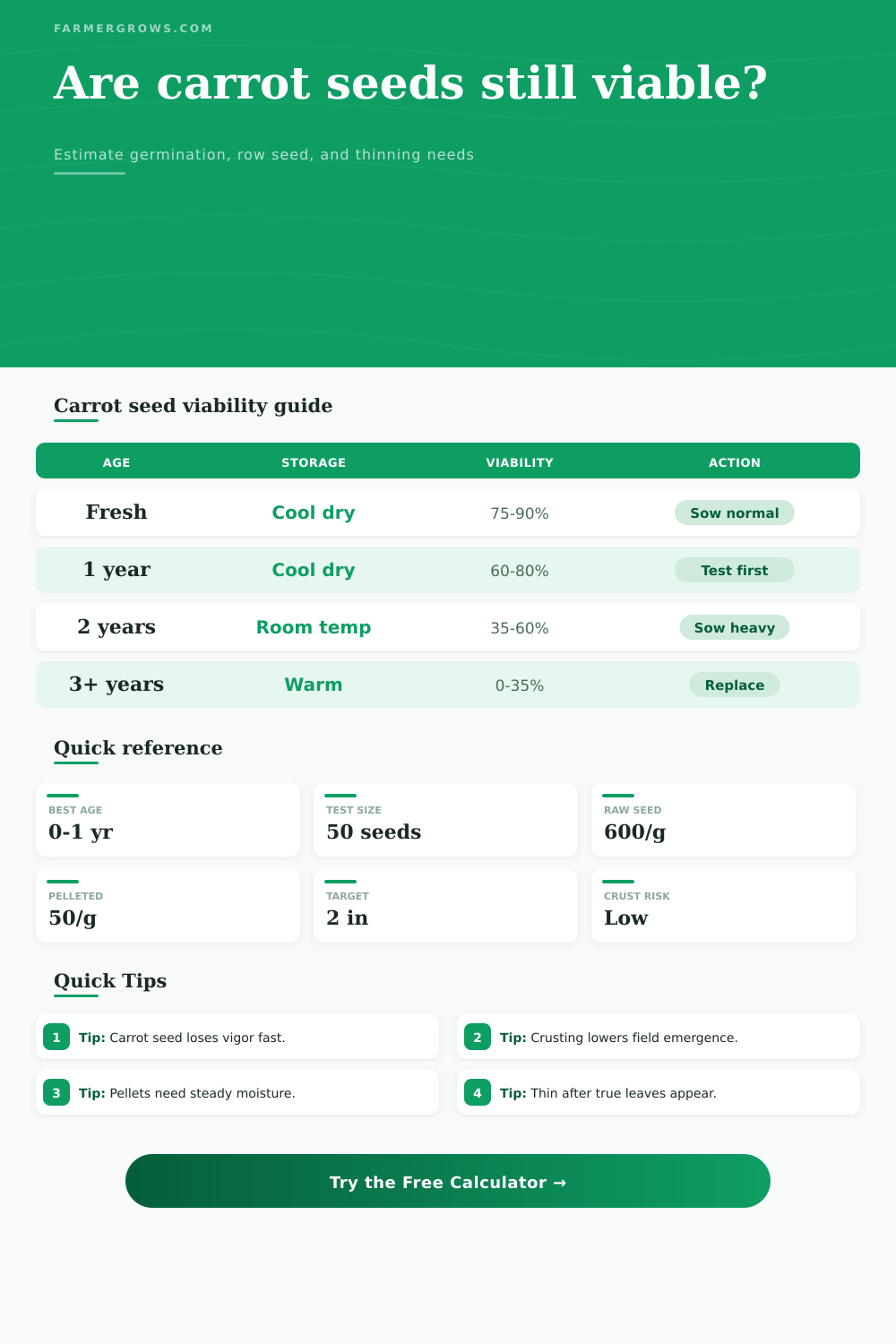
| Seed age | Cool dry | Room temp | Warm or humid |
|---|---|---|---|
| Fresh | 75-90% | 70-85% | 60-75% |
| 1 year | 60-80% | 50-70% | 35-55% |
| 2 years | 40-65% | 25-50% | 10-35% |
| 3 years | 20-45% | 5-30% | 0-15% |
| 4+ years | 0-25% | 0-15% | 0-5% |
| Crop style | Thin to | Rows | Notes |
|---|---|---|---|
| Baby carrots | 0.75-1.25 in | 6-8 in | Harvest small |
| Nantes | 1.5-2 in | 10-12 in | Good garden target |
| Danvers | 2-3 in | 12-18 in | Storage roots |
| Imperator | 2-3 in | 14-18 in | Needs deep soil |
| Chantenay | 2.5-4 in | 12-18 in | Heavy soil type |
| Seed form | Typical count | Placement | Moisture need |
|---|---|---|---|
| Raw seed | 500-900/g | Harder | Normal |
| Coated seed | 200-400/g | Medium | Steady |
| Pelleted seed | 30-90/g | Easier | High |
| Old raw seed | 500-900/g | Harder | Steady |
| Precision pellet | 40-70/g | Easiest | High |
| Condition | Factor | Risk | Adjustment |
|---|---|---|---|
| Loose moist bed | 0.85-0.95 | Low | Sow normal |
| Cool spring soil | 0.75-0.85 | Medium | Add buffer |
| Dry surface | 0.60-0.75 | High | Keep moist |
| Clay crust | 0.45-0.65 | High | Cover lightly |
| Board cover | +0.05 | Lower | Remove at sprout |
For carrot seed older than one season, test before sowing. Weak sprout counts usually mean more field skips than the packet date suggests.
A thin crust can stop small carrot seedlings even when lab germination is acceptable. Boards, burlap, or fine compost can protect the surface.
Calculator results are planning estimates for vegetable seed sowing. Local seed lot quality, variety, planting depth, irrigation, and soil preparation can change actual emergence.
Is that pack of carrot seeds in the pantry still good? Probably not. Carrots are not as forgiving than peas or beans about sitting idle in an open package after a while. But how many won’t grow and why?
A little math exercise and some basic testing with the seed itself yield the answer: an estimate of the number of plant you can expect from that packet. Math makes for less guesswork. And that leads back around to the germination test, which is the most important input into the calculation.
How Many Carrots Will Grow?
Packets has dates on them, which tell us when they were packed, if stored under optimal conditions; we all know that doesn’t happen in the home garden. To get real information, put fifty seeds between two moistened sheets of folded paper towel and see how many emerge within ten days. Thirty-eight? Your germination percentage is seventy-six.
That figure will determine your sowing density or how many seed you need to buy, and you can adjust that number down if necessary. The calculator use the test result along with some data about its storage history to guess field emergence (not so great an environment compared to a warm towel).
Many of us don’t realize how important storage conditions is. Carrots, for instance, are very much affected by temperature and humidity. One that sits in your warm, humid basement for two years is probably not going to do well. Another in the cool, dry cabinet will be fine and maybe even grow better.
The calculator accounts for such factors; it treats a seed in a warm, moist location with more caution then one in an air-conditioned, tightly sealed room. That way if your seeds are strong, you won’t get caught over-planted; if they’re weak, you won’t underplant.
Once viability has been determined, it’s on to the mathematics of spacing and density. Thinning is one of the toughest aspect of carrot cultivation, and they need thinning (most gardeners hate removing baby carrots). Crowding causes stunting and unsweetened roots, however. If you want half-inch-wide baby carrots, or two-inches apart like Nantes varieties, the calculator will tell you approximately how many seed to plant per foot of row.
And if your goal is a particular spacing, it gives you a bit more wiggle room when sowing than what you’ll end up with at harvest time. Since there will be some loss from thinning. So you won’t be surprised by gaps later on.
The other factor that surprised me (besides the fact that I’m not a perfect seeder) was soil. It specifically affects whether the seeds actualy emerge. For example: After you water heavily, or when it rains, carrots has trouble pushing through a crusty soil surface. To account for this, the calculator will decrease your expected emergence percentage based off the “crustiness” of your bed.
Why? Because even with a high germination rate in the lab, they won’t do you much good if they can’t get above the surface tension of dried-out mud. To prevent this, till under a cover or use a loose surface layer until they sprout; the calculator includes this prevention in its final recommendation.
You should of tested first. The difference is pelleted seed. These are coated with a larger pellet that is also easier to work with, but they only contain about one-fifth as many seeds per gram compared to raw. To adjust for this differance between types of seed, the calculator uses the correct seeding rate.
And it avoids that most frequent misstep when using pelleted seed: Sow them like they’re dust. Because you will if you do, and not nearly enough plant will make it into the ground.
It doesn’t matter what kind of seed you prefer. Carrot-stand planning is all about the odds. There are variables beyond our control (erratic spring weather; birds who want to get in on the action). But there are also variables we have control over: We can adjust for soil risk. And we can test our seeds.
Move from hopeful gardening to intentional planting. The calculator crunches the numbers. Now it’s time to think about something that really tests a gardener’s patience: thinning. Fresh seed can help. A tested plan can help even more.