Carrot Seed Shelf Life Calculator
Estimate remaining carrot seed shelf life from packet age, storage temperature, relative humidity, seed moisture, sealed or opened packet condition, and the date you plan to sow.
📋Carrot seed storage presets
Load a realistic packet situation, then change the dates, storage conditions, moisture, packet status, and future planting date for your own seed lot.
🥕Seed packet age and type
Carrot seed is usually short-lived compared with many vegetable seeds. Use the packet date and original germination result as the starting point, then storage conditions adjust the aging rate.
🌡Storage condition inputs
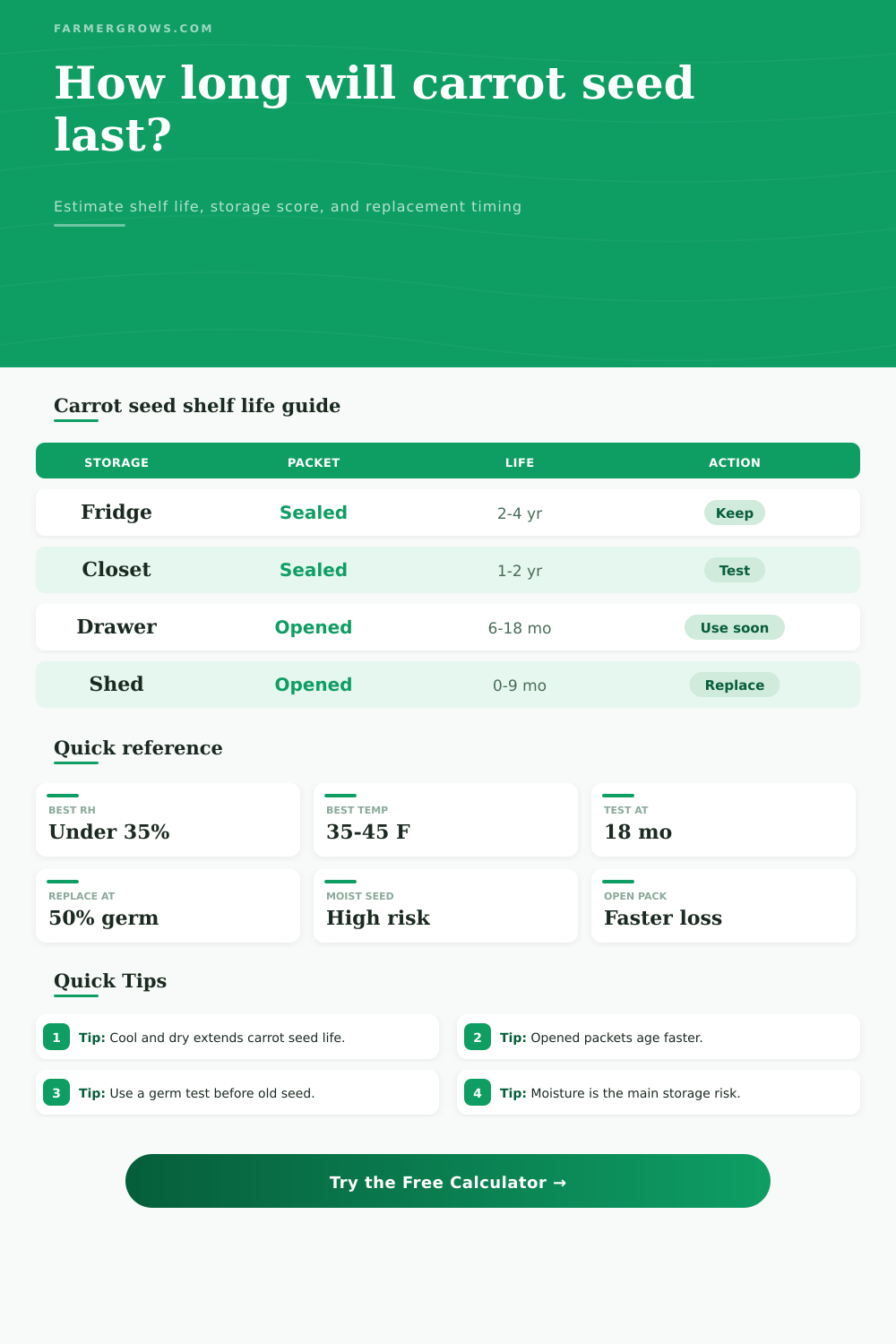
Carrot seed stores best when cool, dry, and sealed. Temperature, relative humidity, seed moisture, and packet exposure are scored together.
Carrot seed shelf life estimate
Calculated from packet age, storage temperature, humidity, seed moisture, package condition, and your future sowing date.
Detailed storage breakdown
📊Packet age and storage indicators
These quick metrics separate the current packet condition from the future planting risk, so you can decide whether to test, use soon, improve storage, or replace.
🧪Future storage scenario comparison
These cards show how the same packet would likely perform by the planned sowing date under common storage choices from today forward.
📘Carrot seed shelf life reference tables
| Storage setup | Packet state | Typical life | Decision point |
|---|---|---|---|
| Refrigerated jar with desiccant | Sealed or clipped | 2-4 years | Test after year 2 |
| Cool indoor closet | Factory sealed | 1-3 years | Use by year 2 |
| Room temperature drawer | Opened and folded | 6-18 months | Test before sowing |
| Warm shed or greenhouse | Opened | 0-9 months | Replace if weak |
| Freezer, very dry seed | Airtight | 3-5 years | Warm before opening |
| Score | Condition | Expected aging | Recommended move |
|---|---|---|---|
| 85-100 | Excellent | Slow decline | Keep sealed and dry |
| 70-84 | Good | Manageable decline | Test older packets |
| 55-69 | Fair | Fast enough to matter | Move to jar now |
| 40-54 | Weak | High decline risk | Use soon or replace |
| Under 40 | Poor | Rapid decline | Do a germ test |
| Future germination | Status | Packet action | Planting note |
|---|---|---|---|
| 80%+ | Strong | Keep packet | Sow normally |
| 65-79% | Usable | Test if valuable | Sow a little extra |
| 50-64% | Marginal | Plan replacement | Use only for small beds |
| 35-49% | Weak | Replace soon | Test before any use |
| Under 35% | Poor | Replace | Do not rely on it |
| Factor | Low risk | Moderate risk | High risk |
|---|---|---|---|
| Temperature | 35-45°F | 46-70°F | Over 80°F |
| Relative humidity | Under 35% | 35-55% | Over 65% |
| Seed moisture | 5-8% | 8-10% | Over 11% |
| Packet | Sealed | Folded open | Torn or damp |
| Container | Jar plus desiccant | Plastic box | Paper in shed |
For opened carrot packets, move seed into a small airtight jar with a fresh desiccant pack and label it with the packed date, current date, and test result.
If a packet will fall below your replacement threshold before sowing, buy fresh seed early enough to avoid rushing a planting window with weak seed.
This calculator is an estimate for planning. A simple germination test is the best check before relying on old carrot seed for an important bed.
Carrots are notoriously fickle when compared with, say, peas or beans; don’t assume you can stash them in a drawer as casually as other seeds (though you may have grabbed a packet in late winter and tossed it in there anyway, right?). Because carrot seeds is actually technically small fruits full of oil, they are more vulnerable to moisture damage and even to going rancid well before they just go dormant.
Knowing that biology shifts the way you think about storing your seed box; and turns some general anxiety about old seed from “Will it work?” to “Can I do anything about it now?” The math for figuring out what’s gone bad and what isn’t is handled by calculator above, so no guesswork about whether that partially used packet is still good, or already a goner.
How to Store Carrot Seeds Properly
You only need to enter your storage conditions. So again: It’s not just old age; it’s also the conditions under which the seed resides in your pantry or garage. Dry seed ages faster when temperature and humidity are high. A baggie of seed in a cool fridge, maybe even zipped up, will retain most of its vigor for several years, but one stashed in a hot shed may be only half-viable after half a year. The calculator considers the average temperature and relative humidity around your storage location. If you’re in a moist climate, or store seed in a kitchen cabinet with steam rising from cooking, the decline comes earlier then the calendar says.
Because seed moisture affects how quickly it deteriorates (damp seed goes bad fast); dry seed last longer. Another home gardener hazard are opened packs. That’s when the factory seal gets cracked, leaving the contents exposed to moisture in the air. The calculator factors that in (it asks if your packets is folded closed, or open, or re-sealed inside a jar). Why does it matter? Even though you may think the air around you is dry, small changes in relative humidity can still get through paper packaging over time. These changes can eventually become large enough to affect germination rates. Putting seeds back inside an airtight container (with a desiccant pack) creates a more stable environment where the clock of degradation gets reset. A quick trip from the drawer to a jar can double your remaining shelf life, the reference tables explains.
To get even more information, and much more than an expiration date can provide, we should of consider the germination rate. This packet is labeled as 2-year old seed,” it says, “but I didn’t store it well…” Well then; maybe it’s not even fifty percent viable anymore at all. The calculator looks at your starting conditions and where they are headed. It estimates how many more days the seeds will live and what percentage will actualy germinate. It also tells you whether to over-seed now to help fill in thin spots later, or just sow as directed.
Typically, a viability rate below fifty percent isn’t worth the frustration of having a few sprouts here and there, only to have nothing grow at all because nothing germinated in the end. Fifty percent is the cutoff that makes me reach for my seedsaver and order replacements instead. The best insurance of all is to test seeds before planting, but again, who tests seeds? Or even how (and when)?
The “storage score” (based off packet condition plus temperature and humidity) gives you a suggested timeline for running the test. If you’ve got a high score, phew! You’re good to go; a low one, well, better get out the paper towels and test yourself before shelling out for a bag of soil. It is a little thing, but it will save you time and money.
Remember: moisture is the main enemy. If you think your seeds might have been in humid conditions, prioritize testing them instead of making a plan.
The bottom line: If you’re going to save carrot seed (or any seed) for another year’s use, treat it as perishable food instead of as equipment. Provide a cool, dry, stable environment where its stored-up energy will remain intact. Adjust your storage system according to those guidelines, and you’ll really stretch out your stash. You want your seeds not just to last, but to be lively enough to do their job when called upon… Meaning, to compete with other living things in the soil and with weed seeds.
Use this as a guide to make yours work well. Start with a clear container, add a drying agent, label it with the date, and store it away from heat sources.