Carrot Plants Per Square Foot Calculator
Estimate carrot plant density, row count, seed quantity, thinning stand, row feet, and harvest weight for raised beds, intensive blocks, market rows, containers, and storage carrot plantings.
Use this calculator before sowing carrots. It combines bed size, usable area, row spacing, final carrot spacing, germination, thinning target, and seed buffer to estimate practical carrot plants per square foot.
Carrot Planting Results
Enter your bed size and spacing to calculate carrot plants per square foot.
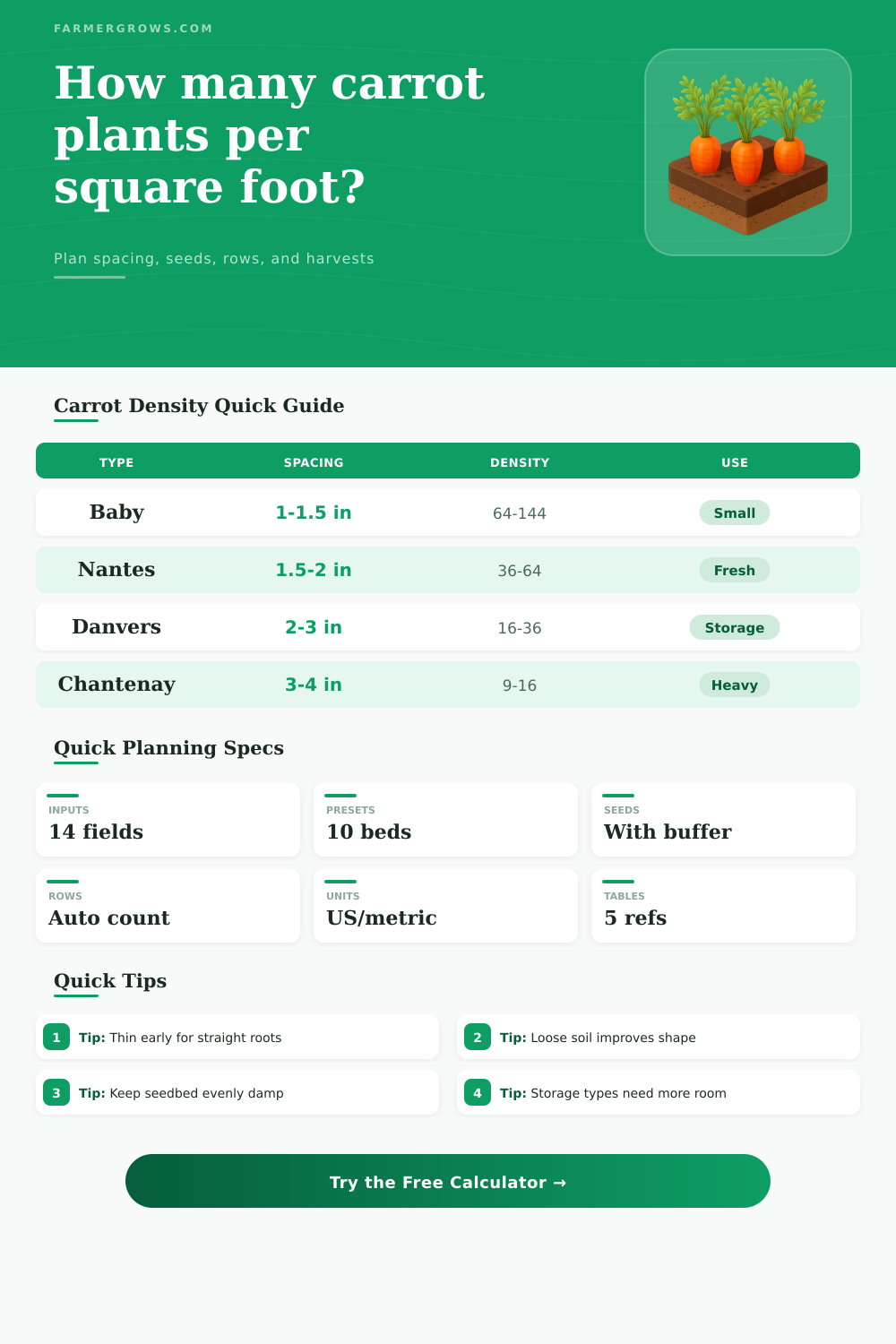
| Carrot type | Final spacing | Rows in bed | Plants per sq ft | Best use |
|---|---|---|---|---|
| Baby or mini carrot | 1 to 1.5 in | 4 to 6 in apart | 64 to 144 | Early bunching, containers, shallow harvests |
| Nantes fresh carrot | 1.5 to 2 in | 5 to 7 in apart | 36 to 64 | Cylindrical roots for fresh eating and bunching |
| Danvers storage carrot | 2 to 3 in | 6 to 9 in apart | 16 to 36 | Heavier fall roots and cellar storage |
| Imperator long carrot | 2.5 to 3.5 in | 8 to 12 in apart | 12 to 23 | Deep loose soil, long straight roots |
| Chantenay broad shoulder | 3 to 4 in | 8 to 12 in apart | 9 to 16 | Heavier or shallower soil where roots broaden |
| Sowing method | Typical seed spacing | Seed buffer | Thinning need | Planning note |
|---|---|---|---|---|
| Hand sowing | 0.5 to 1 in | 20 to 40% | High | Good for home gardens, but thin before roots twist. |
| Pinch sowing | 0.5 to 0.75 in | 25 to 50% | High | Overseeds shallow furrows for uneven spring conditions. |
| Seed tape | 1.5 to 2 in | 5 to 15% | Low | Useful where exact spacing matters more than maximum stand. |
| Pelleted seed | 1 to 2 in | 5 to 20% | Low to medium | Easier to place, but pellets need steady moisture to split. |
| Precision seeder | 0.75 to 1.5 in | 10 to 25% | Medium | Best for long rows and market beds with prepared seedbeds. |
| Bed width | Row spacing | Approx rows | Good carrot type | Notes |
|---|---|---|---|---|
| 18 in container | 4 to 5 in | 3 to 4 | Baby, Parisian, short Nantes | Use deep mix and avoid drying out during germination. |
| 30 in bed | 5 to 6 in | 4 to 5 | Nantes, rainbow mixes | Leaves enough room for hand weeding between rows. |
| 36 in raised bed | 6 in | 5 to 6 | Nantes, Danvers | Common home bed layout with reachable rows. |
| 48 in market bed | 4 to 6 in | 7 to 10 | Bunching and market carrots | Dense systems need clean stale seedbeds and irrigation. |
| 60 in wide bed | 8 to 10 in | 6 to 7 | Storage carrots | Wider rows make fall harvest and lifting easier. |
| Project | Area | Spacing plan | Final carrots | Seed estimate |
|---|---|---|---|---|
| One square foot baby block | 1 sq ft | 1.5 in grid | 64 carrots | 90 to 120 seeds |
| Kitchen raised bed strip | 8 sq ft | 6 in rows, 2 in plants | 190 to 240 carrots | 350 to 500 seeds |
| 4 x 8 ft raised bed | 32 sq ft | 6 in rows, 2 in plants | 750 to 950 carrots | 1,300 to 1,900 seeds |
| 50 ft market row set | 150 sq ft | 5 in rows, 1.5 in plants | 5,000 to 6,800 carrots | 8,000 to 12,000 seeds |
| Fall storage bed | 80 sq ft | 8 in rows, 3 in plants | 1,200 to 1,500 carrots | 2,000 to 3,200 seeds |
| Final spacing | Likely root size | Plants per sq ft | Harvest style | Soil priority |
|---|---|---|---|---|
| 1 in | Very small roots | 100 to 144 | Baby pull or thinning harvest | Fine, stone-free surface layer |
| 1.5 in | Small bunching roots | 50 to 80 | Early bunching carrots | Even moisture for quick emergence |
| 2 in | Medium fresh roots | 30 to 45 | Fresh eating and bunching | Loose soil 8 to 10 in deep |
| 3 in | Larger storage roots | 14 to 24 | Fall harvest and storage | Deep, friable soil with low compaction |
| 4 in | Large shoulders | 8 to 14 | Chantenay and large roots | Room for shoulders to expand evenly |
Thinning tip: Thin carrots when tops are still small. Waiting too long lets neighboring roots twist, fork, or stall before they reach harvest size.
Seedbed tip: Carrot seed needs steady surface moisture. Cover lightly, water gently, and keep crusting soil from sealing the row before emergence.
On paper, you space carrots on the page in a precise grid as if it matters where they go, but in reality, the soil never cooperates. You sow what you consider a wise quantity of seed, and then water hopefully, and up come too many seedling in an entangled mass. No wonder this is the gardener’s nightmare time, thinning crowded roots are not a pleasant task at all. And the roots start intertwining, so you end up damaging more than one when you pull one out. It’s a battle you lose.
Lowering your yield, and the way to make it a doable system is to get density correct before sowing. Instead of having to guess if you have too many plants planted too close together, or too few and wasted space, calculator does the math for you (above). It use variables like survival percentage and germination rate to calculate a realistic target different than an idealistic number. This target is possible given real-world soil conditions, not the perfect ones that most seed packs promise. It factors in seeds you don’t count on getting up: the ones that didn’t make it through the germination process, or that were consumed by slugs instead.
Plan Your Carrot Spacing for Better Roots
In short, it’s not about counting holes; its about planning for loss, and that makes all the difference, if only more people would admit it. The geometry of your bed depends on which kind of carrot you choose. If it’s a Nantes variety, which are straight and slender, you can fit in more plants because there won’t be any loss of shape. But if you select Danvers types, they will forms big shoulders and need elbow room. They will get gnarly rather then smooth if they are forced to fork up and resist their own growth. Baby bunching carrots require far less room per plant than do storage varieties. That isn’t simply because they’re smaller; it’s also because a big root move a lot of dirt in its upward journey, and when the surrounding soil resists, the carrot buckles.
Soil is another factor that influences whether space between plants succeeds or fails. This happens underground and isn’t visible. Sandy loamy soils is loose enough for roots to stretch far and wide with little resistance. Rocky soil or heavy clay will physically stop them no matter what interval they’re planted at, leading to forking instead. If you have tough soil, go wider than narrower.
It’s counter-intuitive; you want to get as much produce per square foot as possible, so why not leave any extra space empty? But crowded carrots in bad soil just turn into one tangle of twisted roots where even if you do save a bit of space you sacrifice the quality of your crop. Preparation wins over density every time.
Most plans go wrong because people don’t want to thin things out. It’s human nature to hope for miracles and believe all your seedling will grow, so we hold on to as many as we can, only to create too much work for ourselves. To be effective, thinning has to be done early, when seedlings are perhaps half an inch tall, before their root systems have grown intertwined. Otherwise, you damage what remains. Seeing how much larger the spacing between finished plants will be compared to the seed-drop spacing makes that clear; it also makes initial sacrifice easier to swallow, which results in less mess at harvest time.
To repeat, density affects how water is managed. Initially there’s less shade, so dense beds dries out more quickly, but their roots will fight hard for whatever moisture they do have at the surface. Until all seeds germinate, it’s important to maintain some degree of moisture in seedbed. Those little shoots won’t be able to force through a hard soil crust. Gentle watering, like a fine mist… Will help prevent this crust from forming. After you get things going, you can switch to a deeper, less-frequent routine as the plants establish themselves. This encourage deep rooting.
Another way to get the most out of available space (but not more plants per square foot) is with succession planting. Rather than cramming a whole row of carrots into a single sowing, you stagger your plantings every two weeks along same row or bed strip. This prevents crowding any one planting, and the harvest just keeps on coming. You can make this adjustment in the calculator as well, so that it scales the seed use over multiple sowings instead of all dumped at once. It changes from a single event to a managed process.
To sum up: Growing a carrot is all about setting yourself up for success. And accepting that carrots don’t always come out as planned. Nature isn’t going to line up on your spreadsheet; that’s why it’s biology and earth science, not a spreadsheet, that has the final say. You should of planned better.
But using this tool helps make those decisions an exercise in informed planning instead of guesswork. With a plan in mind, you know what success will look like when you go out to walk around your garden, which means you’re no longer reacting to trouble but preventing it. All that patience upfront, good spacing equals good patience, is rewarded with a row of straight, orange roots lying in wait in the soil, a reminder that thinking ahead can pay off.