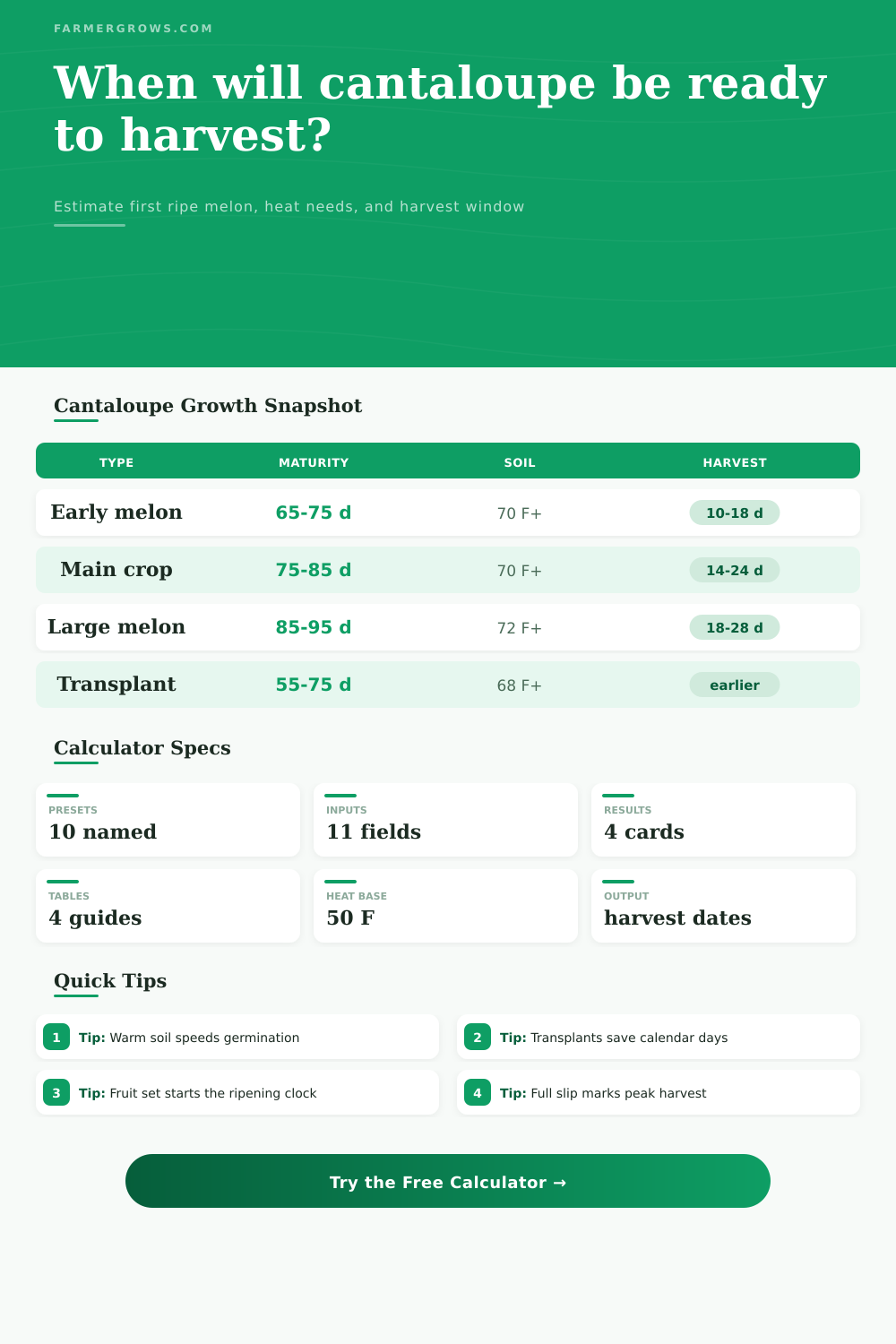
Cantaloupe Growth Time Calculator
Estimate cantaloupe growth time from planting method, variety maturity, soil temperature, daily heat, row cover, transplant age, fruit-set timing, frost date, and the harvest window from first ripe melon to final pick.
Load a melon variety and field setup, then adjust planting date, frost date, heat, soil warmth, row cover, transplant age, stress, and harvest goals.
Seeds need warm soil. Below 65 F, germination delay and weak stands can push the whole melon calendar later.
A 2 to 4 week transplant can save calendar days, but root disturbance or oversized starts can erase part of the gain.
Most cantaloupes need about 35 to 45 days from female flower set to full-slip ripe fruit in warm weather.
Netting, aroma, rind color, and stem slip matter because many muskmelons do not improve much after an early pick.
Your Cantaloupe Growth Timeline
Enter planting, temperature, and variety details to estimate first ripe melon and harvest fit.
| Variety or type | Typical maturity | Fruit size | Timing note | Best use |
|---|---|---|---|---|
| Minnesota Midget | 60 to 70 days | Small | Fastest fit for cool or short seasons | Containers, northern gardens, early harvest |
| Halona | 70 to 76 days | Medium | Early main-crop hybrid with good flavor | Short-season beds and market timing |
| Athena | 75 to 85 days | Medium-large | Common eastern shipping-type melon | Reliable main-crop field production |
| Ambrosia | 82 to 88 days | Medium | High flavor but needs warm finish | Home gardens with steady heat |
| Aphrodite | 82 to 90 days | Large | Large fruit can need more sizing time | Longer warm seasons and rich beds |
| Condition | Soil temperature | Daily heat pace | Timing effect | Grower action |
|---|---|---|---|---|
| Cold for melons | Below 60 F | Low GDD gain | Slow germination, weak roots, possible seed rot | Wait, pre-warm soil, or transplant later |
| Marginal melon soil | 60 to 67 F | Moderate | Adds delay before vines run | Use plastic mulch or low tunnel |
| Good start | 68 to 74 F | Steady | Catalog timing is more realistic | Direct seed or transplant with care |
| Fast melon weather | 75 F and warmer | High | Rapid vines, bloom, and fruit sizing if watered | Protect pollinators and avoid drought swings |
| Method | Usual timing | Calculator adjustment | Best use | Watch point |
|---|---|---|---|---|
| Direct seed | After frost in warm soil | Full emergence and soil delay applies | Long warm seasons and low transplant shock | Cool soil can delay the entire crop |
| Pre-soaked seed | Only in settled warmth | Small start credit | Fast emergence in warm beds | Do not soak seed into cold wet soil |
| Transplant | 2 to 4 week starts | Partial transplant-age credit | Short seasons and earlier harvest | Root disturbance can stall vines |
| Covered transplant | Early protected set-out | Age credit plus cover warmth | High tunnels, row cover, black mulch | Remove cover or vent for pollination |
| Harvest cue | What to look for | Timing meaning | Risk if ignored | Best action |
|---|---|---|---|---|
| Half slip | Stem begins to crack at fruit | Close to ripe but flavor may still build | Early harvest can taste flat | Use only for shipping or pest pressure |
| Full slip | Fruit releases with gentle lift | Peak harvest stage for most muskmelons | Waiting too long softens fruit | Pick and cool quickly |
| Rind color | Green fades toward tan or gold under netting | Confirms ripening progress | Color alone can mislead in cool weather | Combine with aroma and slip |
| Sweet aroma | Melon scent at blossom end | Sugars and volatiles are near harvest quality | Overripe fruit attracts pests | Check the patch daily during peak ripening |
Warmth tip: Cantaloupe is a heat-led crop. A late planting into warm soil can sometimes outrun an early planting that sat in cold ground.
Pollination tip: Row covers help early heat, but flowers need bees. Remove or open covers when female flowers start to appear.
Water tip: Even moisture during vine growth and fruit sizing protects yield. Back off heavy watering near ripening to keep flavor concentrated.
Harvest tip: During the final week, check daily. Full-slip fruit can move from perfect to soft quickly in hot weather.
This calculator is a planning estimate. Cantaloupe timing shifts with variety strain, soil temperature, mulch, pollination, irrigation, disease pressure, plant density, and local frost behavior.
Cantaloupes don’t like being planted in cold ground; it halts their growth and makes them rot. They’re waiting for warmer days before there seeds germinate, and that’s the wrong time to start growing, too. Unless soil is warm enough for roots to take up moisture, nothing will happen on a set calendar day. If you know how nature works here, you has a superior crop of sweet, full-slip melons, not just vines that turn yellow. Follow the soil temperature.
How does it work? The accumulated-heat-unit calculator (above) take the guesswork out of the “days to maturity” number you read on seed packets. That’s an average calculated in ideal conditions; often not what happens in your backyard microclimate. If the soil temperature is just 60 degrees F., the clock hardly ticks; when it hits 72 or higher, the vines takes off. The calculator factors in those realities, along with how much heat you get each day, to create a practical plan for when things will be ready.
How to Grow Sweet Cantaloupes
But it all depends on the kind of variety you select. Some are early, like Minnesota Midget (sixty-five days, hooray), which may not be flavorful enough to make up for their speed. Meanwhile, main-crop hybrids such as Aphrodite or Athena will push to nearly ninety days, building aroma and sugars to reward waiting patienty. Do you want your melons sooner, as a snack, or later, as a dessert?
The chart on the page shows what you need to know: how long your season is, and how large or ripe your melon needs to be. The timing changes quite a bit depending on how seeds are planted. If direct seeded, that’s easy, though not without risk (what happens if there’s a cold snap and things get zapped right as they emerge?). Transplants have a two- to four-week headstart, so they buys calendar days when it really counts (the earliest growing period). But because too-large transplants’ roots may be shocked and take a week to a couple to recover, they also run the risk of stalling out. That’s where folks go wrong, thinking bigger at transplanting means faster down the road. A big tangle of roots is no match for a small but vigorous root system, and it’s all about the latter’s health, not the former’s mass.
Then there’s the problem of pollination. When the vines start to run, things get stuck: To bear fruit, they must be pollinated by bees visiting their female blossoms. Remove any row covers you used to warm up soil early on by bloomtime (or else forget about having fruit). You’ll put this into the calculator (along with other factors like pollination challenges) and extend the expected harvest date to match. It will show you how a hiccup here or there in the environment ripples throughout the whole growing process. One lousy week for the bees could mean waiting an extra couple of weeks before the first ripe melon appears.
Perhaps the most important thing about growing melons is that when it’s time to harvest, there is no wiggle room. Unlike beans or tomatoes (or just about anything else), cantaloupes don’t continue to mature after being picked. If you pick them green, you will eat them green, and they will be dull and flavorless. You are looking for when the stem pulls out clean with only a slight tug. This is called full slip, and it’s the sweet spot. In hot weather, a day or two may be all that lies between perfectly ripe and totally overripe (mush!). A daily inspection of the last week is a must if your goal is maximum sweetness.
Here again, water management is important. But quietly powerful. Excess water right around harvest time will dilute the sugar content of fruits. Consistent moisture all along help the vines expand and also encourages good-sized fruit. Backing off the water a bit when the melons are getting close to maturity prevents sugar from being diluted. So the flavor and aroma concentrates. This little adjustment makes a big difference in taste.
This method accounts for steady growing conditions rather than stress scenarios. If you think there may be some uneven weather ahead, it will help you judge how that might impact your eventual yield. Growing cantaloupes is ultimately an exercise in negotiation: between time and heat. No matter how hard we work, there’s no way to speed up the soil’s warming or make the sun burn brighter, but there are ways to ready yourself for whatever nature provides. Getting your crop planning lined up with reality, both in terms of what varieties you choose to plant and how you approach that plant as it grows (will eliminate a lot of guesswork).
It is not enough to simply grow something; you want to capture that sweet spot where all the elements, texture, aroma, and sugar, all come together just right. And that’s what happens when you get the timing right.